Iskra Fine Art

  • Prints
    • The Tarmac Residency: Airport Landscapes
    • Immersions | At The Shore
    • ColorBath: Images of the Harbor
    • The Floating World
    • Industrial Strength | Urban Industrial Landscape
    • The Scaffold
    • Industrial Pastorale: The Rural/Urban Landscape
    • Botanical Prints | The Natural World
    • Construction | Reconstruction : Urban Landscape
    • Infrastructure
  • Drawings
    • Pencil Drawings: Pandemic Pause
    • Drawings in Dust 1
    • Signs & Symbols (Archive)
    • Botanical Drawings (Archive)
  • Photography
    • New Work Inspired by England
    • Seattle Waterfront Park Photography
    • Architectural Photography | Construction Sites
    • American West Landscape Photography
  • Mixed Media
    • Modern Botanical | Mixed Media on Plaster
    • From the Sea | Water Paintings
    • Sleep Studies
  • Wabi Sabi Abstract
    • Minimalist Modern
    • Ink Painting Abstractions
  • Shop
    • The Water Tower Project
  • About
    • Contact
  • Blog
You are here: Home / Architecture & Sense of Place / Beauty at the Edge: Highway 99 Revisited

Beauty at the Edge: Highway 99 Revisited

April 27, 2014 by Iskra 3 Comments

I am living for awhile in temporary quarters between the Collision Center and the Aurora St. Vincent de Paul’s. My white box in the sky is surrounded by several hundred other white boxes neatly stacked and facing each other’s allotted squares of white venetian blinds. This is called an “apartment complex,” and after documenting the construction of dozens of such projects all over the city it is curious to actually live in one. I looked for several months for a place to stay while my house and studio are under renovation. All politics is personal, and all art is in some way political, in that creative obsessions inevitably run into the economic realities and constructs of power behind them.

For instance, take the economic fact that the smallest of those new boxes in the sky, the ones called “studios” start at $1,300 per month and go up as high as $2,800. And some of them are far smaller than 400 square feet, (even, in the case of apodments, as small as 150 square feet) and may have neither kitchen or bath, because what is a coffee shop for anyway? Just plug in your laptop and stay awhile, wash your hair in the sink at Starbucks if the communal bathroom at Green Bamboo Eco-Pod No. 6 is busy. Scaling down from these heights to something within the range of a temporarily displaced artist, it was hugely challenging to find an apartment that did not have mold, ants, a feral manager, reviews that mentioned hypodermic needles behind the dishwasher, or doors so warped that they wouldn’t shut, much less lock. Then there was the bedroom door with the boot-hole still in it. “Will this be on the pre-existing damage list?” I asked. “Yes, thank goodness that anger-management problem is gone,” the manager said, not suggesting that the door would be replaced. As I banged my head on the eye-level chandelier I kept going, and landed in the benign set of cubes where I currently reside, in what is turning out to be an unsettling experiment in identity.

If you work as an artist long enough you will accumulate oceans of stuff. You can drown. It is good sometimes to step away and reconsider. Perhaps one’s ideas of beauty are at fault. Perhaps there is no need for color or iconography or beloved objects. The walls are not yours, and they shall remain without a single nail. Forget about your known circle. Perhaps you need to meet a different person in the elevator three times a day. “Do you hear my refrigerator?” the young man asks. “People always tell me they can hear my refrigerator.” “No,” you say, pressing the button to go four floors down and two blocks over to the trash compactor, “I don’t think I hear yours but I hear three others and I unplug mine to meditate in the morning.”

You had never considered the power of refrigerator generators to create community, but this opens a new door. All things bleak become interesting. Take the large pit beneath the window that may or may not become a swimming pool. Its gray buckets are like persimmons, perfectly placed against a gray background (if you imagine them orange,) and the blue tarp roped across it makes the sounds of the sea as it billows and ripples in every kind of weather. On waking you can imagine steamer ships passing on the far windowsill, and maybe a European boy in knickers scuffs the sand and holds his hat against the wind, with ribbons blowing gaily behind him.

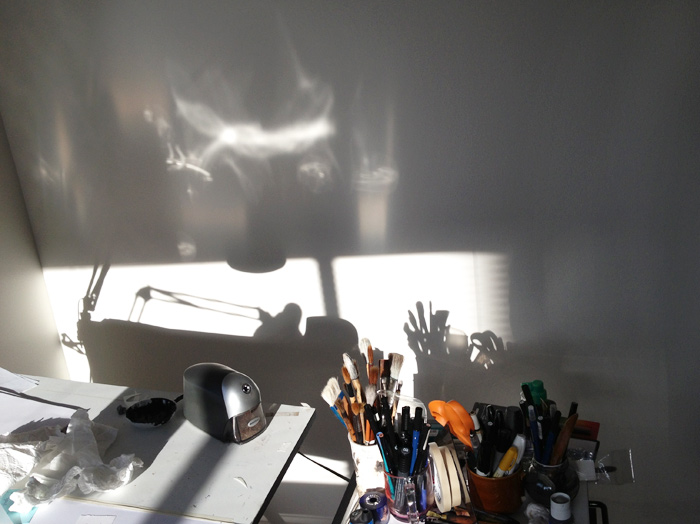
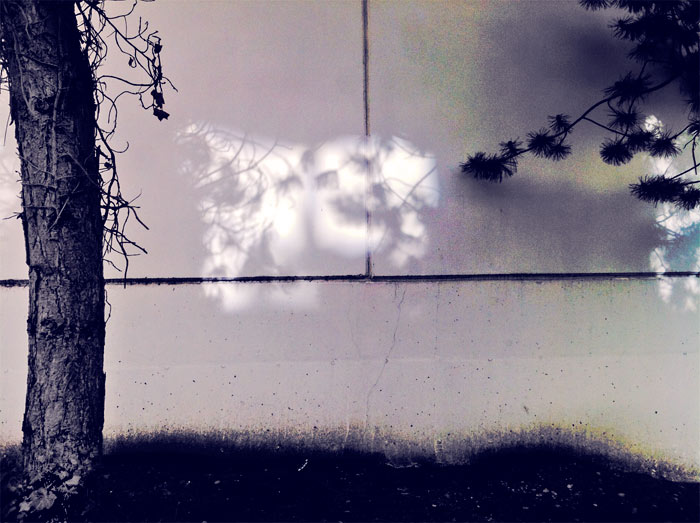
Also, there are always astonishing walls, blank or not, and light writes its poems there, throughout the day and night.
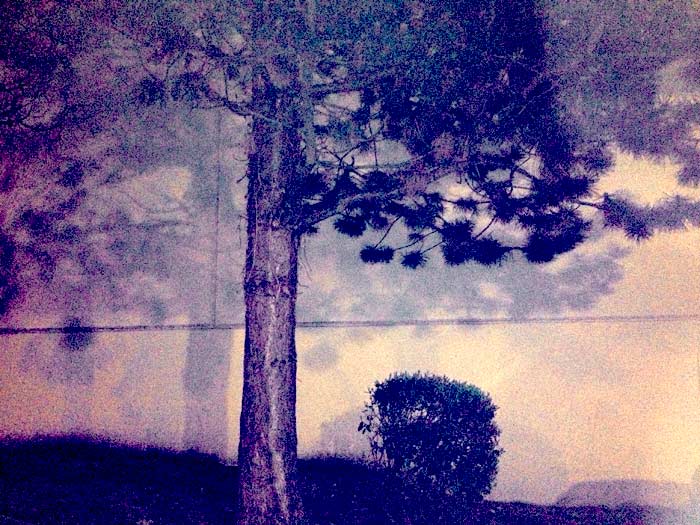
Hokusai At St. Vincent de Paul
Hokusai at St. Vincent de Paul, Midnight © Iskra Johnson
Hokusai On Highway 99 Morning
Hokusai, 6 AM © Deloss Webber
Hummingbird On The Wall, light in the studio
The Hummingbird, © Iskra Johnson

On the second week I went for a run along the new interurban trial. Underneath, plum blossoms smudged pink on tar. Trucks without wheels, fences without posts, everywhere rust, and every spare surface signed by a stranger late at night. Along the backside of the cemetery coiled wire followed the top of Olmstead wrought iron, and a man bicycled slowly towards me, pulling a wagon. His eyebrows had been so perpetually raised in surprise that they had stayed there, like a mountain range, and his face below was impenetrable, mapped by roads with no name. He looked at me long, appraising, and I shivered, and ran faster, towards the young women in pink walking their dogs. An inflatable clown smiled at me from a window in the spare parts warehouse, the anvil clouds of morning flattened into dirty cotton, and I was for a long time the only person on the trail.
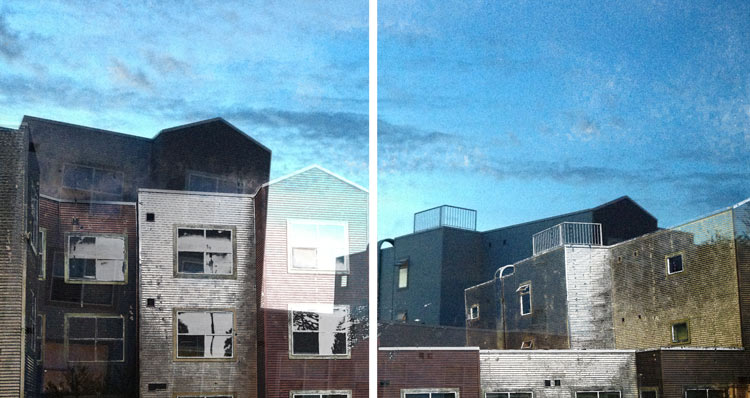
The Triangle & The Square

In this state I came back and ran into the elevator and up three flights and when I raised the blinds of my new windows I realized just how comforting and powerful it is to have a triangle on a square. This complex was built with a flat roof, but triangles have been attached here and there, to give an impression of “house.” The sun rises there, just between the flat and the angle. I just kept looking at it, the miracle of structure and shape.

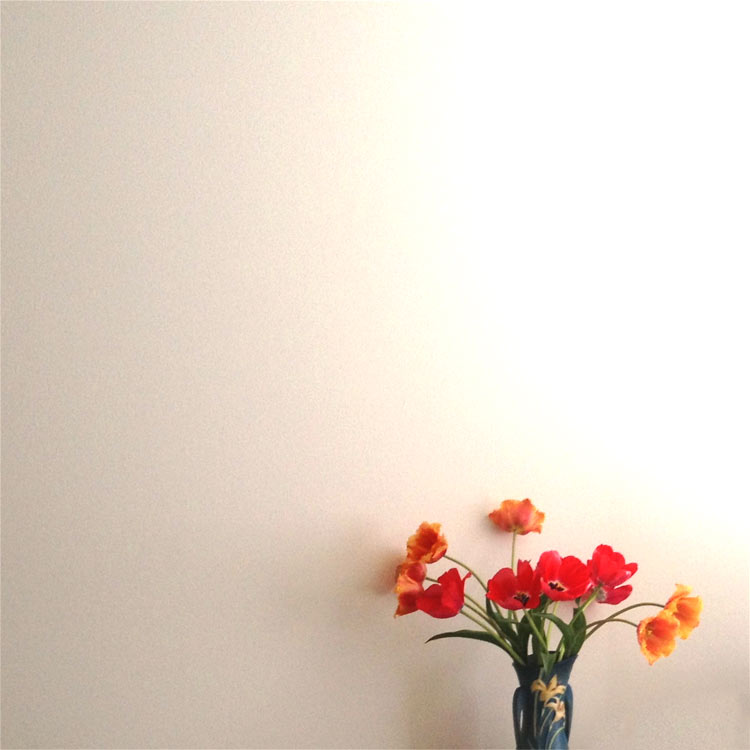
The next day I gave in and put tulips in a vase. Each day, only what is necessary. Start with nothing, start with empty, and begin again. I may become a believer after all.
Flowers In White
Flowers In White, © Iskra Johnson

Filed Under: Architecture & Sense of Place, Meditation & Buddhism, Photography Tagged With: all art is political, all politics is personal, beauty at the edge, edge city, finding beauty, gentrification and art, Highway 99 Revisited, Hokusai on Highway 99, living in architecture, politics & art

Comments

  1. Ruth says

    April 28, 2014 at 2:40 pm

    Iskra, your living situation is clearly GREAT for your writing. Beautiful illustrations. I hope you survive your apartment adventure.

    Reply
  2. Kent S. says

    April 28, 2014 at 5:54 pm

    I believe you.

    Reply
  3. Ken says

    May 17, 2014 at 1:54 am

    Lovely piece. I appreciate you or eye for “beauty everywhere”.

    If you have not ready seen the site lifeedited.com, check it out. It is quite inspiring.

    Reply

Leave a Reply Cancel reply

Your email address will not be published. Required fields are marked *

This site uses Akismet to reduce spam. Learn how your comment data is processed.

Join Iskra’s Mailing List

Don't miss a thing! Subscribe to receive show announcements, first peek at new work and my semi-monthly blog by email. I primarily use the blog for news and updates but by signing up you will also receive the occasional newsletter and special offers for items in my shop.

Iskra Fine Art Blog

the creative process | conversations with artists | the contemplative impulse in art

Instagram

At 18, in my first year in class at Cornish, Charl At 18, in my first year in class at Cornish, Charles Stokes said: “To be an artist, first you must learn to visualize. Your assignment is to go home, close your eyes, and visualize an apple. Rotate it and observe how it looks from every direction, as though you were God and you had just designed this fruit. Then imagine cutting it into pieces and turn each piece in your mind’s eye. If you need to get in the bathtub, do.” A year later, my skin had turned permanently pink from baths, but I was beginning to be able to See. That moment when I really could imagine the apple from above, below, the side, and visualize the slices falling away was a revelation. The cherubim cheered. Today I can shut my eyes in any moment of boredom and see the apple rotate like a muffin on a dim sum tray, round and round, the highlights glinting.

Apples also nearly killed me. When I was 19, I worked for a month in the orchards of Orondo, and slept under the trees in a sleeping bag and little else. Each morning I woke to the drone of crop dusters and the pale white incandescence of pesticides sifting through the leaves. My water came from a galvanized pipe fed directly by the irrigation ditch. Me and Caesar Chavez? Solidaridad. I came back from the orchard with a stomach malady that defeated every doctor I saw. Over the ten years following I lost 32 pounds, and I had been slender to start. At 27 I came within three weeks of death. Over that decade I was tested for everything, and my body claimed an allergy to every food except the pinto bean. No amount of antibiotics or enzymes or the primitive curatives of those days worked. After this inexplicable and punishing siege on my health it took years to get back to food as a good idea. I lived on boiled carrots and rice. The one possible argument to inexplicable: every alternative medicine healer found indications of arsenic, a prime ingredient of pesticides and known disruptor of the digestive tract. (Continued in next comment, complete essay at link in bio.)
Exquisite work by @christinegedye @fountainheadgal Exquisite work by @christinegedye @fountainheadgallery.
Experiments in juxtaposition. Yesterday I worked Experiments in juxtaposition. 

Yesterday I worked in the studio to some kind of divine mix of Raga and drone and hand pan drum and returned to the state of mind I’m here for. 

This study of an eggshell is only incidentally an eggshell; it is any fragile thing regarded with love. I think of the days when there was an antique shop on every block and I would haunt them and find among the watering cans and spoons and rusted winches a lace handkerchief starched and embroidered with imagined daisies by some woman crossing the country in a covered wagon with a packet of seeds. I held the cloth up and watched clerestory light fall from the rafters and transform its quiet folds into something burning, heard the sounding bells of ships in the harbor, the train rumbling in the tunnel, people stumbling and laughing on the boardwalk. 

Light is the keeper of history. As we walked out of the steel plant last week, steam mingled with clouds and enveloped the massive structures around us in softness. Just before my camera died, I took this picture of a steel door. On its face, the flag of an imagined country, stripped of warp and weft and left with only traces. As the world hangs on the edge, held by the flimsiest of props, each day aims another missile at certainty. We still have memory, and that may save us.

#TheFragilityProject
Slow Art. The beat helps tune out the Everything E Slow Art. The beat helps tune out the Everything Else Going On. . .#graphitepencil
I am excited to be part of the annual open studio I am excited to be part of the annual open studio tour for 
Spotlight North 2026, Noon to 5 May 16+17! 
Meet the artists of Shoreline, North Seattle, 
and Lake Forest Park in their native habitat: 

Robin Arnitz, Anna Wetzel Artz, Laura Brodax, Shruti Ghatak, Eva Isaksen, Amanda Knowles, Sarah Norsworthy, Paul Leavitt, Paul Lewing, Iskra Johnson, Dale Lindman, and Shoko Zama.

I will be showing new drawings and paintings influenced by nature and place, as well as ongoing print work, and several new card series. Many people have told me they would love to collect more but their walls are full, or they are moving into smaller spaces. In response, I have created new tiny works you can set on your desk or slip into the spice rack between the oregano and the thyme. I have always loved the intimacy of small work: It is the quietest most personal of conversations. These three pieces are from the hundreds of media studies I do to see “what happens if,” in an experimental state of mind. They are made with a combination of liquid graphite, pencil and paint, and presented like tiny one-of-a kind etchings. Contact me if you are interested in pre-purchase.
Link in bio to the Spotlight North Website. The map will be posted soon!
First glimpse of the Nucor Steel Plant. Probably t First glimpse of the Nucor Steel Plant. Probably the most amazing photo shoot I have ever been on. It will take me months to know what to do with the hundreds of images from this amazing day. Thank you Seattle plein air painters for this rare opportunity. Thank God we had dedicated minders to keep us from falling off the stairs and to help us adjust to the three layers of gear, hard hat, ear coverings, goggles, vest (hint: you need all of them!)

Featured Posts

  • Book Launch! The Water Tower Project from Iskra Fine Art
  • How to Purchase Artwork from Iskra Fine Art
  • About This Blog
  • New Directions in Contemplative Art: Conversations with Artists
  • What is a Transfer Print? (Artist Statement)

Categories

  • Abstract Calligraphy
  • Architecture & Sense of Place
    • Construction/Reconstruction
    • The Alaska Way Viaduct
    • The Water Tower Project
  • Art Reviews
  • Artist Studio Visits
    • The Mystic Muse: Artists Working in the Contemplative Traditions
  • Botanical Art
    • Botanical Art Cards
  • Collage
    • Digital Collage
  • Commissioned Art
  • Drawing
  • Essays
    • Object Lessons: Essays and images inspired by "A History of the World in 100 Objects."
  • Iskra Shows, Upcoming and Past
  • Iskra Sketchbooks & Journals
  • Living With Art
  • Meditation & Buddhism
  • Mixed Media
  • Painting
  • Photocollage
  • Photography
    • American West Landscape Photography
  • Print Sale
  • Prints
    • Transfer Prints
  • Seattle Iconic Landscape Prints
  • Social Media for Artists
    • The 100 Day Projects
  • The Garden
    • The Gardener's Almanac of Irreproducible Phenomena
  • The Spiritual in Art
  • Travel
    • Road Trips
  • Uncategorized

Archives

Search

Connect on Facebook

Iskra Fine Art Facebook Page

Creative Inspiration

  • Alternative Photography
  • An Artist's Retreat
  • Anonymous Chinese Textile Genius: Moo Won
  • Chocolate Is A Verb
  • Contemplative Art Process: Danila Rumold
  • Eva Isaksen
  • Old Industrial Japan
  • The Altered Page
  • The Heart Sutra Loop
  • The Patra Passage

Galleries for Contemplative Art

  • ArtXchange Gallery
  • Seattle Asian Art Museum

Links

  • CollageArt.org
  • Iskra at SAM Gallery
  • Iskra Fine Art on Houzz
  • Seattle Art Museum Blog
  • Seattle Artist League
  • Seattle Print Arts
  • Seeing Fresh: Contemplative Photography
  • The Painter's Keys

What I'm Reading: Online Magazines and Books I Love

  • 16 mi.
  • Essays by David Whyte
  • Evening Will Come: Poetry
  • Hyperallergic
  • Painter's Table
  • Shu: Reinventing Books in Contemporary Chinese Art
  • Streetsy
  • The Original Van Gogh's Ear Anthology
  • Tricycle Magazine
  • Unincorporated Persons in the Late Honda Dynasty
  • Vanguard

Let’s Connect

  • Contact Iskra
  • How to purchase artwork
  • Iskra Fine Art Blog : The creative process, conversations with artists, the contemplative impulse in art
  • Facebook
  • Instagram
  • Pinterest
  • Twitter

All Images Copyright © 2026  Iskra Johnson · Site by LND · WordPress