Iskra Fine Art

  • Prints
    • The Tarmac Residency: Airport Landscapes
    • Immersions | At The Shore
    • ColorBath: Images of the Harbor
    • The Floating World
    • Industrial Strength | Urban Industrial Landscape
    • The Scaffold
    • Industrial Pastorale: The Rural/Urban Landscape
    • Botanical Prints | The Natural World
    • Construction | Reconstruction : Urban Landscape
    • Infrastructure
  • Drawings
    • Pencil Drawings: Pandemic Pause
    • Drawings in Dust 1
    • Signs & Symbols (Archive)
    • Botanical Drawings (Archive)
  • Photography
    • New Work Inspired by England
    • Seattle Waterfront Park Photography
    • Architectural Photography | Construction Sites
    • American West Landscape Photography
  • Mixed Media
    • Modern Botanical | Mixed Media on Plaster
    • From the Sea | Water Paintings
    • Sleep Studies
  • Wabi Sabi Abstract
    • Minimalist Modern
    • Ink Painting Abstractions
  • Shop
    • The Water Tower Project
  • About
    • Contact
  • Blog

Notes on Saul Bellow

November 29, 2010 by Iskra Leave a Comment

One of the great pleasures of the gray days is coffee combined with the New York Times Book Review. I look forward to this moment for the way the newsprint reflects the color of the winter sky, the endlessly inventive illustrations and for the writing: often the reviewers leave me with as much to linger over and absorb as the books themselves. This week carried a particularly beautiful review by Leon Wieseltier of the letters of Saul Bellow. I am a letterkeeper. I belong to the vanishing lineage of those who dwelled in garrets and drawing rooms and “prewar flats” and lived to transcribe the moments of their lives for people they would never see but nonetheless carried with them as vital witness. To look back on letters from this century of the instant-message and the tweet has a special poignance.

What spoke to me most in this review were Bellow’s insights on metaphor, symbol, ideology and creative resilience. As a visual artist, narrative and symbol are my guiding frames of reference. But both can be hazardous to successful art. I take to heart these excerpts, as wisdom to work and live by.

“…the poetry of his prose, its force of consciousness, lay always in its fidelity to the concrete. In the appearances of things and circumstances and psyches, he discerned the revelatory details…“American books, including my own…pant so after meaning. They are earnestly moral, didactic; they build them ever more stately mansions, and they exhort and plead and refine…. A work of art should rest on perception.”

“Ideology is of no use to us in refurnishing the empty house….” What is of use, by contrast, is humanism. Humanism is “the most subversive of all — and I am a Humanist.” The absence of irony from that avowal is like a cool breeze. Trotsky, Rich, Steiner: Bellow was forever chasing the answer, but his disappointment in belief never dissuaded him from the chase. “The best of me was formed in the jumps.”

Metaphor is the juxtaposition of disparate elements of the world in which an unsuspected commonality, an illuminating partial likeness, has been discovered, and the more unlikely the juxtaposition, the greater the consequent sensation of the unifying of the world; and so the range of a writer’s metaphor is a measure of the range of his cognition.”

Read the complete review.

The-Latch
© Iskra Johnson


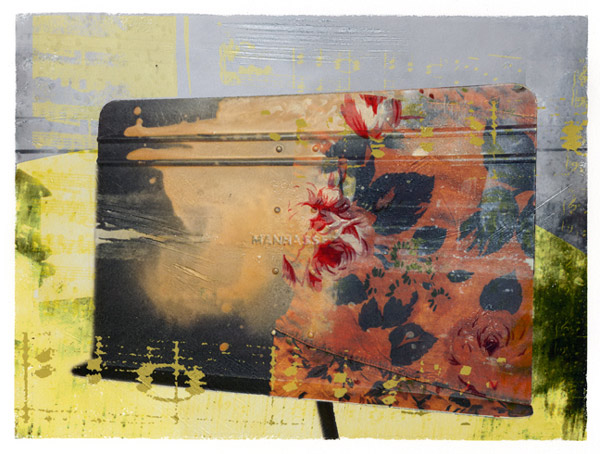
Photo collage from a series in progress called “Werkspace” about the physical and emotional space of creativity. Original photos by Iskra Johnson taken at Pratt print studios in Seattle.

Filed Under: Photography Tagged With: inspirational quotes about metaphor, Leon Wieseltier, review of Saul Bellow, Werkspace

Postcard From the Village

November 25, 2010 by Iskra 1 Comment

The robins have been ice skating on the pond. Every morning just as I am finishing my tea they confer en masse, and compete with the starling, the bold jay and the infinite supply of juncos for stage time. I have been thinking about the idea of village at this time of year, so focused as it is on connection and on gathering together. I went out to get my mail, and the mailbox startled me with its beauty. As I walked back through the snow ideas of human friendship, of nature’s dumb and lovely company and the ways we stay in touch when far away swirled in my mind.

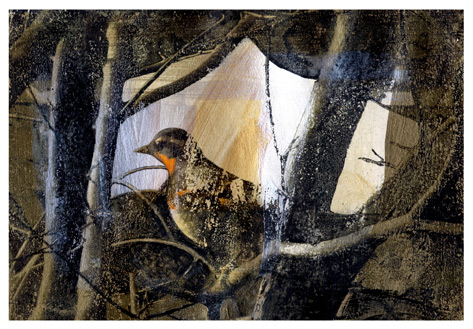
I started collaging with a juxtaposition of the robin and the mailbox, and then realized that the robin properly belonged on his own card, “in” the box. I found an ancient postcard from a dear friend who wrote to me from Germany the day she met her true love. If ever I considered throwing out the archives of a lifetime’s correspondence today I thought better– to have nothing but email in ones’ drawer and to have to buy emotional ephemera from Ebay……!

I can’t decide which of these two versions works better. I tried about a million layer effects and sizes of the postmark. I laboriously changed the date to today (now hidden.) I finally knocked it back to almost invisible. I rarely put human faces in my work as I am more interested in asking the audience to see the view rather than to notice the viewer. But I think I like this woman of the German stamp. She has a winter face.

On the other hand, the pure nature narrative, the robin trading me his bright color for a few sunflower seeds. Tell me what you think.


© 2010 Iskra Johnson

Filed Under: Photography Tagged With: holiday card, mailbox in the snow, robins, thanksgiving, Winter postcard

First Snow, 2010

November 23, 2010 by Iskra Leave a Comment

I took a walk to get basics, praying that on this snowbound day before Thanksgiving the multitudes would leave me bagels. (They did, and I can love them for this as the Pilgrims would.) On the way I saw a man on a bicycle smiling on sheet ice. He shouted as he pedaled past, “This is the best kind of weather!” Next up a white dog, looking fine and pretty and knowing white on white works. I felt like I was looking at the new York Times fashion issue and it hurt. I had miss-matched mittens and one hand, the leather driving glove hand, seemed to have gone green with frostbite. I stopped at Sears. Give me the Lands End special, a pedigreed 30 below warm fisted mitten, please.

On the way home I walked by the car where in July a woman leaned against hot blue metal in a floor length fur coat and smoked a cigarette. Today, surrounded by frozen mud and snow and ice,  her car was covered with beachtowels, floral tablecloths from the old country, and lurid afghans in red and orange and green. I noted especially the striped cords binding the afghan to the windshield. There was no snow on the car itself and so perhaps this is some kind of magic, the application of beachtowels thus warding off the chill. There are things I do not understand, and for this I am also thankful, even a day earlier than necessary.

First-Snow

Filed Under: Photography Tagged With: artist journals, frozen garden photo, frozen pond, journal of a Pilgrim, winter journal

The Poppies are the Last to Go

November 8, 2010 by Iskra Leave a Comment

Buddha-With-Poppies


Happiness-Chair-In-Autumn

How Many Minutes from Yesterday: Garden, Early November © Iskra Johnson

Filed Under: Photography, The Garden Tagged With: Garden Buddha, garden in Autumn, Seattle artist Garden, yellow poppies

The Ink Floor: Collaboration with Martin French

August 15, 2010 by Iskra Leave a Comment

Last month at the Icon 6 Illustration conference I met illustrator Martin French. We had seen each others’ work for years, but had never met in person. After a long talk about process, creativity and the pros and cons of working in solitude he challenged me to a day of experimental collaboration in the studio. Knowing Martin’s expertise with the figure and his enviable mastery of the calligraphic mark I was, shall we say, petrified. 

But the more I thought about it the more it seemed like we could learn a lot from working side by side. Martin works in the language of the figure in motion, but lately he has been creating letter forms. I usually work with the isolated symbol or the alphabet, but have been wanting to get back to the origins of calligraphic art: abstract marks, the field, composition, and a more expressive way of working than my usual projects require.  

August is the month for creative renewal and experimentation around here: the garden is at its peak, the days are warm and long, and most clients are at the Hamptons….or wherever it is that clients go.  Martin came up from Portland and we worked in my studio for a day. With apologies to Paul and Suzanne at Workbook, we painted on the back of my old reprints — hey, what else are you going to do with promo pages from 1995? Martin worked on the floor and I abandoned my usual slantboard, liberated to be working on a large flat table usually reserved for junk. We made tools out of unexpected materials, poured ink into trays, and turned on Thievery Corporation. Some of the results follow here. The second image is Martin’s, you can see more of his pieces at his blog linked above. The last pieces use fragments of my drawings, scanned and colorized.

IskraFloorTable
 

MFrenchFloorImages
 

IskraFloorBasket
 

Inktable1

InkTable2

Origins

Mohawk3 © 2010 Iskra Johnson  WordForm 1

GrayMohawk© 2010 Iskra Johnson  WordForm 2

Vocabulary1Orange-copy
  © 2010 Iskra Johnson  Vocabulary 1

Vocabulary2IFBlog © 2010 Iskra Johnson  Vocabulary 2


Mermaid1-copy
 © 2010 Iskra Johnson   
 First Mermaid

Filed Under: Uncategorized Tagged With: collaboration with Martin French, Collaborative calligraphy, ink composition, Iskra experimental work, mark making, Martin French, mermaid, new work from Iskra, summer in the studio

  • « Previous Page
  • 1
  • …
  • 51
  • 52
  • 53
  • 54
  • 55
  • …
  • 58
  • Next Page »

Join Iskra’s Mailing List

Don't miss a thing! Subscribe to receive show announcements, first peek at new work and my semi-monthly blog by email. I primarily use the blog for news and updates but by signing up you will also receive the occasional newsletter and special offers for items in my shop.

Iskra Fine Art Blog

the creative process | conversations with artists | the contemplative impulse in art

Instagram

Today’s mood, from the morning walk. Today’s mood, from the morning walk.
A metaphysical idea waiting to become a drawing. A A metaphysical idea waiting to become a drawing. All day I have been studying graphite, the most evanescent of mediums. Fragility. Once you break the egg, scatter the nest, leave the children without family on an abandoned beach, what then? 

I have spent the day drawing. In the background, which becomes foreground with one click, is the news of the rounding up of another thousand or so human beings by bounty hunters given a quota, thrown into concrete cages and disappeared because someone decided that America is no longer the home of the #huddledmasses.

The plaque on the Statue of Liberty says:

“Here at our sea-washed, sunset gates shall stand
A mighty woman with a torch, whose flame
Is the imprisoned lightning, and her name
Mother of Exiles. From her beacon-hand
Glows world-wide welcome; her mild eyes command
The air-bridged harbor that twin cities frame.
“Keep, ancient lands, your storied pomp!” cries she
With silent lips. “Give me your tired, your poor,
Your huddled masses yearning to breathe free,
The wretched refuse of your teeming shore.
Send these, the homeless, tempest-tost to me,
I lift my lamp beside the golden door!”

Noem and Holman have not, apparently, run their hands over these words.

How do you continue making art at a time like this? You chase the metaphor. There is always a constant truth beneath the chaos.
Media studies. Addition and subtraction. Media studies. Addition and subtraction.
Somehow, between checking the news and the usual d Somehow, between checking the news and the usual distractions I managed to complete a drawing. Going back to the beginning: drawings in dust. 9.5 x 12” Charcoal powder, compressed charcoal, charcoal pencil on Moleskine. I feel peaceful for the first time in weeks.
The train tracks that go along Golden Gardens and The train tracks that go along Golden Gardens and pause briefly at the locks create a rupture in the city landscape. When the trains go by, the roar and squeal is like a thousand wild animals let out of their cage, and the ducks in the pond at the edge of the park shudder and dive under the water. A little farther north at Carkeek there is someone every year who steps in front of the train and whoever witnesses that is never the same. 

Sometimes the cargo containers are filled with coal, uncovered, and I have been part of demonstrations, which included polar bears and Orcas, objecting to that. Now, as we are being asked to casually accept nuclear reactors on every block as the price of having artificial intelligence, coal and its simple visible dust might look a little more friendly. The train brings with it economics and politics and life and death and class and all the people on the beach are just trying to have a moment in the sun. And the boaters at the marina, if they have finished polishing and descaling and mending the sails are lying back with a guitar and getting lost in the mountains. If you are willing to live right next to the train tracks, you can pay a much lower price for your home, but your dreams will change. I have lived next to the train tracks when I was very, very small and every night I woke up screaming and ran across the floor in the beams of the streetlight looking for safety. I have woken up in a train yard on a bed of cardboard and gotten on the train in the dark. Only when you do that, do you know just how hard metal is.

I’ve been drawing recently from life and this study was done from a photograph. It drove me crazy trying to see details that I couldn’t really see and feel them with the pencil. I’ve abandoned the drawing for now, but I learned a great deal about perseverance and obliteration and re-perseverance. Also how machines pretend that they are perfectly symmetrical and are not. And when you don’t draw them with perfection, they look just plain wrong so you have to make them more perfect than they are, at least when they are in perspective.
Tonight’s abandoned bird. The next one will be bet Tonight’s abandoned bird. The next one will be better. I’ve never tried to draw a Robin before. I’ve been obsessed with them since David Lynch sent them over to my childhood house, where they spent day and night getting drunk on the holly berries outside the kitchen window. And if you don’t know what I’m talking about google Laura Dern, Blue Velvet. And the Robin. It’s a hymnal to the good and the normal, done absolutely abnormally. I am learning all kinds of amazing things about how Robins build their nests. They start with mud. I did not know this. And in a drought, they will drag straw into a birdbath to get it wet and then drag the straw over a wormhole. Robins build their nests in the most unlikely places: drain spouts, highway overpasses, really bad motel parking lots. It’s kind of like how people find third place in community, even in the bleakest places. A franchise McDonald’s where people become regulars and always get the fries and just the fries because that’s all they can afford is a similar statement of naive valor: people talking to strangers and becoming known and taking shelter where they can. And if they leave a shredded napkin out there by their car, it will end up woven in with the straw and the leaves and the cigarette butts perched up there in the nest on the backside of the billboard.

Featured Posts

  • Book Launch! The Water Tower Project from Iskra Fine Art
  • How to Purchase Artwork from Iskra Fine Art
  • About This Blog
  • New Directions in Contemplative Art: Conversations with Artists
  • What is a Transfer Print? (Artist Statement)

Categories

  • Abstract Calligraphy
  • Architecture & Sense of Place
    • Construction/Reconstruction
    • The Alaska Way Viaduct
    • The Water Tower Project
  • Art Reviews
  • Artist Studio Visits
    • The Mystic Muse: Artists Working in the Contemplative Traditions
  • Botanical Art
    • Botanical Art Cards
  • Collage
    • Digital Collage
  • Commissioned Art
  • Drawing
  • Essays
    • Object Lessons: Essays and images inspired by "A History of the World in 100 Objects."
  • Iskra Shows, Upcoming and Past
  • Iskra Sketchbooks & Journals
  • Living With Art
  • Meditation & Buddhism
  • Mixed Media
  • Painting
  • Photocollage
  • Photography
    • American West Landscape Photography
  • Print Sale
  • Prints
    • Transfer Prints
  • Seattle Iconic Landscape Prints
  • Social Media for Artists
    • The 100 Day Projects
  • The Garden
    • The Gardener's Almanac of Irreproducible Phenomena
  • The Spiritual in Art
  • Travel
    • Road Trips
  • Uncategorized

Archives

Search

Connect on Facebook

Iskra Fine Art Facebook Page

Creative Inspiration

  • Alternative Photography
  • An Artist's Retreat
  • Anonymous Chinese Textile Genius: Moo Won
  • Chocolate Is A Verb
  • Contemplative Art Process: Danila Rumold
  • Eva Isaksen
  • Old Industrial Japan
  • The Altered Page
  • The Heart Sutra Loop
  • The Patra Passage

Galleries for Contemplative Art

  • ArtXchange Gallery
  • Seattle Asian Art Museum

Links

  • CollageArt.org
  • Iskra at SAM Gallery
  • Iskra Fine Art on Houzz
  • Seattle Art Museum Blog
  • Seattle Artist League
  • Seattle Print Arts
  • Seeing Fresh: Contemplative Photography
  • The Painter's Keys

What I'm Reading: Online Magazines and Books I Love

  • 16 mi.
  • Essays by David Whyte
  • Evening Will Come: Poetry
  • Hyperallergic
  • Painter's Table
  • Shu: Reinventing Books in Contemporary Chinese Art
  • Streetsy
  • The Original Van Gogh's Ear Anthology
  • Tricycle Magazine
  • Unincorporated Persons in the Late Honda Dynasty
  • Vanguard

Let’s Connect

  • Contact Iskra
  • How to purchase artwork
  • Iskra Fine Art Blog : The creative process, conversations with artists, the contemplative impulse in art
  • Facebook
  • Instagram
  • Pinterest
  • Twitter

All Images Copyright © 2026  Iskra Johnson · Site by LND · WordPress