Iskra Fine Art

  • Prints
    • The Tarmac Residency: Airport Landscapes
    • Immersions | At The Shore
    • ColorBath: Images of the Harbor
    • The Floating World
    • Industrial Strength | Urban Industrial Landscape
    • The Scaffold
    • Industrial Pastorale: The Rural/Urban Landscape
    • Botanical Prints | The Natural World
    • Construction | Reconstruction : Urban Landscape
    • Infrastructure
  • Drawings
    • Pencil Drawings: Pandemic Pause
    • Drawings in Dust 1
    • Signs & Symbols (Archive)
    • Botanical Drawings (Archive)
  • Photography
    • New Work Inspired by England
    • Seattle Waterfront Park Photography
    • Architectural Photography | Construction Sites
    • American West Landscape Photography
  • Mixed Media
    • Modern Botanical | Mixed Media on Plaster
    • From the Sea | Water Paintings
    • Sleep Studies
  • Wabi Sabi Abstract
    • Minimalist Modern
    • Ink Painting Abstractions
  • Shop
    • The Water Tower Project
  • About
    • Contact
  • Blog
You are here: Home / Collage / Digital Collage / Homage to Nabokov’s “Speak Memory”: Ex Libris 100 Books Exhibit, Seattle

Homage to Nabokov’s “Speak Memory”: Ex Libris 100 Books Exhibit, Seattle

February 18, 2014 by Iskra Leave a Comment

        “The cradle rocks above an abyss, and common sense tells us that our existence is but a brief crack of light between the eternities of darkness.”         

“Come with us by all means, but do not chase butterflies, child, it spoils the rhythm of the walk.” — Speak Memory, by Vladimir Nabokov
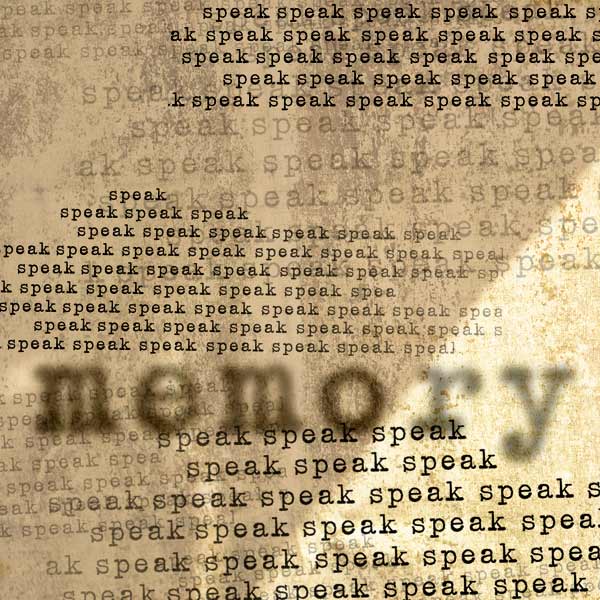
Speak Memory Nabokov Typographic Study
Typographic Study for “Speak Memory” © Iskra Johnson

When I was invited to participate in the exhibit “Ex Libris: 100 Artists, 100 Books” I had no question about which book I would choose to interpret. Vladimir Nabokov’s Speak Memory: An Autobiography Revisited has murmured in the back of my mind for twenty years as an unsolved koan. In my work as a book title designer I have designed a dozen hypothetical covers as portfolio exercises, and always I felt I could do another hundred without exhausting the timeless incantation of the words. I knew that this time I wanted to focus on shadow and light, the beauty of sensory experience and tactile surface. Not only did Nabokov write some of the most evocative and sensual literature of the 20th century, but he made his mark in lepidoptery as a passionate and obsessive collector of butterflies, with an entire genus, Nabokovia named after him. It seemed to me any homage to the book must also include a butterfly, and more than that, a re-enactment of the chase.

We can no longer blithely step out into a field of wild flowers and find a butterfly at whim; I have only seen three in my garden in the past year. In lieu of this science offers us the Tropical Butterfly House at the Seattle Center,  where I could wander in the middle of December and collect specimens with my camera. Similarly, for years I have been collecting shadows, and with chlorophyll and pins and camera in hand I set about to capture from new days and old archives the perfect juxtaposition of light and dark. I have always loved the indirect but powerful effect of shadows as characters off stage. They shift and blur without our control and change in an instant, and they invite a compositional element that reflects the fleeting certainty of memory.
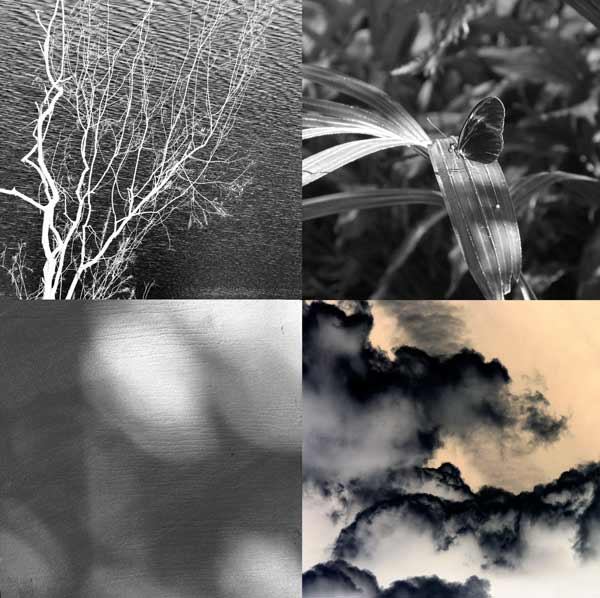
Speak Memory Nabokov Mood Exploration
Photographic study for “Speak, Memory” © Iskra Johnson

“… my Swallowtail, with a mighty rustle, flew into her face, then made for the open window, and presently was but a golden fleck dipping and dodging and soaring eastward, over timber and tundra, to Vologda, Viatka and Perm, and beyond the Ural range to Yakutsk and Verkhne Kolymsk, where it lost a tail, to the fair Island of St. Lawrence, and across Alaska to Dawson, and southward along the Rocky Mountains — to be finally overtaken and captured, after a fourty-year race, on an immigrant dandelion under an endemic aspen near Boulder.” —Speak Memory

I knew that I wanted to create an image of evanescence, but also something that had physical presence and some aspect of dimensionality. I experimented with image transfer, physical collage, and plaster. I arrived in the end at a very different approach to physicality. The images are collaged in Photoshop with the transparent immateriality of thought, but are mounted as specimens might be, on panels, and glazed with layers of acrylic resin as though encased in a vitrine. The quiet typography and shape of the panels reference both a tombstone and the original division, the abyss, of the opening lines of the book.
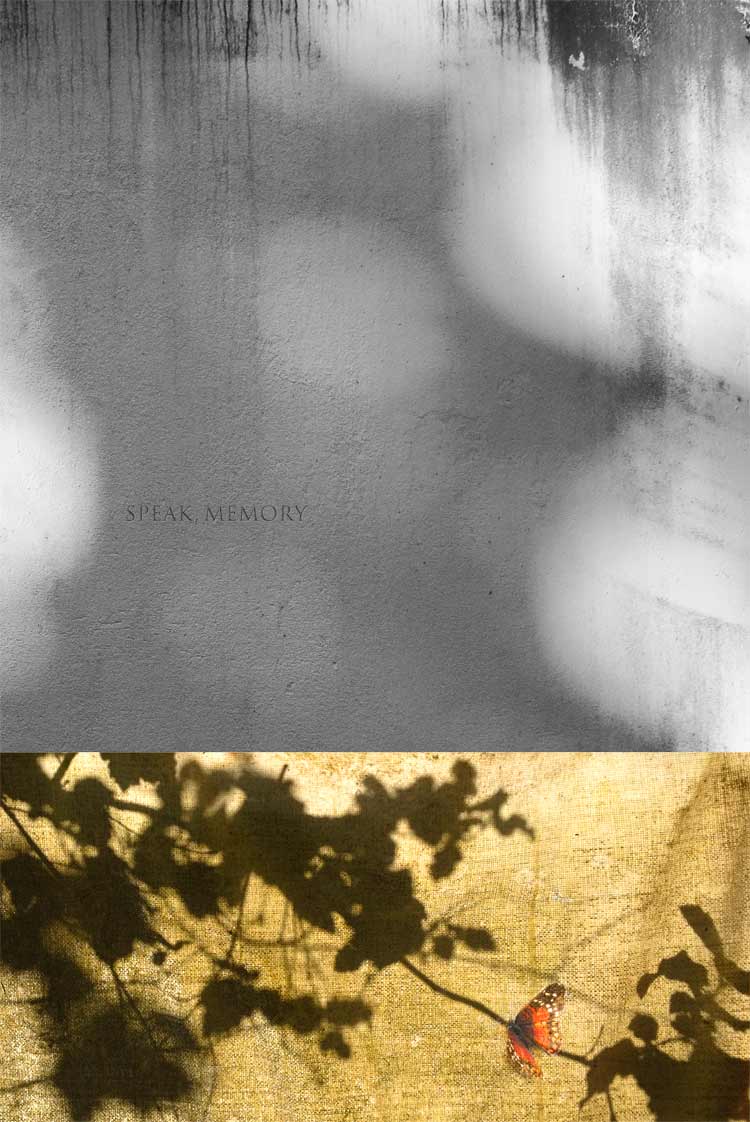
Speak Memory Ex Libris ©Iskra Johnson
“Speak Memory,” 22 x 16 inches, Photocollage on joined panel, © Iskra Johnson

For readers with interest in the technical aspects of this, I will say it wasn’t easy. Although I made dozens of tests on small panels with adhesives and with acrylic resins, when it came to the final full scale piece all kinds of problems appeared. Who knew gluing a piece of paper onto a piece of wood could be so tricky? Piece of cake if it is 8 inches, but at 16 inches it was hair-raisingly difficult to center the image with just the right amount of border to later trim and sand off. I learned the hard way that it is a good idea to place a thick towel between the paper and a hard surface while drying with weights. If there is a slight warp in the panel the towel will help to fill in the indentation and ensure that all of the paper makes contact with the glued board.
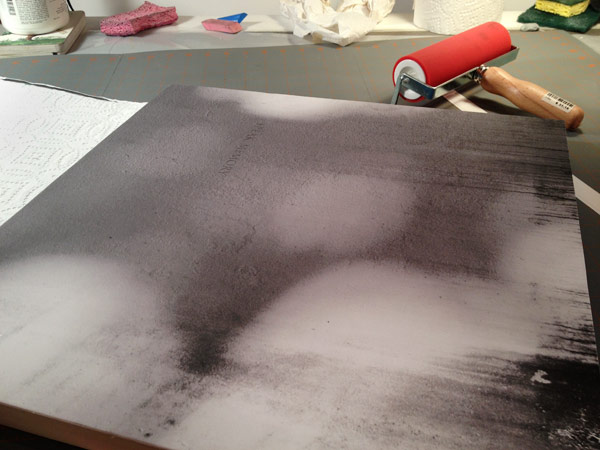
Mounting Paper on Panel
Mounting the print onto prepared panel: brayer, tissue, Golden Gel gloss, unthinned. Be sure to coat the panel first with a sealer to keep resin from the wood from bleeding through. Leave 1/8 inch of paper all around, trim and sand with a sanding block held vertically at a right angle to the front.

If you have a concern as I do with the archival treatment of digital collage, I pass along here my mistakes and discoveries. I tried Golden’s UV sprays first, and they left a pebble pattern that no amount of subsequent resin could hide. I then tried brushing on a thick coat of Golden UV Topcoat, and the brush strokes caught light and got in the way of a seamless surface. I discovered that if I diluted the Gel with about 30% water and used a sumi brush with a feather-light touch I could do two coats of sufficient depth to protect from UV rays, and still have a lovely surface that bonded well with the next layer. I use only archival pigment printers, (the Epson 3880 or a Canon) which do not bleed with water, so diluting the Gel is not a problem.

For my final coats I used two layers of Golden GAC 800. I have seen the application demonstrated with brush, but I found that if I poured it far fewer bubbles appeared–and contrary to the specs that say it won’t craze, it will if it is poured too heavily. One or two light coats work best. They will look milky, but if you stand on one foot and watch for five hours you will be pleasantly surprised. This beats watching the space bar fill on your computer, and adds some drama to life. To deal with bubbles, do tests using isopropyl alcohol: spray-mist immediately after the pour is done. I have tried several formulations of alcohol, and unfortunately, they are all different, and some will leave pits in the surface. You have about two minutes to lift random butterfly dust or eyelashes out of the surface, but after that you will find indentations form and appear about 24 hours later. Do not wear a black fuzzy sweater.
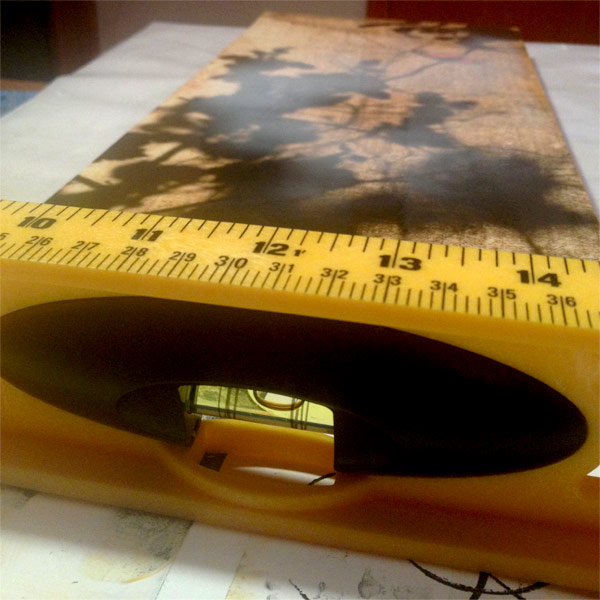
Watching GAC 800 dry, applying acrylic resin
On the first tries I did not use a level, and it is essential to lay your panel on a surface that doesn’t tilt.

The Ex Libris exhibit is the brainchild of artist, curator and entrepreneur Siolo Thompson. It is being held in conjunction with the Association of Writers & Writing Programs being held in Seattle this February 26 through March 1. A selection of works from Ex Libris may be seen on exhibit at the Seattle Convention Center during the exhibit. See the entire exhibit opening First Thursday March 6 at Axis Gallery at 308 1st Avenue Seattle, 98102. And for previews of the work if you are interested in purchase, contact Siolo at siolo.thompson at gmail.com.

A last word from Mr. Nabokov:

“‘Natural Selection’ in the Darwinian sense, could not explain the miraculous coincidence of imitative aspect and imitative behavior, nor could one appeal to the theory of “the struggle for life” when a protective device was carried to a point of mimetic subtlety, exuberance, and luxury far in excess of a predator’s power of appreciation. I discovered in nature the non-utilitarian delights that I sought in art. Both were a form of magic, both were a game of intricate enchantment and deception.”
Butterfly fragment

Filed Under: Digital Collage, Iskra Shows, Upcoming and Past, Photocollage, Photography Tagged With: art process, AWP Seattle, book title as muse, etymology of collage, Ex Libris Seattle, how to apply GAC 800, how to mount photo on panel, Iskra in Ex Libris, photocollage, Speak Memory, Vladimir Nabokov homage

Leave a Reply Cancel reply

Your email address will not be published. Required fields are marked *

This site uses Akismet to reduce spam. Learn how your comment data is processed.

Join Iskra’s Mailing List

Don't miss a thing! Subscribe to receive show announcements, first peek at new work and my semi-monthly blog by email. I primarily use the blog for news and updates but by signing up you will also receive the occasional newsletter and special offers for items in my shop.

Iskra Fine Art Blog

the creative process | conversations with artists | the contemplative impulse in art

Instagram

Today’s mood, from the morning walk. Today’s mood, from the morning walk.
A metaphysical idea waiting to become a drawing. A A metaphysical idea waiting to become a drawing. All day I have been studying graphite, the most evanescent of mediums. Fragility. Once you break the egg, scatter the nest, leave the children without family on an abandoned beach, what then? 

I have spent the day drawing. In the background, which becomes foreground with one click, is the news of the rounding up of another thousand or so human beings by bounty hunters given a quota, thrown into concrete cages and disappeared because someone decided that America is no longer the home of the #huddledmasses.

The plaque on the Statue of Liberty says:

“Here at our sea-washed, sunset gates shall stand
A mighty woman with a torch, whose flame
Is the imprisoned lightning, and her name
Mother of Exiles. From her beacon-hand
Glows world-wide welcome; her mild eyes command
The air-bridged harbor that twin cities frame.
“Keep, ancient lands, your storied pomp!” cries she
With silent lips. “Give me your tired, your poor,
Your huddled masses yearning to breathe free,
The wretched refuse of your teeming shore.
Send these, the homeless, tempest-tost to me,
I lift my lamp beside the golden door!”

Noem and Holman have not, apparently, run their hands over these words.

How do you continue making art at a time like this? You chase the metaphor. There is always a constant truth beneath the chaos.
Media studies. Addition and subtraction. Media studies. Addition and subtraction.
Somehow, between checking the news and the usual d Somehow, between checking the news and the usual distractions I managed to complete a drawing. Going back to the beginning: drawings in dust. 9.5 x 12” Charcoal powder, compressed charcoal, charcoal pencil on Moleskine. I feel peaceful for the first time in weeks.
The train tracks that go along Golden Gardens and The train tracks that go along Golden Gardens and pause briefly at the locks create a rupture in the city landscape. When the trains go by, the roar and squeal is like a thousand wild animals let out of their cage, and the ducks in the pond at the edge of the park shudder and dive under the water. A little farther north at Carkeek there is someone every year who steps in front of the train and whoever witnesses that is never the same. 

Sometimes the cargo containers are filled with coal, uncovered, and I have been part of demonstrations, which included polar bears and Orcas, objecting to that. Now, as we are being asked to casually accept nuclear reactors on every block as the price of having artificial intelligence, coal and its simple visible dust might look a little more friendly. The train brings with it economics and politics and life and death and class and all the people on the beach are just trying to have a moment in the sun. And the boaters at the marina, if they have finished polishing and descaling and mending the sails are lying back with a guitar and getting lost in the mountains. If you are willing to live right next to the train tracks, you can pay a much lower price for your home, but your dreams will change. I have lived next to the train tracks when I was very, very small and every night I woke up screaming and ran across the floor in the beams of the streetlight looking for safety. I have woken up in a train yard on a bed of cardboard and gotten on the train in the dark. Only when you do that, do you know just how hard metal is.

I’ve been drawing recently from life and this study was done from a photograph. It drove me crazy trying to see details that I couldn’t really see and feel them with the pencil. I’ve abandoned the drawing for now, but I learned a great deal about perseverance and obliteration and re-perseverance. Also how machines pretend that they are perfectly symmetrical and are not. And when you don’t draw them with perfection, they look just plain wrong so you have to make them more perfect than they are, at least when they are in perspective.
Tonight’s abandoned bird. The next one will be bet Tonight’s abandoned bird. The next one will be better. I’ve never tried to draw a Robin before. I’ve been obsessed with them since David Lynch sent them over to my childhood house, where they spent day and night getting drunk on the holly berries outside the kitchen window. And if you don’t know what I’m talking about google Laura Dern, Blue Velvet. And the Robin. It’s a hymnal to the good and the normal, done absolutely abnormally. I am learning all kinds of amazing things about how Robins build their nests. They start with mud. I did not know this. And in a drought, they will drag straw into a birdbath to get it wet and then drag the straw over a wormhole. Robins build their nests in the most unlikely places: drain spouts, highway overpasses, really bad motel parking lots. It’s kind of like how people find third place in community, even in the bleakest places. A franchise McDonald’s where people become regulars and always get the fries and just the fries because that’s all they can afford is a similar statement of naive valor: people talking to strangers and becoming known and taking shelter where they can. And if they leave a shredded napkin out there by their car, it will end up woven in with the straw and the leaves and the cigarette butts perched up there in the nest on the backside of the billboard.

Featured Posts

  • Book Launch! The Water Tower Project from Iskra Fine Art
  • How to Purchase Artwork from Iskra Fine Art
  • About This Blog
  • New Directions in Contemplative Art: Conversations with Artists
  • What is a Transfer Print? (Artist Statement)

Categories

  • Abstract Calligraphy
  • Architecture & Sense of Place
    • Construction/Reconstruction
    • The Alaska Way Viaduct
    • The Water Tower Project
  • Art Reviews
  • Artist Studio Visits
    • The Mystic Muse: Artists Working in the Contemplative Traditions
  • Botanical Art
    • Botanical Art Cards
  • Collage
    • Digital Collage
  • Commissioned Art
  • Drawing
  • Essays
    • Object Lessons: Essays and images inspired by "A History of the World in 100 Objects."
  • Iskra Shows, Upcoming and Past
  • Iskra Sketchbooks & Journals
  • Living With Art
  • Meditation & Buddhism
  • Mixed Media
  • Painting
  • Photocollage
  • Photography
    • American West Landscape Photography
  • Print Sale
  • Prints
    • Transfer Prints
  • Seattle Iconic Landscape Prints
  • Social Media for Artists
    • The 100 Day Projects
  • The Garden
    • The Gardener's Almanac of Irreproducible Phenomena
  • The Spiritual in Art
  • Travel
    • Road Trips
  • Uncategorized

Archives

Search

Connect on Facebook

Iskra Fine Art Facebook Page

Creative Inspiration

  • Alternative Photography
  • An Artist's Retreat
  • Anonymous Chinese Textile Genius: Moo Won
  • Chocolate Is A Verb
  • Contemplative Art Process: Danila Rumold
  • Eva Isaksen
  • Old Industrial Japan
  • The Altered Page
  • The Heart Sutra Loop
  • The Patra Passage

Galleries for Contemplative Art

  • ArtXchange Gallery
  • Seattle Asian Art Museum

Links

  • CollageArt.org
  • Iskra at SAM Gallery
  • Iskra Fine Art on Houzz
  • Seattle Art Museum Blog
  • Seattle Artist League
  • Seattle Print Arts
  • Seeing Fresh: Contemplative Photography
  • The Painter's Keys

What I'm Reading: Online Magazines and Books I Love

  • 16 mi.
  • Essays by David Whyte
  • Evening Will Come: Poetry
  • Hyperallergic
  • Painter's Table
  • Shu: Reinventing Books in Contemporary Chinese Art
  • Streetsy
  • The Original Van Gogh's Ear Anthology
  • Tricycle Magazine
  • Unincorporated Persons in the Late Honda Dynasty
  • Vanguard

Let’s Connect

  • Contact Iskra
  • How to purchase artwork
  • Iskra Fine Art Blog : The creative process, conversations with artists, the contemplative impulse in art
  • Facebook
  • Instagram
  • Pinterest
  • Twitter

All Images Copyright © 2026  Iskra Johnson · Site by LND · WordPress