Iskra Fine Art

  • Prints
    • The Tarmac Residency: Airport Landscapes
    • Immersions | At The Shore
    • ColorBath: Images of the Harbor
    • The Floating World
    • Industrial Strength | Urban Industrial Landscape
    • The Scaffold
    • Industrial Pastorale: The Rural/Urban Landscape
    • Botanical Prints | The Natural World
    • Construction | Reconstruction : Urban Landscape
    • Infrastructure
  • Drawings
    • Pencil Drawings: Pandemic Pause
    • Drawings in Dust 1
    • Signs & Symbols (Archive)
    • Botanical Drawings (Archive)
  • Photography
    • New Work Inspired by England
    • Seattle Waterfront Park Photography
    • Architectural Photography | Construction Sites
    • American West Landscape Photography
  • Mixed Media
    • Modern Botanical | Mixed Media on Plaster
    • From the Sea | Water Paintings
    • Sleep Studies
  • Wabi Sabi Abstract
    • Minimalist Modern
    • Ink Painting Abstractions
  • Shop
    • The Water Tower Project
  • About
    • Contact
  • Blog
You are here: Home / Archives for Buddha kitsch

New Directions in Contemplative Art: Conversations with Artists

October 13, 2012 by Iskra 2 Comments

Iconography_Drawing
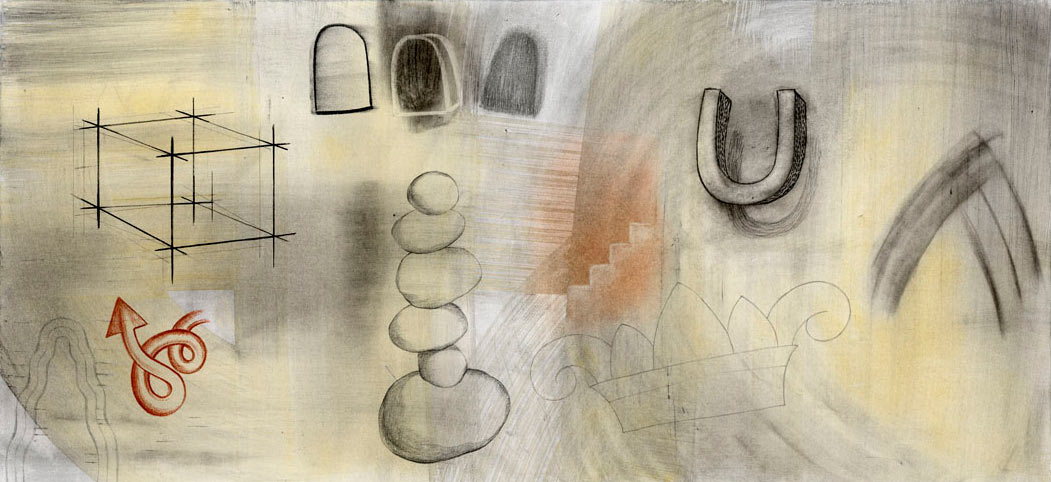
“Help Along the Way” Mixed Media Drawing, © Iskra Johnson

This week I am launching a new series of occasional interviews with artists working in the contemplative/devotional traditions. Many of these artists work within the rich iconography of Buddhism, and specifically with the image of the Buddha. Historically the Buddha is represented as a figure of serene composure, elegance and grace. The eyes look inward, closed or downward cast, the shoulders curve gently into hands held in perfect mudra.  A careful ritualized mathematics guides the distance between folds in the Buddha’s robes and the size and placement of snails on his head. The surface is stone-hard or wood, impenetrable.

This is a statue, not a man–and certainly not a woman, although Greek influence gives his robes a lyrical sweep and his body is not the emaciated one of early more ascetic representations. Not just the province of practicing “Buddhists,” the Buddha image lives ubiquitously in the contemporary marketplace of imagery and ideas. The popular shorthand for “Buddhism” is the relinquishment of desire and a state of serene acceptance, exemplified by the immobile statue. The statue is an ideal. What happens when society fills its spiritual landscape with an image of an ideal rather than a real?

It sets up a struggle, a dichotomy, hazardous and blessed in equal measure. The essence of devotional art is an image and an ideal larger than the human capacity to realize. It is aspirational. And in aspiration is a keen and particular form of suffering: you never get there, you are always leaning towards, but never reaching. Modern life, at least as practiced in America, is about getting there: and it is about getting. There is grasping and a kind of avarice in that. As well, a valuable practical truth and wisdom. The democratic revolutions tumbled the monarchies: we can all consider ourselves kings, queens, or at least the head of our local precinct caucus. Darwin, driving a nail into holy hierarchies, established that we might be on a less than mystical trajectory from birth to death and nowhere does he tell us if the soul is an acquired or inherited trait. Given the melting ice caps we don’t know if we or the sutras will be here in 2020. It is only logical to say: why not now? Why not me? Why can’t I understand in my own terms, and right now, — quickly?

The membrane between the modern urgency to leap efficiently from aspiration to getting and a deeper, timeless and more thoughtful understanding is being explored by the artists, writers and other creators reinventing religious iconography on their own terms. Some of them continue in the lineage of traditional forms, repositioning them in modern environments. Others take the sly point of view, working in illustration and advertising, and others work from the ground up re-inventing the very iconographic forms, with their own personal and aesthetic mathematics. Irony is rare, and to me this is a welcome blessing. These artists are not afraid to wear their aspiration on their sleeve. They may risk condescension and accusations of blasphemy from the spiritual establishments, and incomprehension from the secular consumer, and yet they continue on.

As someone who has followed the Buddhist path– with some detours– for most of my adult life, I want to talk to these people. The Buddha image in particular has huge resonance for me. I have done and continue to do visual art, or what I think of more properly as contemplative practice, that incorporates the image of the Buddha. This practice has led me towards viewing my own art making, regardless of the subject, as an extension of contemplation, primarily motivated by a desire for insight, beauty and emotional ballast, and secondarily as an object in the marketplace. I look forward to visiting the studios and work of artists with a similar perspective, and to seeing the varieties of ways in which their practice takes form.

Please check back from time to see the latest artists interviewed in the category of “The Mystic Muse“, or subscribe to receive this blog in your mailbox.
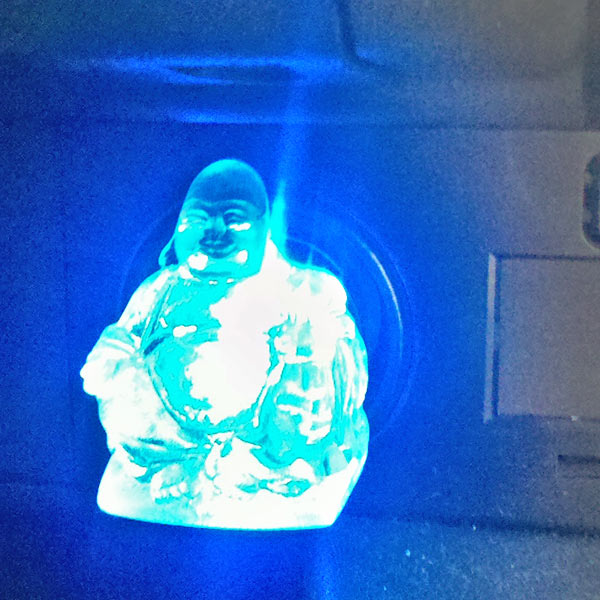
My companion in travels, the plug-in-‘88 Toyota-cigarette-lighter-laughing-while-driving-Buddha. Factory made in a high-stress environment by card-carrying atheists, no doubt.

Filed Under: The Mystic Muse: Artists Working in the Contemplative Traditions Tagged With: Buddha kitsch, Buddhist iconography, contemplative art, devotional art, essays on buddhist art, popular Buddhism, religious symbols in art

Join Iskra’s Mailing List

Don't miss a thing! Subscribe to receive show announcements, first peek at new work and my semi-monthly blog by email. I primarily use the blog for news and updates but by signing up you will also receive the occasional newsletter and special offers for items in my shop.

Iskra Fine Art Blog

the creative process | conversations with artists | the contemplative impulse in art

Instagram

Media studies. Addition and subtraction. Media studies. Addition and subtraction.
Somehow, between checking the news and the usual d Somehow, between checking the news and the usual distractions I managed to complete a drawing. Going back to the beginning: drawings in dust. 9.5 x 12” Charcoal powder, compressed charcoal, charcoal pencil on Moleskine. I feel peaceful for the first time in weeks.
The train tracks that go along Golden Gardens and The train tracks that go along Golden Gardens and pause briefly at the locks create a rupture in the city landscape. When the trains go by, the roar and squeal is like a thousand wild animals let out of their cage, and the ducks in the pond at the edge of the park shudder and dive under the water. A little farther north at Carkeek there is someone every year who steps in front of the train and whoever witnesses that is never the same. 

Sometimes the cargo containers are filled with coal, uncovered, and I have been part of demonstrations, which included polar bears and Orcas, objecting to that. Now, as we are being asked to casually accept nuclear reactors on every block as the price of having artificial intelligence, coal and its simple visible dust might look a little more friendly. The train brings with it economics and politics and life and death and class and all the people on the beach are just trying to have a moment in the sun. And the boaters at the marina, if they have finished polishing and descaling and mending the sails are lying back with a guitar and getting lost in the mountains. If you are willing to live right next to the train tracks, you can pay a much lower price for your home, but your dreams will change. I have lived next to the train tracks when I was very, very small and every night I woke up screaming and ran across the floor in the beams of the streetlight looking for safety. I have woken up in a train yard on a bed of cardboard and gotten on the train in the dark. Only when you do that, do you know just how hard metal is.

I’ve been drawing recently from life and this study was done from a photograph. It drove me crazy trying to see details that I couldn’t really see and feel them with the pencil. I’ve abandoned the drawing for now, but I learned a great deal about perseverance and obliteration and re-perseverance. Also how machines pretend that they are perfectly symmetrical and are not. And when you don’t draw them with perfection, they look just plain wrong so you have to make them more perfect than they are, at least when they are in perspective.
Tonight’s abandoned bird. The next one will be bet Tonight’s abandoned bird. The next one will be better. I’ve never tried to draw a Robin before. I’ve been obsessed with them since David Lynch sent them over to my childhood house, where they spent day and night getting drunk on the holly berries outside the kitchen window. And if you don’t know what I’m talking about google Laura Dern, Blue Velvet. And the Robin. It’s a hymnal to the good and the normal, done absolutely abnormally. I am learning all kinds of amazing things about how Robins build their nests. They start with mud. I did not know this. And in a drought, they will drag straw into a birdbath to get it wet and then drag the straw over a wormhole. Robins build their nests in the most unlikely places: drain spouts, highway overpasses, really bad motel parking lots. It’s kind of like how people find third place in community, even in the bleakest places. A franchise McDonald’s where people become regulars and always get the fries and just the fries because that’s all they can afford is a similar statement of naive valor: people talking to strangers and becoming known and taking shelter where they can. And if they leave a shredded napkin out there by their car, it will end up woven in with the straw and the leaves and the cigarette butts perched up there in the nest on the backside of the billboard.
Waking up. Waking up.
What if there were no mistakes? What if there were What if there were no mistakes?
What if there were just infinite possibilities?. . .

Featured Posts

  • Book Launch! The Water Tower Project from Iskra Fine Art
  • How to Purchase Artwork from Iskra Fine Art
  • About This Blog
  • New Directions in Contemplative Art: Conversations with Artists
  • What is a Transfer Print? (Artist Statement)

Categories

  • Abstract Calligraphy
  • Architecture & Sense of Place
    • Construction/Reconstruction
    • The Alaska Way Viaduct
    • The Water Tower Project
  • Art Reviews
  • Artist Studio Visits
    • The Mystic Muse: Artists Working in the Contemplative Traditions
  • Botanical Art
    • Botanical Art Cards
  • Collage
    • Digital Collage
  • Commissioned Art
  • Drawing
  • Essays
    • Object Lessons: Essays and images inspired by "A History of the World in 100 Objects."
  • Iskra Shows, Upcoming and Past
  • Iskra Sketchbooks & Journals
  • Living With Art
  • Meditation & Buddhism
  • Mixed Media
  • Painting
  • Photocollage
  • Photography
    • American West Landscape Photography
  • Print Sale
  • Prints
    • Transfer Prints
  • Seattle Iconic Landscape Prints
  • Social Media for Artists
    • The 100 Day Projects
  • The Garden
    • The Gardener's Almanac of Irreproducible Phenomena
  • The Spiritual in Art
  • Travel
    • Road Trips
  • Uncategorized

Archives

Search

Connect on Facebook

Iskra Fine Art Facebook Page

Creative Inspiration

  • Alternative Photography
  • An Artist's Retreat
  • Anonymous Chinese Textile Genius: Moo Won
  • Chocolate Is A Verb
  • Contemplative Art Process: Danila Rumold
  • Eva Isaksen
  • Old Industrial Japan
  • The Altered Page
  • The Heart Sutra Loop
  • The Patra Passage

Galleries for Contemplative Art

  • ArtXchange Gallery
  • Seattle Asian Art Museum

Links

  • CollageArt.org
  • Iskra at SAM Gallery
  • Iskra Fine Art on Houzz
  • Seattle Art Museum Blog
  • Seattle Artist League
  • Seattle Print Arts
  • Seeing Fresh: Contemplative Photography
  • The Painter's Keys

What I'm Reading: Online Magazines and Books I Love

  • 16 mi.
  • Essays by David Whyte
  • Evening Will Come: Poetry
  • Hyperallergic
  • Painter's Table
  • Shu: Reinventing Books in Contemporary Chinese Art
  • Streetsy
  • The Original Van Gogh's Ear Anthology
  • Tricycle Magazine
  • Unincorporated Persons in the Late Honda Dynasty
  • Vanguard

Let’s Connect

  • Contact Iskra
  • How to purchase artwork
  • Iskra Fine Art Blog : The creative process, conversations with artists, the contemplative impulse in art
  • Facebook
  • Instagram
  • Pinterest
  • Twitter

All Images Copyright © 2026  Iskra Johnson · Site by LND · WordPress