Iskra Fine Art

  • Prints
    • The Tarmac Residency: Airport Landscapes
    • Immersions | At The Shore
    • ColorBath: Images of the Harbor
    • The Floating World
    • Industrial Strength | Urban Industrial Landscape
    • The Scaffold
    • Industrial Pastorale: The Rural/Urban Landscape
    • Botanical Prints | The Natural World
    • Construction | Reconstruction : Urban Landscape
    • Infrastructure
  • Drawings
    • Pencil Drawings: Pandemic Pause
    • Drawings in Dust 1
    • Signs & Symbols (Archive)
    • Botanical Drawings (Archive)
  • Photography
    • Nucor Steel Industrial Landscape Photography
    • New Work Inspired by England
    • Seattle Waterfront Park Photography
    • Architectural Photography | Construction Sites
    • American West Landscape Photography
  • Mixed Media
    • Modern Botanical | Mixed Media on Plaster
    • From the Sea | Water Paintings
    • Sleep Studies
  • Wabi Sabi Abstract
    • Minimalist Modern
    • Ink Painting Abstractions
  • Shop
    • The Water Tower Project
  • About
    • Contact
  • Blog
You are here: Home / Architecture & Sense of Place / Gentrification and Appropriation, the Tagger and the Voyeur: Chinatown in Transition

Gentrification and Appropriation, the Tagger and the Voyeur: Chinatown in Transition

January 19, 2016 by Iskra Leave a Comment

The walker in the city is an innocent and a dreamer. The walker in the city is a tourist, a voyeur, an appropriator and thief. Always with a camera, alert to the capture.  And now run home, to flaunt the souvenirs of beautiful decay.
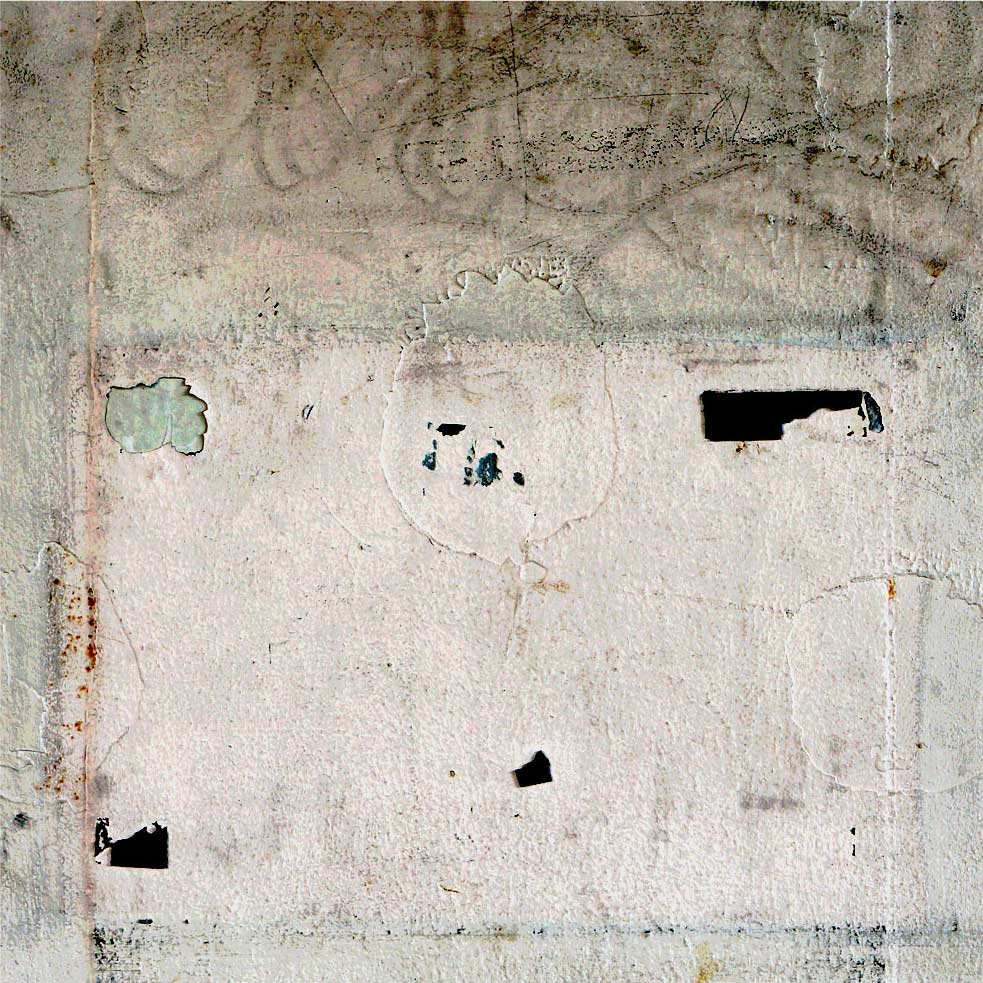
Little Cuba At Jackson, © Iskra Johnson
Little Cuba at Jackson © Iskra johnson

And if the walker has no home but a shopping cart and a space under the Dearborn exit ramp, the walker in the city is a “vagrant,” a word that seems like it should come from the same root as “vacant” but does not.

This person asleep unconscionably at 1 PM under loud traffic is also a thief, stealing a sense of comfort and safety from the other walker, the one with the cellphone held up looking anxiously sideways and sniffing: homelessness doesn’t smell so good.

The support system for the first walker is an entire technopolis devoted to the instant global image stream and the fine distinctions aficionados can make within the pungent hashtags of #ruinporn, #beautifuldecay, and #grime_nation. The support for the second walker is thin, but offers here and there the generosity of climate, a spare dollar, free food or a freestanding and temporarily private toilet.

I don’t know if the 13 people sleeping between the Chinese columns on Tuesday requested spray paint embellishment for their living room. Statistics from a study commissioned by the city of Seattle indicate that the taggers at large are predominantly suburban, male, white, 18-35 years old and focused on “fame, rebellion, self-expression and power.” (I would love to have seen the motivational intake interview form….). Unlikely they are thinking of either the wallpaper designs for those who dream in the daytime or the feelings of the muralist who’s cartouche has been deformed by a crudely exploding B.
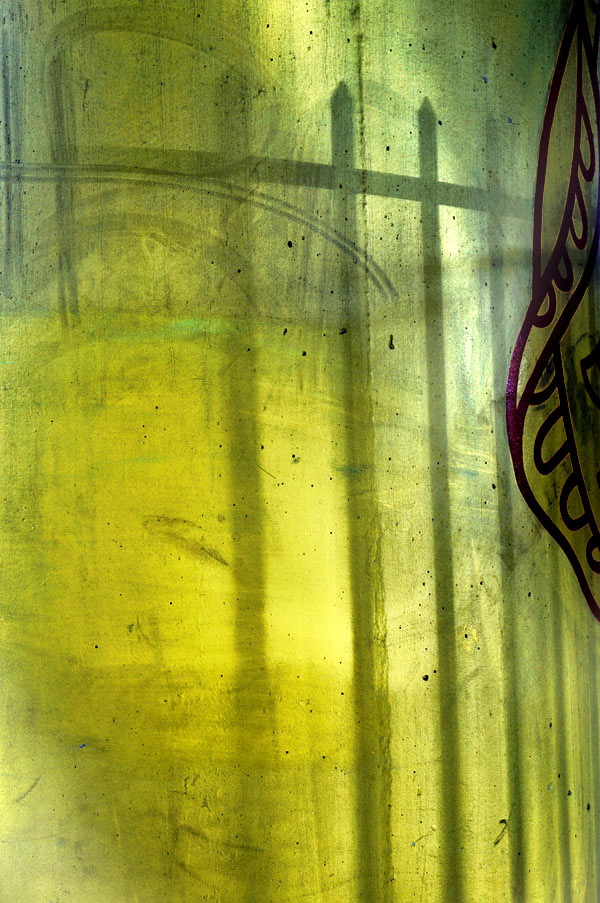
The Pillar © Iskra Johnson

The emotional effect of graffiti is to double down on alienation. Who owns what? Let’s scream about it. Who owns the view? the conjunction of this and that? The way the sky falls in the corner by the blackberry vine and the man in the white apron comes out to say: We saved the grass for the dogs. Much easier to clean up after them on grass. But I wouldn’t walk over there.

What is appropriation? Doesn’t the person in Armani on his way to a meeting observe the same view as the boy with the spray can? and the guy who just lost his shopping cart? Isn’t the view still a horizon with clouds and a mountain? Maybe subtle colors are a bit brighter under the spraypaint huff-haze, and maybe duller after MD 20/20 than a good martini. All sunsets, they say, were born under the influence, and are the eternal signpost of happy hour.

Who owns happiness, that one dazzling glimpse with the clocktower, the bay, the mountains, and the remnant Beaux Arts hotels framing it all in luminous terra cotta?
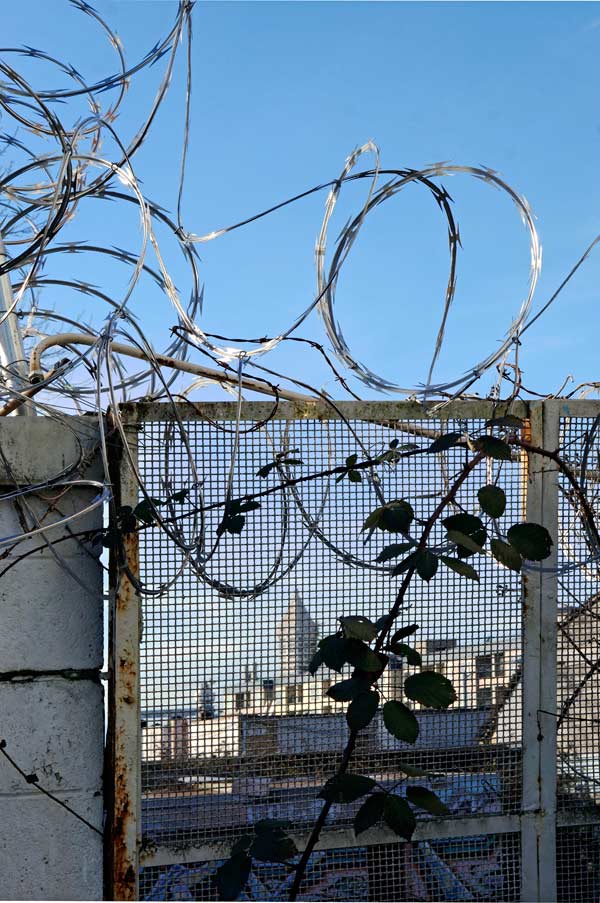
The Beautiful View © Iskra Johnson
The View, Just Before Happy Hour, © Iskra Johnson

I have been away for a long time. Returning to the ID, without illusion, but with memory burned in from years spent on these streets as a student of John Leong I can tell something is off. It’s like the soul of this place collapsed and I can’t put my finger on it. There was always a grace to Chinatown, visible in the layers of history carefully worn and layered, an untranslatable telling of settlement, abandonment and return. It was stoic, and the pain of forced location and relocation showed in its own mute language of architecture and a depth of surface. Every detail of Chinatown declared: this is a place. Now as I walk down Jackson I see a war going on.

THE BEST WAY: Paint the Entire Wall:

Repaint the entire wall, or paint up to 7 feet high (making a straight line across the top) with a color that matches the wall. This leaves no trace of graffiti and does not draw the attention of the vandals. This method is 10 times more effective than patching.

 THE NEXT BEST WAY: Paint in Patches:

When it is not possible to paint the entire wall, use a closely matched color blocked over the graffiti in neat, square shapes. The closer the color match, the more effective it is in preventing further vandalism. Square up your work. Covering over the graffiti in the shape of a square makes the paint-out less noticeable. Clean up drips and spills before moving on to the next site.

                                                        –Seattle City Guide to graffiti removal

What you see now is acres of rectangles painted up to 7 feet and a whole lotta inset squares and no drips: the rude face of the war between civic pride, preservation and vandalism. In this exhausting cycle of erasure, insult and re-rasure, a furious energy expends until the buildings seem hollowed out to mere partitions, taped and leaning, and waiting for the next assault.

The influx of medical marijuana shops and massage parlors in Little Saigon, increased homeless encampments and gang activity has not helped matters. The community has yet to recover from the shock last summer of the apparently ‘accidental’ murder of Donnie Chin, and a melancholy hangs in the air.

In the face of this, graffiti’s assault seems even more gratuitous. It shows no distinction between its targets, running heedlessly over hand carved stonework and centuries-old brick, stop signs, storefronts, and meticulous community murals. It’s random drag race path obscures the city beneath it, built of the people living and working and vesting in their community, and not just passing through.

In Seattle’s apologetic conversations of social justice, where the harshest tag is “privilege,” and its lack confers instant righteousness, the current waves of graffiti look suspect. Mostly lacking in any obvious skill, and technically falling more into the category of tagging than graffiti, the markings come across as a form of entitlement imposed by outsiders that degrades the integrity of place and history. You could see it as a reverse mirror image of gentrification. The latter of course is better-funded, and the city does not criminalize it. The ID teeters on the edge of gentrification, it holds its breath, and the City seems to look away. As Thanh Tan points out in her piece in the Seattle Times, there is also shared responsibility, and a cultural resistance in areas like Little Saigon to reaching out to local government and building the processes that will help the community thrive.

"Do Not Block" Chinatown graffiti © Iskra

Cherry Blossoms wall graffiti in Chinatown/ID Seattle, © Iskra Johnson
Springtime in Chinatown, authorship variable……

As I researched local reporting on development and gentrification in the ID and elsewhere I made a point of reading the comments. The pattern there struck me as not unlike tagging: relentless, dismissive, readily reduced to this exchange:

Something unique/precious/ethnic/historical

is being threatened by:

rich people/white people/brown people/young people/tech people/money itself.

No matter how impassioned the argument for preservation of the former, the comments devolve to some version of this: Before there were Chinese people here there were black people here and before there were black people there were poor Italians and before there were Italians it was Indians so get over it: change happens. What goes missing is any meaningful conversation about value and choice, and the irreplaceability of what is sacrificed to change. The patina and design of old brick and terracotta is not just a gloss for a tourist postcard. Patina is not “just” “surface” it is the record of the lives people lead. The architecture of place is composed of  intangibles that are rarely found on the new condo punchlist.

Like the Beaux Arts buildings swathed in scaffolds and gauze I am watching the horizon and holding my breath. Meanwhile, I’m also gathering text messages, and re-coding the street. See more from Text Messages, visual journal notes and sources of inspiration on my Instagram.
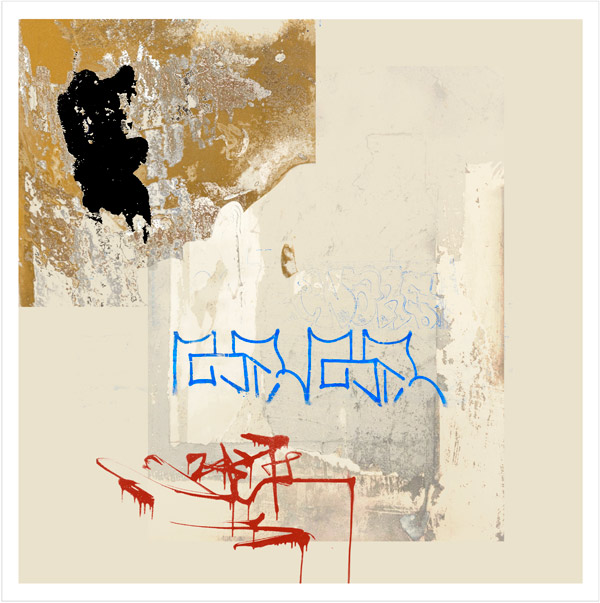
Stele, Archival Pigment Print by Iskra
Stele 1: Reclamation/Appropriation, Archival Pigment Print, 16×16 inches, © Iskra Johnson


In reading about what is going on in the ID, thinking about the pace of change in Seattle and the themes of gentrification and appropriation I came across Arcade’s fascinating issue on Art and Data Culture. This series of articles looks at artists working backwards from data points to create visual representation of personal emotion and place, and it is an extraordinary collection. This piece in particular struck me. I would be very curious to see the idea applied as an emotional mapping of graffiti:

Aleph of Emotions, a project by Singapore-based creative technologist Mithru Vigneshwara, lets us see the world around us through the lens of feelings attached to places. According to writer Jorge Luis Borges, the Aleph is a point in the universe that allows anyone who looks into it to see everything else in the universe with perfect clarity. Vigneshwara uses the Aleph as a metaphor for an infinite archive of emotions. In this work, emotions are derived from geocoded Twitter messages, mapped to their corresponding locations and made accessible through a camera-like device. The user can point the device in any direction, and the viewfinder screen will display a visualization of emotions attached to that place. Aleph of Emotions is compelling in that it links the physical environment to the emotions of others, which we can discover experientially as we move through the world. It contextualizes information that was previously abstract, revealing a hidden truth about the places around us. 

Filed Under: Architecture & Sense of Place Tagged With: appropriation, beautiful decay, chinatown, gentrification, graffiti, little saigon, Seattle ID, tagging, urban decay

Leave a Reply Cancel reply

Your email address will not be published. Required fields are marked *

This site uses Akismet to reduce spam. Learn how your comment data is processed.

Join Iskra’s Mailing List

Don't miss a thing! Subscribe to receive show announcements, first peek at new work and my semi-monthly blog by email. I primarily use the blog for news and updates but by signing up you will also receive the occasional newsletter and special offers for items in my shop.

Iskra Fine Art Blog

the creative process | conversations with artists | the contemplative impulse in art

Instagram

The photography show opening Friday, October 9th a The photography show opening Friday, October 9th at Slip Gallery is curated by my friend and fellow photographer, Scott Wipperman. This seemed like a good time to share his work and the story of our friendship on the road. Half the photographs are his and half are mine. This is an excerpt, and you can read the rest of it on my blog, see link tree in bio:

One of the rarest gifts in the life of an artist is finding a creative muse: someone who truly sees your work, and better yet, has a similar vision that is just enough different that you can collaborate without competing. In the often solitary studio life these connections can be difficult to find, but during pandemic, Instagram brought a new creative companion into my life. I do not know who started following who first. But in May 2020 I found myself sharing instant messages with a photographer working under the name “Concrete spaces“— a handle that immediately piqued my interest. Concrete has been one of my obsessions for years. Miraculously, there was someone out there who understood why I was working on a book called Parking Lot Floors Of North America. . .

©️Scott Wippermann

©️Scott Wippermann

©️Scott Wippermann

©️Scott Wippermann

©️Iskra Johnson

©️Iskra Johnson

©️Iskra Johnson

©️Scott Wippermann

©️Iskra Johnson
I am excited to be part of a show opening Friday, I am excited to be part of a show opening Friday, October 9th featuring eight Seattle  photographers and curated by Scott Wipperman @concretespaces at Slip Gallery. The theme of this show is complex and interesting: Intimate Structures. How the human body and human emotions connect with the built environment. And how the structures in our environment shape our lives, our relationships, and our possibilities. I will be showing industrial landscape as well as six pieces from the series “Immersions” based on tableaus of human relationship captured at Seattle’s waterlines. A diving platform is a stage, and the summer season a riveting drama of ever-shifting players. Most of these pieces have not been shown before.

I’m fascinated by the work of the seven other photographers, each one approaching the theme of the show from a completely different perspective, using both traditional photography and contemporary experimental techniques. Alienation, sublimation, meditation, connection:
Annie Regerson
Dimitri Wessendorf
Gillian Peckham
Iskra Johnson
Janis Mathieson
Mack Greene
Nina Bolger
Scott Wipperman
I hope to see you there!

The runs until the end of October. 
Thursday – Friday: 1:00 PM – 6:00 PM
Saturday – Sunday: 1:00 PM – 4:00 PM

Slip Gallery
2301 First Avenue in Belltown

Two Divers ©️Iskra Johnson

Guardian ©️Iskra Johnson
Morning Pages: Doors The first thing I saw when I Morning Pages: Doors

The first thing I saw when I woke up this morning was shadows on a door. Last night, I dreamt of an old building, one I have visited in dreams for years. It is a co-op apartment in some imaginary Canadian city, on a long steep hill above which are what appear to be the Swiss Alps. It was built in the early 1900’s and has grand staircases and balconies, huge rooms, bronze doorknobs and leaded glass windows. In my dreams, I interview with the board, I make an offer and I even buy an apartment— and then suddenly the door of my new home opens into a parking lot or a garage or someone else’s basement and I wake up and check my bank account, mystified by the power of this particular place, and how opening a door universally signals a new chapter in the story. 

Doors and windows are the most metaphoric parts of architecture. 100 years ago builders understood the attention they deserved. Now I live in a city where we have torn down historic churches, dumped the stained glass into a landfill and replaced these devotional structures with stacked box apartment complexes covered with Hardie Plank. I’m watching million dollar houses go up in my neighborhood with the cheapest vinyl windows from Home Depot, no eaves and often no roof— simply a flat lid to seal the box — and no trim at all. It is architecture as expedience, and it degrades the experience of how we see and experience the commons, and our human values, because, as Churchill noted, “We shape our buildings and afterward our buildings shape us.” 

We don’t look twice at these new houses, whereas I can look at this particular building somewhere in England for hours. Whoever built this wall took great care. They used the art of subtraction to add rather than to diminish. The vast flat wall of stone, the curved lintels, make the windows and doors speak. The doors and windows are not grand, but curiously condensed. They are portals through which one must squeeze with effort, which makes a person pause, and wonder. Later, they may find themselves dreaming of what is behind the walls.
Westminster Mall deconstruction project. I had to Westminster Mall deconstruction project. I had to go to the Department of Licensing this morning and stand in line and it gave me an opportunity to watch the Sears building come down. Sears was the last place left in the Seattle area where you could buy a vacuum cleaner from a man wearing creased polyester slacks, a tucked in shirt and an engraved name badge making a commission on the number of vacuum cleaner bags you bought to go with the Electrolux. I fondly remember my conversations about uprights versus canisters. This building is where I bought a snowsuit for a child that just barely fit me the day we had the epic snow and I was caught unprepared. I walked a mile on ice to get to Sears and then left looking like a nine year-old robot trying to get my knees to bend and move swaddled in 4 inches of poly blend padding. But I was warm! I doubt that anything that goes up this year in the Westminster Mall will last as long as Sears did. And there will be no catalogue unless I create one.
Excited tonight for the opening of Art and Steel a Excited tonight for the opening of Art and Steel at Youngstown Cultural Center! This is primarily a painting show from the Plein Air Watercolorists Association of Seattle (although I don’t think any of us were actually painting inside the mill on our tour!) I have been included as a photographer and mixed media artist, see last image in carousel, “Glide.” 

An exhibition of paintings telling the story of steel fabrication at NUCOR mill, hosted by Delridge Neighborhood Dev Association.

Friday, September 18 | 6:30 PM - 9:00 PM
Join us for a special evening celebrating art, industry, and community.

This exhibition features original paintings that tell the story of steel fabrication at the NUCOR Mill, presented by the Delridge Neighborhood Development Association (DNDA).
The evening will include a panel discussion, light refreshments, and an opportunity to learn more about the intersection of art, labor, and local history.

All donations made during the event will be matched and directed to DNDA’s Art Education Programs, helping support creative opportunities in our community.
Friday was my birthday. 9.11 is a day of remembran Friday was my birthday. 9.11 is a day of remembrance and national tragedy, and it seems bizarre to claim some kind of importance for having been being born on that day in the context of the event. 

Several days after, I allow myself reflection on the passage of time. This is me 15 years ago, with my Canon Powershot, which offers an astonishing naive pre-Cabrian 6 Mb image. It was much more kind than today's 24 MP iPhone, which not only captures the older me but turns that version into a character from Shakespeare with hi-def Bertrand Russel thought lines above my eyebrows and unforgiving evidence of allergies and time. 

On reflection I realize that 2011 was a very good year. I am going to allow myself to be that person for the month, and remember what that was like. The love of my life from the 8th grade had come to stay with me that summer. He took terrible photos of me that I now realize were not so bad. 99% of of the corrosive social media influences had not been invented yet. Women over whatever age was deemed desirable were not subjected to an ad every minute telling us that a new part of our face or body had gone south, and offering us a (discounted! on sale! watch the entire 30 minute video!!) $165 remedy on a monthly subscription to fix it. 

Now every day I look at the thinking and brooding lines above my eyebrows (which are also the lines caused by considering how funny some things can be even when crying) and ask myself what Bertrand Russel would say. If you are too young to know that name, AI is your ever-friend and will tell you how you too can become a "towering British philosopher, logician, mathematician, and social critic" and also how to fix those lines that come from considering things with your face. 

I think my romance with the iPhone is coming to a partial close. I want to go back to the idea of “glass.” It costs serious wages. It is made by Germans— Lately, (subtract the umlaut) Sony, the wizards of sand and heat and bending light to high high focus. I need to return to optics, f-stop, aperture, focal length— words that require frowning. 61 megapixels seems like the bare minimum. There is no cosmetic cure to being a lens-based artist:))

Featured Posts

  • Book Launch! The Water Tower Project from Iskra Fine Art
  • How to Purchase Artwork from Iskra Fine Art
  • About This Blog
  • New Directions in Contemplative Art: Conversations with Artists
  • What is a Transfer Print? (Artist Statement)

Categories

  • Abstract Calligraphy
  • Architecture & Sense of Place
    • Construction/Reconstruction
    • The Alaska Way Viaduct
    • The Water Tower Project
  • Art Reviews
  • Artist Studio Visits
    • The Mystic Muse: Artists Working in the Contemplative Traditions
  • Botanical Art
    • Botanical Art Cards
  • Collage
    • Digital Collage
  • Commissioned Art
  • Drawing
  • Essays
    • Object Lessons: Essays and images inspired by "A History of the World in 100 Objects."
  • Iskra Shows, Upcoming and Past
  • Iskra Sketchbooks & Journals
  • Living With Art
  • Meditation & Buddhism
  • Mixed Media
  • Painting
  • Photocollage
  • Photography
    • American West Landscape Photography
  • Print Sale
  • Prints
    • Transfer Prints
  • Seattle Iconic Landscape Prints
  • Social Media for Artists
    • The 100 Day Projects
  • The Garden
    • The Gardener's Almanac of Irreproducible Phenomena
  • The Spiritual in Art
  • Travel
    • Road Trips
  • Uncategorized

Archives

Search

Connect on Facebook

Iskra Fine Art Facebook Page

Creative Inspiration

  • Alternative Photography
  • An Artist's Retreat
  • Anonymous Chinese Textile Genius: Moo Won
  • Chocolate Is A Verb
  • Contemplative Art Process: Danila Rumold
  • Eva Isaksen
  • Old Industrial Japan
  • The Altered Page
  • The Heart Sutra Loop
  • The Patra Passage

Galleries for Contemplative Art

  • ArtXchange Gallery
  • Seattle Asian Art Museum

Links

  • CollageArt.org
  • Iskra at SAM Gallery
  • Iskra Fine Art on Houzz
  • Seattle Art Museum Blog
  • Seattle Artist League
  • Seattle Print Arts
  • Seeing Fresh: Contemplative Photography
  • The Painter's Keys

What I'm Reading: Online Magazines and Books I Love

  • 16 mi.
  • Essays by David Whyte
  • Evening Will Come: Poetry
  • Hyperallergic
  • Painter's Table
  • Shu: Reinventing Books in Contemporary Chinese Art
  • Streetsy
  • The Original Van Gogh's Ear Anthology
  • Tricycle Magazine
  • Unincorporated Persons in the Late Honda Dynasty
  • Vanguard

Let’s Connect

  • Contact Iskra
  • How to purchase artwork
  • Iskra Fine Art Blog : The creative process, conversations with artists, the contemplative impulse in art
  • Facebook
  • Instagram
  • Pinterest
  • Twitter

All Images Copyright © 2026  Iskra Johnson · Site by LND · WordPress