Iskra Fine Art

  • Prints
    • The Tarmac Residency: Airport Landscapes
    • Immersions | At The Shore
    • ColorBath: Images of the Harbor
    • The Floating World
    • Industrial Strength | Urban Industrial Landscape
    • The Scaffold
    • Industrial Pastorale: The Rural/Urban Landscape
    • Botanical Prints | The Natural World
    • Construction | Reconstruction : Urban Landscape
    • Infrastructure
  • Drawings
    • Pencil Drawings: Pandemic Pause
    • Drawings in Dust 1
    • Signs & Symbols (Archive)
    • Botanical Drawings (Archive)
  • Photography
    • Nucor Steel Industrial Landscape Photography
    • New Work Inspired by England
    • Seattle Waterfront Park Photography
    • Architectural Photography | Construction Sites
    • American West Landscape Photography
  • Mixed Media
    • Modern Botanical | Mixed Media on Plaster
    • From the Sea | Water Paintings
    • Sleep Studies
  • Wabi Sabi Abstract
    • Minimalist Modern
    • Ink Painting Abstractions
  • Shop
    • The Water Tower Project
  • About
    • Contact
  • Blog
You are here: Home / The Spiritual in Art / Art & Solitude

Art & Solitude

May 25, 2014 by Iskra 2 Comments


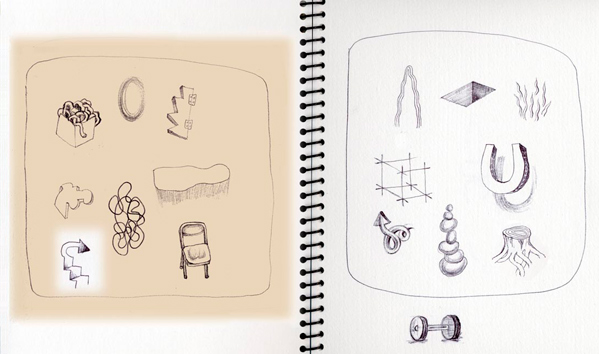
GroupTherapy(DayOne)
Group Therapy, Day One, Sketchbook, © Iskra Johnson

“Here in my isolation I can grow stronger. Poetry seems to come of itself, without effort, and I need only let myself dream a little while painting to suggest it.” ~ Paul Gauguin

“Because she favours solitude and indwelling, an artist can live a significantly more claustrophobic life that she had ever intended.” ~ Eric Maisel

“The ecstatic state of wholeness is bound to be transient because it has no part in the total pattern of ‘adaptation through maladaptation’ which is characteristic of our species… the hunger of imagination, the desire and pursuit of the whole, take origin from the realization that something is missing, from awareness of incompleteness.”

― Anthony Storr, Solitude: A Return to the Self

Sometimes I look back on all of my relationships and am tempted to conclude that the longest and most powerful one, my “primary relationship” has been with solitude itself. It is in the accumulated years of a life alone in a room with work, or in the fields or the streets, wandering, that I have always felt most “my self.” Alone, there is no one to entertain or impress –– only impressions themselves and the gathering of them. If I am lucky there is not even a gatherer, just the verb itself, and some editing hand does the work without my being aware of paying attention, resulting in a collected sense of “coming to my self” ie. experiencing “meaning.”

For an artist the product of this inner process often lives intangibly for a long time. It’s a glimmer, a felt-sense of possibility. Hammering it out into a Real Thing and accepting the distance between promise and actuality can mean a long-distance swim through the slough of doubt, with no wetsuit and no cage to ward off sharks. This is where the fabled suffering of the artist comes in, and it seems to be what most fascinates therapists, analysts, and the people who pay them. The tension I feel between public and private, inner state and outer product, has lately been exacerbated by social media, and the paradox that while one is completely alone in a room there is a potential audience of millions sitting just on the other side of the Device. Others are there, yet not-there. Silence takes on new shapes, as does doubt.
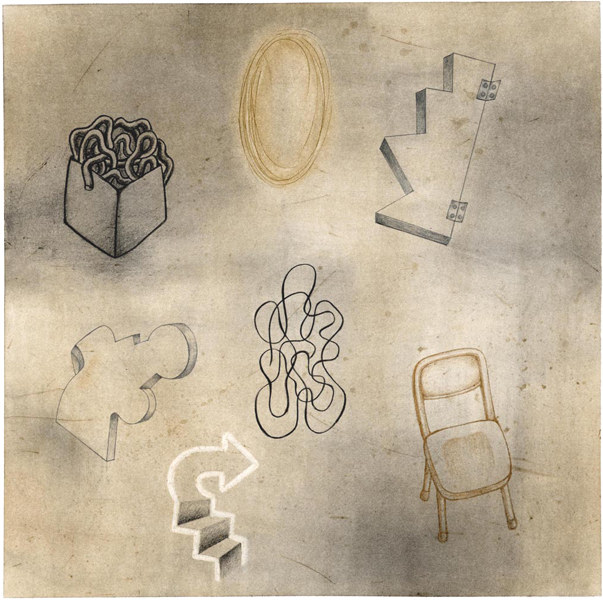
Group Encounter, mixed media drawing
Group Encounter, 10″ x 10″, mixed media on paper © Iskra Johnson

One can always use back-up on irresolvable dilemmas, so I immediately said yes when recently invited to a lecture on “Solitude and Creativity.” The lecture kicked off a weekend sponsored by the Seattle Psychoanalytic Society on “Solitude and Relatedness in Art and Life.” It seemed they had custom made this lecture for me! I conveniently forgot, as I often do when buying tickets to such things, the phenomenon of cultural narcolepsy. It’s the four-foot rule: if a cultural authority is more than four feet away from me and speaking in a darkened room, I fall asleep. Which I promptly did on this occasion, soothed by the comfortable seats and the hush of academic politeness in the auditorium of the Frye Museum.

The hush was abruptly shattered by what will always in the future be spoken of as The Outburst. Lights up, question and answer period murmuring and slow….. references to the speaker’s previous books…. the cost of isolation….. the danger of delusion, and anecdotes of famous artists. Out of nowhere comes the wild man, shouting, half-leaping from his seat with the power of each exclamation point. “I don’t see your face!” he began, jabbing his finger in the air in the direction of the woman on stage. (We can all agree on this first sentence, and this only.) From here unspooled a passionately escalating rant of about three minutes, during which the audience collectively clenched the armrests, and security hovered in the wings. Did the man have a gun? How to deal? Will he take over the entire discussion, like a Trotskyite at a PTA meeting? Does he have cohorts? The speaker on stage did not acknowledge one word of his commentary, and turned crisply to the next questioner. Everyone exhaled, and I started taking notes. Because what he said, or what I thought he said was worth the price of a two hour nap.

But first, what various companions in the audience said he said:

I don’t know, I have no idea what he said, he was so angry, it seemed like years of anger, and it seemed very personal. I was afraid.

He was just crazy. He seemed to think she was his mother.

He kept saying he couldn’t see her face, and he meant that in daily life, in modern life, we don’t see each other. He was talking about the alienation and loneliness of modern life.

Whatever he was talking about, it was completely off-topic.

This being a psycholanalytic gathering we must accept that projection happens, and is perhaps the only currency of “reality.” I’ll accept that my own memory and notes were complete projection. But I heard the man say, “I don’t see your face, I see the color and the shape. But I do not know who you are…” and from there the increasingly adamant tirade addressed the fallacy of her entire premise, that there was a person alone in a studio “being alone” and that there was some kind of suffering. To him there was no alone, there was no person being alone, there was in fact just the unconditional and unidentified: the shape, the color, the abstraction. And this resulted in products (called “art”) that reflected this state, a valuable and irreplaceable state that can only be accessed in solitude. His perspective was not unlike that of a spiritual teacher who chides the student asking about how they will know when they have achieved enlightenment. The answer is likely to blow up the idea of a ‘self’ even being aware of achieving a ‘thing’ called enlightenment, and the student will feel both shamed and annoyed at how off-topic the answer was.

Truly, I don’t go into my studio hoping to brood or do heroic battle with loneliness. I would like to keep my equanimity and both of my ears nicely attached to my head. I go, however, hoping to step into the unconditional, in some unexpected form. Some artwork is the scaffold, the steps to getting to that state, and other work is a report back from direct experience. If we are lucky, the report gives the viewer a glimpse. No face, no name, no limits, just being there. When I see that kind of work I am very hopeful, and transfixed.

It is quite possible the man was off-topic, that he was delusional, ‘mad’ in both senses, yet what he said seemed to me quite wonderful. If anybody was there that night who would like to share their memory of The Outburst, what was said, and what it meant to you, I will be very curious. I am happy to trade projections with you any time.
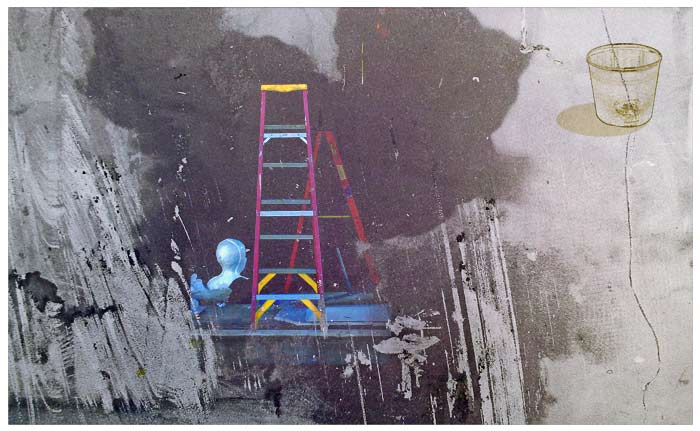
Ladder-&-Wall-Photocollage
Ladder & Wall, mixed media transfer print © Iskra Johnson

A few of my favorite writers on solitude, meaning and art:

Anthony Storr, Solitude, a Return to the Self

James Hillman, The Soul’s Code

 Eric Maisel, Coaching the Artist Within

And a video interview with the inimitable Agnes Martin

Filed Under: The Spiritual in Art Tagged With: art & solitude, being alone, eric maisel, james hillman, quotes about solitude

Comments

  1. tom says

    May 26, 2014 at 3:18 am

    If there isn’t actually a place called the slough of doubt, there should be, right here, in the land of deception pass and point no point.
    Speaking of which, what is the point, when there is no audience, real or virtual? Alone in the studio, refining combinations of movement, shape, surprise, certainty. Seeking honesty.
    When I believe I have translated the clamor of influences into a message of ringing clarity, I put it in a drawer in the flat file. The current continues to flow, and the tangle of voices needs to be sorted out yet again. No time to linger over the last pretty package. And it would be OK if no one ever saw it, except that one whiny little voice craves affirmation, and always needs to hear that the whole business is worthwhile. Tell me again that What I’m doing matters! And that I’m doing it especially well.
    On that note, Iskra, do you still have that ladder print?

    Reply
  2. tom says

    May 26, 2014 at 3:19 am

    “Why talk when you can paint?”
    Milton Avery

    Reply

Leave a Reply Cancel reply

Your email address will not be published. Required fields are marked *

This site uses Akismet to reduce spam. Learn how your comment data is processed.

Join Iskra’s Mailing List

Don't miss a thing! Subscribe to receive show announcements, first peek at new work and my semi-monthly blog by email. I primarily use the blog for news and updates but by signing up you will also receive the occasional newsletter and special offers for items in my shop.

Iskra Fine Art Blog

the creative process | conversations with artists | the contemplative impulse in art

Instagram

The photography show opening Friday, October 9th a The photography show opening Friday, October 9th at Slip Gallery is curated by my friend and fellow photographer, Scott Wipperman. This seemed like a good time to share his work and the story of our friendship on the road. Half the photographs are his and half are mine. This is an excerpt, and you can read the rest of it on my blog, see link tree in bio:

One of the rarest gifts in the life of an artist is finding a creative muse: someone who truly sees your work, and better yet, has a similar vision that is just enough different that you can collaborate without competing. In the often solitary studio life these connections can be difficult to find, but during pandemic, Instagram brought a new creative companion into my life. I do not know who started following who first. But in May 2020 I found myself sharing instant messages with a photographer working under the name “Concrete spaces“— a handle that immediately piqued my interest. Concrete has been one of my obsessions for years. Miraculously, there was someone out there who understood why I was working on a book called Parking Lot Floors Of North America. . .

©️Scott Wippermann

©️Scott Wippermann

©️Scott Wippermann

©️Scott Wippermann

©️Iskra Johnson

©️Iskra Johnson

©️Iskra Johnson

©️Scott Wippermann

©️Iskra Johnson
I am excited to be part of a show opening Friday, I am excited to be part of a show opening Friday, October 9th featuring eight Seattle  photographers and curated by Scott Wipperman @concretespaces at Slip Gallery. The theme of this show is complex and interesting: Intimate Structures. How the human body and human emotions connect with the built environment. And how the structures in our environment shape our lives, our relationships, and our possibilities. I will be showing industrial landscape as well as six pieces from the series “Immersions” based on tableaus of human relationship captured at Seattle’s waterlines. A diving platform is a stage, and the summer season a riveting drama of ever-shifting players. Most of these pieces have not been shown before.

I’m fascinated by the work of the seven other photographers, each one approaching the theme of the show from a completely different perspective, using both traditional photography and contemporary experimental techniques. Alienation, sublimation, meditation, connection:
Annie Regerson
Dimitri Wessendorf
Gillian Peckham
Iskra Johnson
Janis Mathieson
Mack Greene
Nina Bolger
Scott Wipperman
I hope to see you there!

The runs until the end of October. 
Thursday – Friday: 1:00 PM – 6:00 PM
Saturday – Sunday: 1:00 PM – 4:00 PM

Slip Gallery
2301 First Avenue in Belltown

Two Divers ©️Iskra Johnson

Guardian ©️Iskra Johnson
Morning Pages: Doors The first thing I saw when I Morning Pages: Doors

The first thing I saw when I woke up this morning was shadows on a door. Last night, I dreamt of an old building, one I have visited in dreams for years. It is a co-op apartment in some imaginary Canadian city, on a long steep hill above which are what appear to be the Swiss Alps. It was built in the early 1900’s and has grand staircases and balconies, huge rooms, bronze doorknobs and leaded glass windows. In my dreams, I interview with the board, I make an offer and I even buy an apartment— and then suddenly the door of my new home opens into a parking lot or a garage or someone else’s basement and I wake up and check my bank account, mystified by the power of this particular place, and how opening a door universally signals a new chapter in the story. 

Doors and windows are the most metaphoric parts of architecture. 100 years ago builders understood the attention they deserved. Now I live in a city where we have torn down historic churches, dumped the stained glass into a landfill and replaced these devotional structures with stacked box apartment complexes covered with Hardie Plank. I’m watching million dollar houses go up in my neighborhood with the cheapest vinyl windows from Home Depot, no eaves and often no roof— simply a flat lid to seal the box — and no trim at all. It is architecture as expedience, and it degrades the experience of how we see and experience the commons, and our human values, because, as Churchill noted, “We shape our buildings and afterward our buildings shape us.” 

We don’t look twice at these new houses, whereas I can look at this particular building somewhere in England for hours. Whoever built this wall took great care. They used the art of subtraction to add rather than to diminish. The vast flat wall of stone, the curved lintels, make the windows and doors speak. The doors and windows are not grand, but curiously condensed. They are portals through which one must squeeze with effort, which makes a person pause, and wonder. Later, they may find themselves dreaming of what is behind the walls.
Westminster Mall deconstruction project. I had to Westminster Mall deconstruction project. I had to go to the Department of Licensing this morning and stand in line and it gave me an opportunity to watch the Sears building come down. Sears was the last place left in the Seattle area where you could buy a vacuum cleaner from a man wearing creased polyester slacks, a tucked in shirt and an engraved name badge making a commission on the number of vacuum cleaner bags you bought to go with the Electrolux. I fondly remember my conversations about uprights versus canisters. This building is where I bought a snowsuit for a child that just barely fit me the day we had the epic snow and I was caught unprepared. I walked a mile on ice to get to Sears and then left looking like a nine year-old robot trying to get my knees to bend and move swaddled in 4 inches of poly blend padding. But I was warm! I doubt that anything that goes up this year in the Westminster Mall will last as long as Sears did. And there will be no catalogue unless I create one.
Excited tonight for the opening of Art and Steel a Excited tonight for the opening of Art and Steel at Youngstown Cultural Center! This is primarily a painting show from the Plein Air Watercolorists Association of Seattle (although I don’t think any of us were actually painting inside the mill on our tour!) I have been included as a photographer and mixed media artist, see last image in carousel, “Glide.” 

An exhibition of paintings telling the story of steel fabrication at NUCOR mill, hosted by Delridge Neighborhood Dev Association.

Friday, September 18 | 6:30 PM - 9:00 PM
Join us for a special evening celebrating art, industry, and community.

This exhibition features original paintings that tell the story of steel fabrication at the NUCOR Mill, presented by the Delridge Neighborhood Development Association (DNDA).
The evening will include a panel discussion, light refreshments, and an opportunity to learn more about the intersection of art, labor, and local history.

All donations made during the event will be matched and directed to DNDA’s Art Education Programs, helping support creative opportunities in our community.
Friday was my birthday. 9.11 is a day of remembran Friday was my birthday. 9.11 is a day of remembrance and national tragedy, and it seems bizarre to claim some kind of importance for having been being born on that day in the context of the event. 

Several days after, I allow myself reflection on the passage of time. This is me 15 years ago, with my Canon Powershot, which offers an astonishing naive pre-Cabrian 6 Mb image. It was much more kind than today's 24 MP iPhone, which not only captures the older me but turns that version into a character from Shakespeare with hi-def Bertrand Russel thought lines above my eyebrows and unforgiving evidence of allergies and time. 

On reflection I realize that 2011 was a very good year. I am going to allow myself to be that person for the month, and remember what that was like. The love of my life from the 8th grade had come to stay with me that summer. He took terrible photos of me that I now realize were not so bad. 99% of of the corrosive social media influences had not been invented yet. Women over whatever age was deemed desirable were not subjected to an ad every minute telling us that a new part of our face or body had gone south, and offering us a (discounted! on sale! watch the entire 30 minute video!!) $165 remedy on a monthly subscription to fix it. 

Now every day I look at the thinking and brooding lines above my eyebrows (which are also the lines caused by considering how funny some things can be even when crying) and ask myself what Bertrand Russel would say. If you are too young to know that name, AI is your ever-friend and will tell you how you too can become a "towering British philosopher, logician, mathematician, and social critic" and also how to fix those lines that come from considering things with your face. 

I think my romance with the iPhone is coming to a partial close. I want to go back to the idea of “glass.” It costs serious wages. It is made by Germans— Lately, (subtract the umlaut) Sony, the wizards of sand and heat and bending light to high high focus. I need to return to optics, f-stop, aperture, focal length— words that require frowning. 61 megapixels seems like the bare minimum. There is no cosmetic cure to being a lens-based artist:))

Featured Posts

  • Book Launch! The Water Tower Project from Iskra Fine Art
  • How to Purchase Artwork from Iskra Fine Art
  • About This Blog
  • New Directions in Contemplative Art: Conversations with Artists
  • What is a Transfer Print? (Artist Statement)

Categories

  • Abstract Calligraphy
  • Architecture & Sense of Place
    • Construction/Reconstruction
    • The Alaska Way Viaduct
    • The Water Tower Project
  • Art Reviews
  • Artist Studio Visits
    • The Mystic Muse: Artists Working in the Contemplative Traditions
  • Botanical Art
    • Botanical Art Cards
  • Collage
    • Digital Collage
  • Commissioned Art
  • Drawing
  • Essays
    • Object Lessons: Essays and images inspired by "A History of the World in 100 Objects."
  • Iskra Shows, Upcoming and Past
  • Iskra Sketchbooks & Journals
  • Living With Art
  • Meditation & Buddhism
  • Mixed Media
  • Painting
  • Photocollage
  • Photography
    • American West Landscape Photography
  • Print Sale
  • Prints
    • Transfer Prints
  • Seattle Iconic Landscape Prints
  • Social Media for Artists
    • The 100 Day Projects
  • The Garden
    • The Gardener's Almanac of Irreproducible Phenomena
  • The Spiritual in Art
  • Travel
    • Road Trips
  • Uncategorized

Archives

Search

Connect on Facebook

Iskra Fine Art Facebook Page

Creative Inspiration

  • Alternative Photography
  • An Artist's Retreat
  • Anonymous Chinese Textile Genius: Moo Won
  • Chocolate Is A Verb
  • Contemplative Art Process: Danila Rumold
  • Eva Isaksen
  • Old Industrial Japan
  • The Altered Page
  • The Heart Sutra Loop
  • The Patra Passage

Galleries for Contemplative Art

  • ArtXchange Gallery
  • Seattle Asian Art Museum

Links

  • CollageArt.org
  • Iskra at SAM Gallery
  • Iskra Fine Art on Houzz
  • Seattle Art Museum Blog
  • Seattle Artist League
  • Seattle Print Arts
  • Seeing Fresh: Contemplative Photography
  • The Painter's Keys

What I'm Reading: Online Magazines and Books I Love

  • 16 mi.
  • Essays by David Whyte
  • Evening Will Come: Poetry
  • Hyperallergic
  • Painter's Table
  • Shu: Reinventing Books in Contemporary Chinese Art
  • Streetsy
  • The Original Van Gogh's Ear Anthology
  • Tricycle Magazine
  • Unincorporated Persons in the Late Honda Dynasty
  • Vanguard

Let’s Connect

  • Contact Iskra
  • How to purchase artwork
  • Iskra Fine Art Blog : The creative process, conversations with artists, the contemplative impulse in art
  • Facebook
  • Instagram
  • Pinterest
  • Twitter

All Images Copyright © 2026  Iskra Johnson · Site by LND · WordPress