Iskra Fine Art

  • Prints
    • The Tarmac Residency: Airport Landscapes
    • Immersions | At The Shore
    • ColorBath: Images of the Harbor
    • The Floating World
    • Industrial Strength | Urban Industrial Landscape
    • The Scaffold
    • Industrial Pastorale: The Rural/Urban Landscape
    • Botanical Prints | The Natural World
    • Construction | Reconstruction : Urban Landscape
    • Infrastructure
  • Drawings
    • Pencil Drawings: Pandemic Pause
    • Drawings in Dust 1
    • Signs & Symbols (Archive)
    • Botanical Drawings (Archive)
  • Photography
    • New Work Inspired by England
    • Seattle Waterfront Park Photography
    • Architectural Photography | Construction Sites
    • American West Landscape Photography
  • Mixed Media
    • Modern Botanical | Mixed Media on Plaster
    • From the Sea | Water Paintings
    • Sleep Studies
  • Wabi Sabi Abstract
    • Minimalist Modern
    • Ink Painting Abstractions
  • Shop
    • The Water Tower Project
  • About
    • Contact
  • Blog
You are here: Home / Archives for Iskra

On reading “A History of the World in 100 Objects”

April 23, 2012 by Iskra Leave a Comment

Reading Couch
Reading space reclaimed…….

Definitions of the verb “to read” routinely omit the key ingredient that makes reading reading: I would define it as: to enter an immersive state by way of the sequential turning of the pages of a book. <Syn>: to dive, to swim, to be transformed by knowledge and imagination. I can track the date at which my capacity to enter this state vanished with the arrival of my smart phone. Also in danger, the capacity to attach meaning to anything for longer than it takes to text a smile emoticon. I have watched over the past year as the foundations of what I used to fondly think of as “focus” and “purpose” seem to be slipping away. It seems that I have handed over my brain for rewiring by cyber-reality, without building in a compensating survival channel.

In recognition of this dire situation I bought a book, a big, real hardcover book that cost over $40 from a still-standing bricks and mortar bookstore and decided to use it as my way to “practice reading” and rediscover the immersive state. I first noticed the book on the new arrivals table, picked it up, and while holding it felt my pulse quicken as though I had locked eyes with a handsome stranger on a train. I put it back and thought about it for a week. I went back.

Now each evening I look forward to curling up on the couch with a chapter of “A History of the World in 100 Objects” by Neil MacGregor, director of the British Museum. The book began as a radio program broadcast by the BBC. In the absence of visual reference, the power of the chosen 100 objects had to be conveyed by narration alone, which accounts in part for the elegance, precision and lyric beauty of the prose. A book of this size, two inches thick and weighing three pounds, is not convenient. The pages do not lie flat; you must anchor them with your thumb or your elbow. It is a physical act, this reading. The book itself is an object of contemplation.

MacGregor covers a dizzying range of objects and eras: the first Ming banknote, an Mozambiquan throne of guns, the Borobudur Buddha head,a sandal label from the time of the Pharaohs. The object that has won my complete allegiance comes early, the Ice Age mammoth antler from Montastruc carved with swimming reindeer. It marks a change in the development of human consciousness:

Across the world, humans started to create patterns that decorate and intrigue, to make jewellery to adorn the body, and to produce representations of the animals that shared their world. They were making objects that were less about physically changing the world than about exploring the order and the patterns that can be seen in it….The stone tools we looked at previously raised the question of whether it is making things that makes us human. Could you conceive of being human without using objects to negotiate the world? ….Why do all modern humans share the compulsion to make works of art? Why does man the tool-maker everywhere turn into man the artist?

The description of the two reindeer that follows gives me huge respect for what goes into really “knowing” antiquities. Scholars and archaeologists see not just the beauty of the carving, but they can discern that the season is autumn, when the reindeers’ antlers are longest and their coats are healthiest. The female swims behind the male, and is carved with accuracy only a hunter and butcher of animals could have known. This artifact comes from a time 13,000 years ago when reindeer roamed Europe and were the chief source of food and survival for human hunter-gatherers. Archeologists can tell that at least four different stone technologies were used to carve it. And spiritual scholars and thinkers see more:

You can feel that somebody’s making this who was projecting themselves with huge imaginative generosity into the world around, and saw and felt in their bones that rhythm. In the art of this period you see human beings trying to enter fully into the flow of life, so that they become part of the whole process of animal life that’s going on around them, in a way which isn’t just about managing the animal world, or guaranteeing them success in hunting. I think it’s more than that. It’s really a desire to be at home in the world at a deeper level, and that’s actually a very religious impulse, to be at home in the world. We sometimes tend to identify religion with not being at home in the world, as if the real stuff were elsewhere in Heaven; and yet if you look at religious origins, at a lot of the mainstream themes in the great world religions, it’s the other way round – it’s how to live here and now and be part of that flow of life. –Dr. Rowan Williams, Archbishop of Canterbury

I read this and am filled with elation. I also look back at my earliest attempt at sculpture and can only laugh with gallows humor at how far from Ice Age integrity I have come. At eight I was given an Ivory Soap elephant-carving kit. Yes I, a mostly city girl who sometimes lived on a farm about as far away from elephants as a person can possibly get, was going to learn sculpture by carving what I profoundly did-not-know. I looked at the diagrams, I held the cube of soap in my hand, I despaired. And it only got worse as the soap slipped and the tools gouged and nicked, chopping off precious and irreplaceable Ivory. The ear resembled an ear only from the left, above, and became a leaf of cabbage from any other direction. I recall setting down the tools on the farmhouse kitchen table and wondering, how do you hide an elephant?

A few years ago I found myself with a group of people in a house on a hill in Utah, being guided by a sculptor through a visioning exercise that involved a ball of clay. As we closed our eyes and looked inward we warmed the clay with our hands. And then, eyes still closed, we started to make what we saw. That is as close as I have come to the knowing of the Ice Age cave.
Filed Under: Object Lessons: Essays and images inspired by "A History of the World in 100 Objects."

“100 Objects” Part Two: Art as Devotional Practice

April 23, 2012 by Iskra Leave a Comment

I have slowly been working my way through “A History of the World in 100 Objects” (see previous post.) I have given up the idea of dutiful chronological study and instead I choose chapters at random. Last night I landed on “Gold Coins of Kumaragupta” and found a passage on Hindu worship that struck me on multiple levels:

Hindus will see a deity, on the whole, as God present. God can manifest anywhere, so the physical manifestation of the image is considered to be a great aid in gaining the presence of God. By going to the temple, you see this image that is the presence. Or you can have the image in your own home — Hindus will invite God to come into this deity-form, they will wake god up in the morning with an offering of sweets. The deity wil have been put to bed in a bed the night before, raised up, it will be bathed in warm water, ghee, honey, yoghurt, and then dressed in handmade dresses — usually made of silk — and garlanded with beautiful flowers and then set up for worship for the day. It’s a very interesting process of practicing the presence of God.

–Shaunaka Rishi Das, Hindu cleric and Director of the Oxford Centre for Hindu Studies

There is a wonderful poignance to this image of bathing the deity, of feeding it sweets, of dressing it — such tenderness. It made me think, where do I practice this in my own life? And do I practice this in my work?

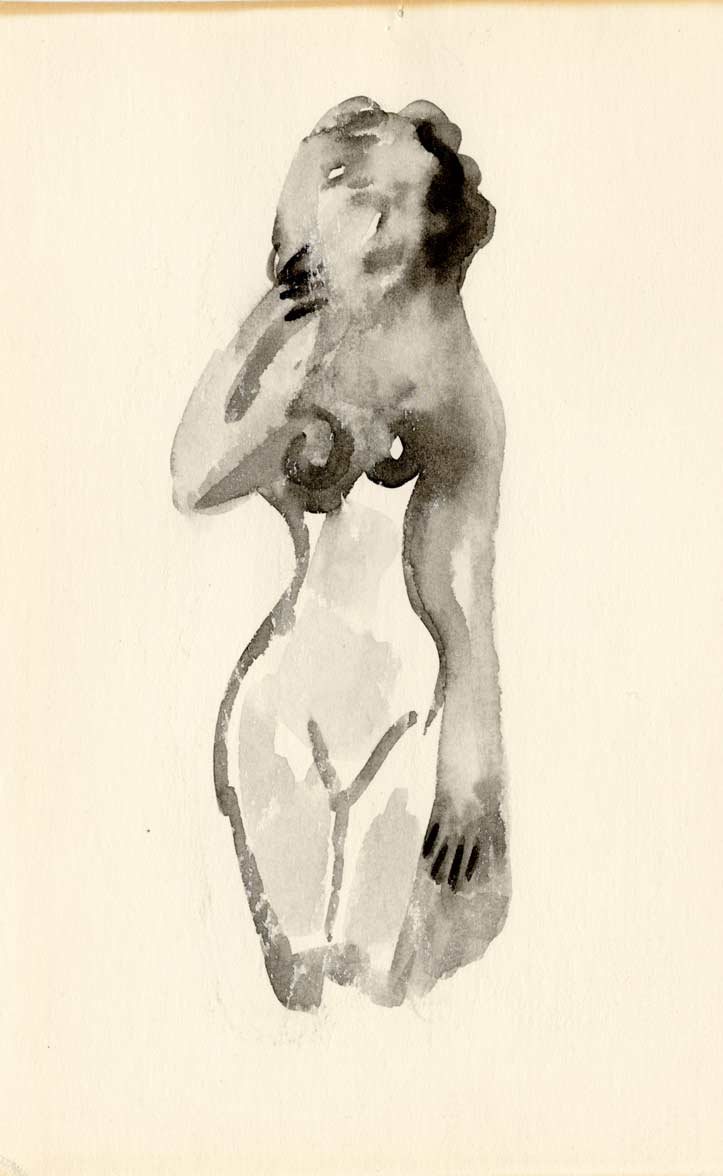
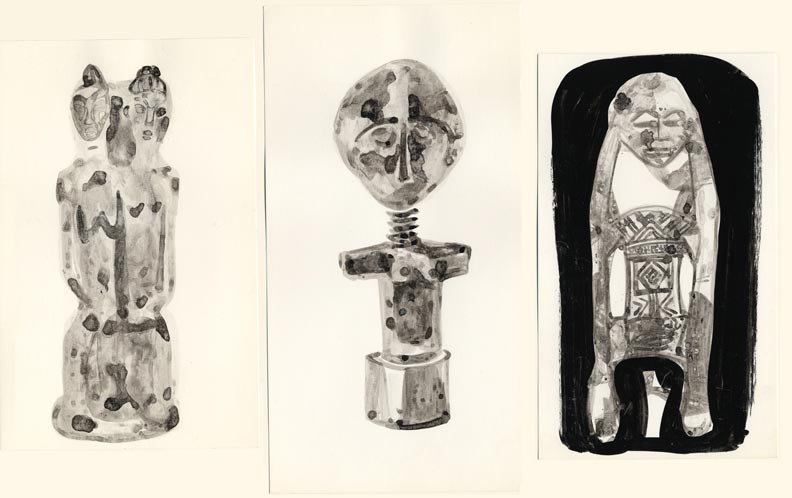
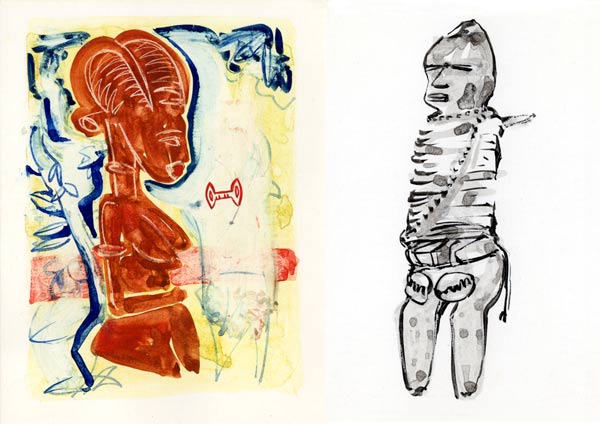
In the process of designing the new and revised version of my website I have been going through my archives and deciding what to add in, keep or delete. After sleeping on the passage above, I remembered a series I had done a long time ago which reflects this same devotional impulse, although not in a Hindu frame of reference. For about a year I painted hundreds of small studies of African fetish figures. I used books on African sculpture as my reference, and did my studies the way I would practice kanji, repeating them over and over again, on different papers and with different paints and inks, trying to allow the “figure” to become part of me. The practice became a mobius of energy between myself and the ritual object. The koan was “what is the self?”

Devotional-Figures
Devotional Figures, watercolor on paper, Iskra johnson

The figures fell into fifteen or twenty different tribal archetypes including a woman holding her head, her body or her baby, a figure holding a mirror, a figure holding a drum, and a recurring double figure, two conjoined in various ways. The paintings’ very smallness helped me to keep the practice devotional. I wasn’t creating anything for a “wall.” But I was inviting the gods into my house. It is good to remember to open that door.

Statue-Studies
Statue Studies, gouache on paper, © Iskra Johnson
Muse
Muse, watercolor on paper, ©Iskra Johnson


Filed Under: Object Lessons: Essays and images inspired by "A History of the World in 100 Objects.", The Spiritual in Art Tagged With: devotional art, fetish paintings, paintings from sculpture

Line Study with Captive Twig: An Ode to Botanical Tradition

February 28, 2012 by Iskra Leave a Comment

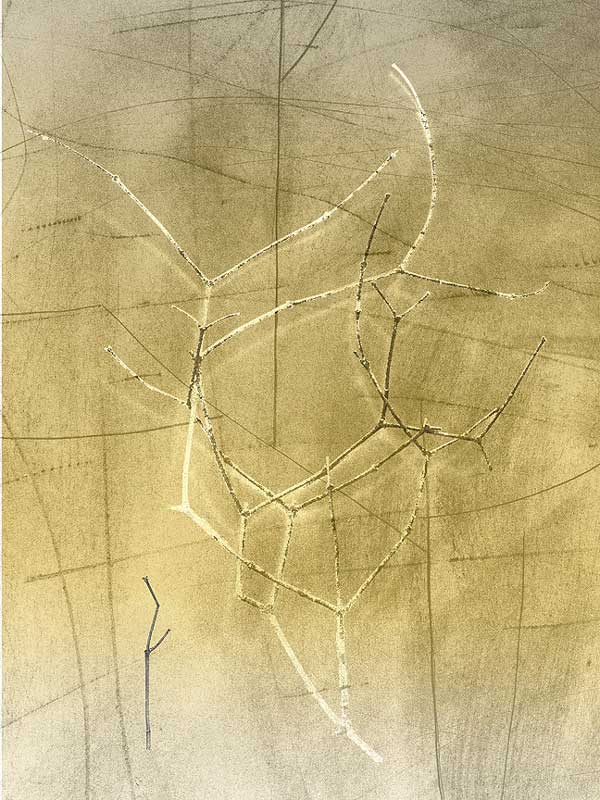
Spring is coming too early;  green shoots, unfurling leaves. I have been shouting at the clematis and honeysuckle and lillies to stop. We need more sleep, more dreaming time — and snow is on the way. I am in winter still, in love with architecture.

Line Study with Captive Twig
Twig in Space: Botanika, © Iskra Johnson


Filed Under: The Garden Tagged With: mixed media botanical art, new botanical art, twig drawing

Seattle Print Arts Salon Meeting at Ruth Hesse Studio

February 22, 2012 by Iskra Leave a Comment

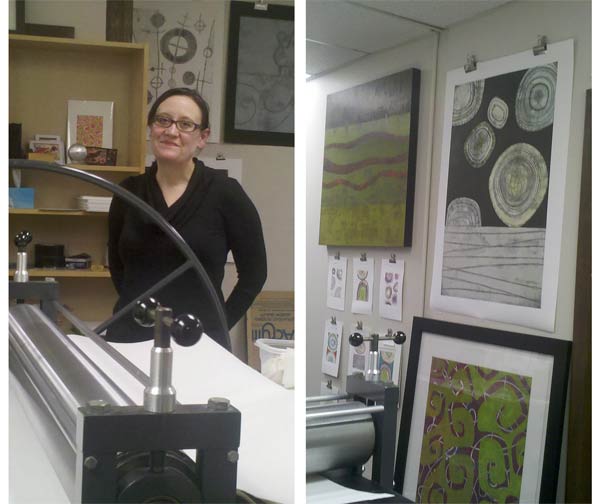
Tonight Painters Under Pressure, my SPA salon, met at the studio of Ruth Hesse. In addition to being talented printmakers and artists this group of 7 is rousingly funny and has an appreciation for food and politics, both of which take up at least some part of our monthly meetings before we get to the central business of sharing and critiquing our work. I will be doing a detailed profile on the salon at a later time.

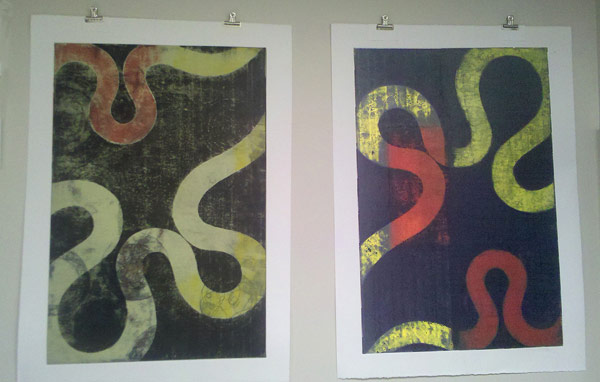
This post is an alert to those who may not have heard that Ruth is having her fabulous annual print sale this weekend. Ruth’s East Magnolia studio is tucked into a marine area in view of the water and a dazzling maze of industrial stuff. I’ve got to go back in the daylight. This is an area I have never been to and it seems like a whole mysterious city-behind-the-city that I had never known existed. You can get a map and directions to the studio here. The sale will be from 2-6 on Sunday February 26th, with prices ranging from $35 to $1,000. Below, some quick cellphone snaps of her work and space.

Ruth-Hesse-Prints

Ruth-Hesse-in-Studio

See more of Ruth Hesse’s work at her website.

“Often, my prints live in my To Be Continued folder, where they germinate until I have the right combination of colors and textures to layer on top of them. I live for the moment when discordant elements come together to make something unpredictable and beautiful.  That’s what excites me about monotype.

Life is a layering of experiences, be they planned, spontaneous, embarrassing, proud, painful or sublime.  Without that layering, there’s no depth.  There’s great hope in accepting the difficult stages in life (or the life of a print), placing faith in the process that everything will turn out okay in the end.” –R. Hesse

Filed Under: Uncategorized Tagged With: Ruth Hesse open studio, SPA Salons

Hilo, the Big Island, Just Before the Rain

February 21, 2012 by Iskra Leave a Comment

Architectural-Drawing-Hilo-Hawaii
Hilo, © Iskra Johnson, charcoal dust and water, 15" x 19"

If you would like to see this drawing in person it is currently available at Prographica Gallery.

Filed Under: Drawing Tagged With: Atmospheric charcoal drawing of buildings, Charcoal Drawing of Hilo Hawaii

  • « Previous Page
  • 1
  • …
  • 42
  • 43
  • 44
  • 45
  • 46
  • …
  • 58
  • Next Page »

Join Iskra’s Mailing List

Don't miss a thing! Subscribe to receive show announcements, first peek at new work and my semi-monthly blog by email. I primarily use the blog for news and updates but by signing up you will also receive the occasional newsletter and special offers for items in my shop.

Iskra Fine Art Blog

the creative process | conversations with artists | the contemplative impulse in art

Instagram

Today’s mood, from the morning walk. Today’s mood, from the morning walk.
A metaphysical idea waiting to become a drawing. A A metaphysical idea waiting to become a drawing. All day I have been studying graphite, the most evanescent of mediums. Fragility. Once you break the egg, scatter the nest, leave the children without family on an abandoned beach, what then? 

I have spent the day drawing. In the background, which becomes foreground with one click, is the news of the rounding up of another thousand or so human beings by bounty hunters given a quota, thrown into concrete cages and disappeared because someone decided that America is no longer the home of the #huddledmasses.

The plaque on the Statue of Liberty says:

“Here at our sea-washed, sunset gates shall stand
A mighty woman with a torch, whose flame
Is the imprisoned lightning, and her name
Mother of Exiles. From her beacon-hand
Glows world-wide welcome; her mild eyes command
The air-bridged harbor that twin cities frame.
“Keep, ancient lands, your storied pomp!” cries she
With silent lips. “Give me your tired, your poor,
Your huddled masses yearning to breathe free,
The wretched refuse of your teeming shore.
Send these, the homeless, tempest-tost to me,
I lift my lamp beside the golden door!”

Noem and Holman have not, apparently, run their hands over these words.

How do you continue making art at a time like this? You chase the metaphor. There is always a constant truth beneath the chaos.
Media studies. Addition and subtraction. Media studies. Addition and subtraction.
Somehow, between checking the news and the usual d Somehow, between checking the news and the usual distractions I managed to complete a drawing. Going back to the beginning: drawings in dust. 9.5 x 12” Charcoal powder, compressed charcoal, charcoal pencil on Moleskine. I feel peaceful for the first time in weeks.
The train tracks that go along Golden Gardens and The train tracks that go along Golden Gardens and pause briefly at the locks create a rupture in the city landscape. When the trains go by, the roar and squeal is like a thousand wild animals let out of their cage, and the ducks in the pond at the edge of the park shudder and dive under the water. A little farther north at Carkeek there is someone every year who steps in front of the train and whoever witnesses that is never the same. 

Sometimes the cargo containers are filled with coal, uncovered, and I have been part of demonstrations, which included polar bears and Orcas, objecting to that. Now, as we are being asked to casually accept nuclear reactors on every block as the price of having artificial intelligence, coal and its simple visible dust might look a little more friendly. The train brings with it economics and politics and life and death and class and all the people on the beach are just trying to have a moment in the sun. And the boaters at the marina, if they have finished polishing and descaling and mending the sails are lying back with a guitar and getting lost in the mountains. If you are willing to live right next to the train tracks, you can pay a much lower price for your home, but your dreams will change. I have lived next to the train tracks when I was very, very small and every night I woke up screaming and ran across the floor in the beams of the streetlight looking for safety. I have woken up in a train yard on a bed of cardboard and gotten on the train in the dark. Only when you do that, do you know just how hard metal is.

I’ve been drawing recently from life and this study was done from a photograph. It drove me crazy trying to see details that I couldn’t really see and feel them with the pencil. I’ve abandoned the drawing for now, but I learned a great deal about perseverance and obliteration and re-perseverance. Also how machines pretend that they are perfectly symmetrical and are not. And when you don’t draw them with perfection, they look just plain wrong so you have to make them more perfect than they are, at least when they are in perspective.
Tonight’s abandoned bird. The next one will be bet Tonight’s abandoned bird. The next one will be better. I’ve never tried to draw a Robin before. I’ve been obsessed with them since David Lynch sent them over to my childhood house, where they spent day and night getting drunk on the holly berries outside the kitchen window. And if you don’t know what I’m talking about google Laura Dern, Blue Velvet. And the Robin. It’s a hymnal to the good and the normal, done absolutely abnormally. I am learning all kinds of amazing things about how Robins build their nests. They start with mud. I did not know this. And in a drought, they will drag straw into a birdbath to get it wet and then drag the straw over a wormhole. Robins build their nests in the most unlikely places: drain spouts, highway overpasses, really bad motel parking lots. It’s kind of like how people find third place in community, even in the bleakest places. A franchise McDonald’s where people become regulars and always get the fries and just the fries because that’s all they can afford is a similar statement of naive valor: people talking to strangers and becoming known and taking shelter where they can. And if they leave a shredded napkin out there by their car, it will end up woven in with the straw and the leaves and the cigarette butts perched up there in the nest on the backside of the billboard.

Featured Posts

  • Book Launch! The Water Tower Project from Iskra Fine Art
  • How to Purchase Artwork from Iskra Fine Art
  • About This Blog
  • New Directions in Contemplative Art: Conversations with Artists
  • What is a Transfer Print? (Artist Statement)

Categories

  • Abstract Calligraphy
  • Architecture & Sense of Place
    • Construction/Reconstruction
    • The Alaska Way Viaduct
    • The Water Tower Project
  • Art Reviews
  • Artist Studio Visits
    • The Mystic Muse: Artists Working in the Contemplative Traditions
  • Botanical Art
    • Botanical Art Cards
  • Collage
    • Digital Collage
  • Commissioned Art
  • Drawing
  • Essays
    • Object Lessons: Essays and images inspired by "A History of the World in 100 Objects."
  • Iskra Shows, Upcoming and Past
  • Iskra Sketchbooks & Journals
  • Living With Art
  • Meditation & Buddhism
  • Mixed Media
  • Painting
  • Photocollage
  • Photography
    • American West Landscape Photography
  • Print Sale
  • Prints
    • Transfer Prints
  • Seattle Iconic Landscape Prints
  • Social Media for Artists
    • The 100 Day Projects
  • The Garden
    • The Gardener's Almanac of Irreproducible Phenomena
  • The Spiritual in Art
  • Travel
    • Road Trips
  • Uncategorized

Archives

Search

Connect on Facebook

Iskra Fine Art Facebook Page

Creative Inspiration

  • Alternative Photography
  • An Artist's Retreat
  • Anonymous Chinese Textile Genius: Moo Won
  • Chocolate Is A Verb
  • Contemplative Art Process: Danila Rumold
  • Eva Isaksen
  • Old Industrial Japan
  • The Altered Page
  • The Heart Sutra Loop
  • The Patra Passage

Galleries for Contemplative Art

  • ArtXchange Gallery
  • Seattle Asian Art Museum

Links

  • CollageArt.org
  • Iskra at SAM Gallery
  • Iskra Fine Art on Houzz
  • Seattle Art Museum Blog
  • Seattle Artist League
  • Seattle Print Arts
  • Seeing Fresh: Contemplative Photography
  • The Painter's Keys

What I'm Reading: Online Magazines and Books I Love

  • 16 mi.
  • Essays by David Whyte
  • Evening Will Come: Poetry
  • Hyperallergic
  • Painter's Table
  • Shu: Reinventing Books in Contemporary Chinese Art
  • Streetsy
  • The Original Van Gogh's Ear Anthology
  • Tricycle Magazine
  • Unincorporated Persons in the Late Honda Dynasty
  • Vanguard

Let’s Connect

  • Contact Iskra
  • How to purchase artwork
  • Iskra Fine Art Blog : The creative process, conversations with artists, the contemplative impulse in art
  • Facebook
  • Instagram
  • Pinterest
  • Twitter

All Images Copyright © 2026  Iskra Johnson · Site by LND · WordPress