Iskra Fine Art

  • Prints
    • The Tarmac Residency: Airport Landscapes
    • Immersions | At The Shore
    • ColorBath: Images of the Harbor
    • The Floating World
    • Industrial Strength | Urban Industrial Landscape
    • The Scaffold
    • Industrial Pastorale: The Rural/Urban Landscape
    • Botanical Prints | The Natural World
    • Construction | Reconstruction : Urban Landscape
    • Infrastructure
  • Drawings
    • Pencil Drawings: Pandemic Pause
    • Drawings in Dust 1
    • Signs & Symbols (Archive)
    • Botanical Drawings (Archive)
  • Photography
    • Nucor Steel Industrial Landscape Photography
    • New Work Inspired by England
    • Seattle Waterfront Park Photography
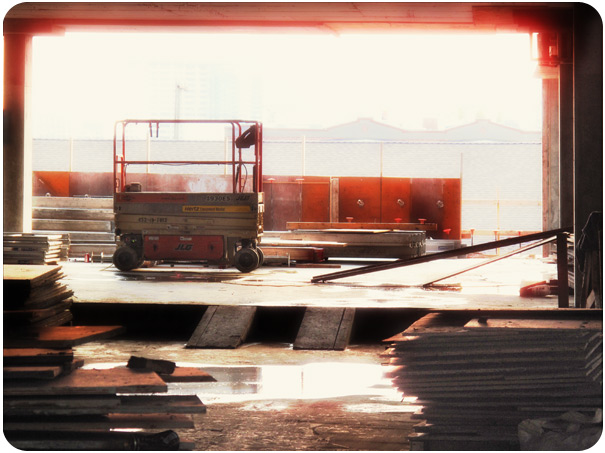
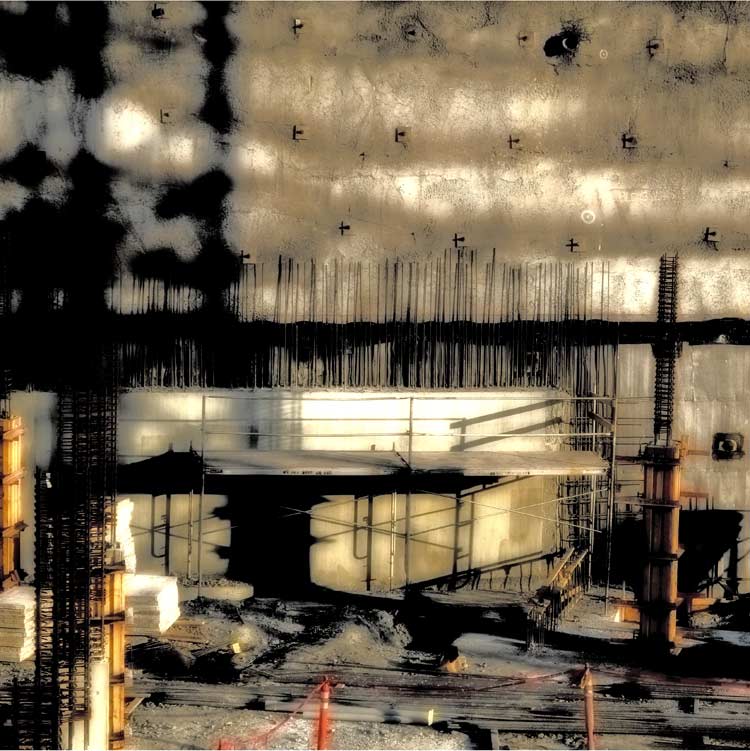
    • Architectural Photography | Construction Sites
    • American West Landscape Photography
  • Mixed Media
    • Modern Botanical | Mixed Media on Plaster
    • From the Sea | Water Paintings
    • Sleep Studies
  • Wabi Sabi Abstract
    • Minimalist Modern
    • Ink Painting Abstractions
  • Shop
    • The Water Tower Project
  • About
    • Contact
  • Blog
You are here: Home / Archives for Photography

Notes from the Road: An Artist’s Trip to the Palouse

August 28, 2012 by Iskra 4 Comments

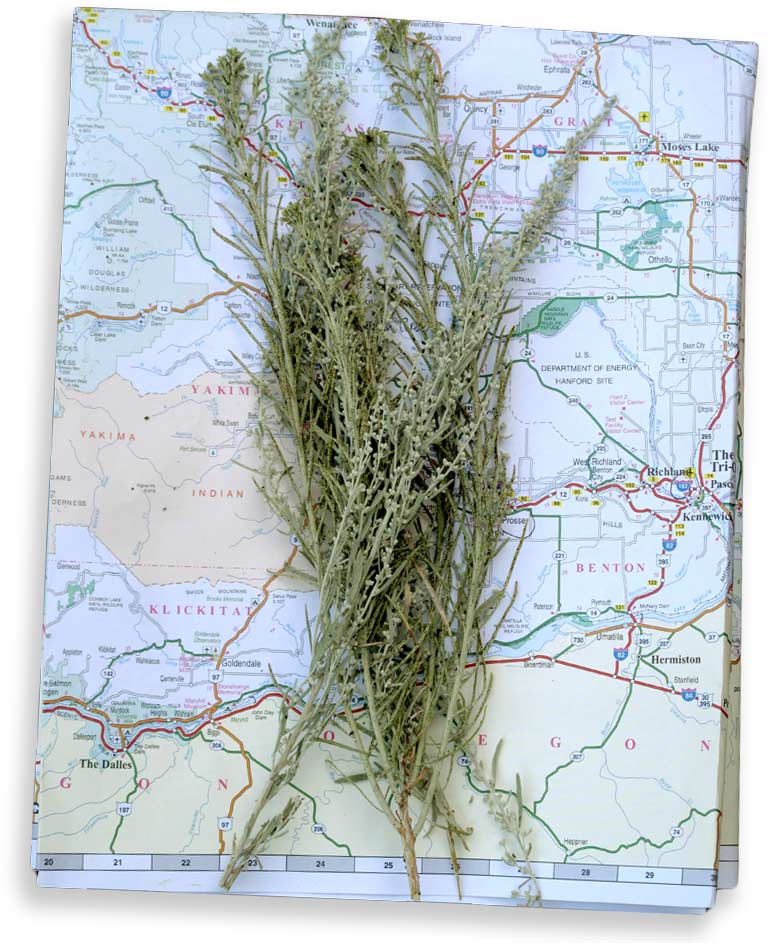
Sage_On_Map_EasternWashingtonWeeks after returning from Eastern Washington, I can’t seem to put the map away. From the corner of my eye I see the blue of the rivers and the lakes and the pale butter of desert and wheat. The whole map seems cast in the blue of the sky. It keeps me on the road even as I stand in my kitchen looking at weather the color of concrete. I read the names of the towns and put them together, knowing I would believe these people were real if I read them in a story: Clayton Ford, Lamona St. John, Gilmer Packwood, Randle Bingen, or just plain Quincy, with no last name. I want to have a cousin named Mayfield, and I want to marry a man named Dusty, which lines up along the road to Othello right next to Hay. To look at the map, to be in the map, they infuse each other – the blue sky the same color as these meandering backroads. The names of these places are equal parts dirt and aspiration. Yes to the beat up range horse and the saddle whose rosette tooling has worn flat from years of use, and yes to the Spokane carousel whose horses bloom with gilded chinoiserie.
Palouse-Road

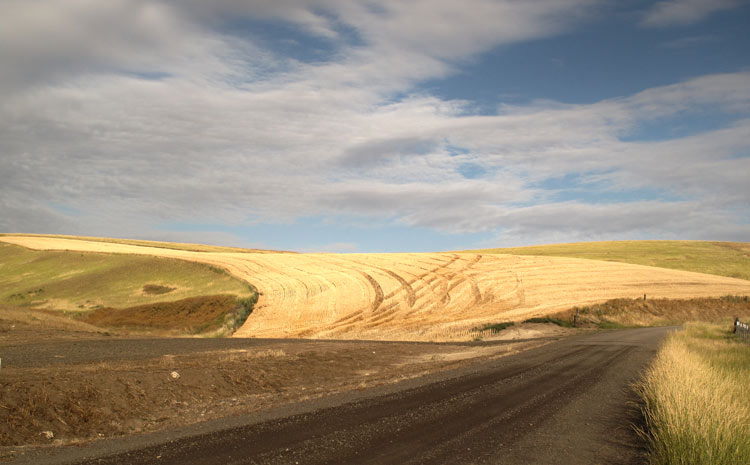
Here in The West, in the upper left-hand corner formerly known as The Oregon Territories, (and before that as the land of the Nez Pierce, the Quinault and the Yakima Nations), we are divided by mountains. The usual associations of the compass don’t hold; The “East” is not know for its Buddhists and pagans and barefoot Occupiers but for small towns with even smaller churches with firmly held conservative beliefs. The West curls its lip at the East and mocks its Bible-quoting politicians and lack of tender regard for restoring the gray wolf. The East would prefer not to sponsor seawalls and fancy underground freeways and weddings in which both the bride and the groom are named Meg. And yet for all its smug urban insularity, people of the West regard the East with nostalgia and they carry a certain ache for its rural beauty. Out there is the land. No matter how thick the condominiums or how constipating the traffic or how high the price of a double latte vente with vanilla on the west side, the land is out there just over the pass saying: we have space and sky here for you. It’s saved for you and in the bank: beauty.

Every few years I make the pilgrimage across the Cascade mountains, to see if that space is still there or if I imagined it. This August I went with two artist friends to stay on a farm outside the farming town of Pomeroy and look after a herd of goats. It was delicious to be with companions who live to stop and to look. We packed a week of lunch, and checked our brakes for the long steep slope down the other side of the mountains.
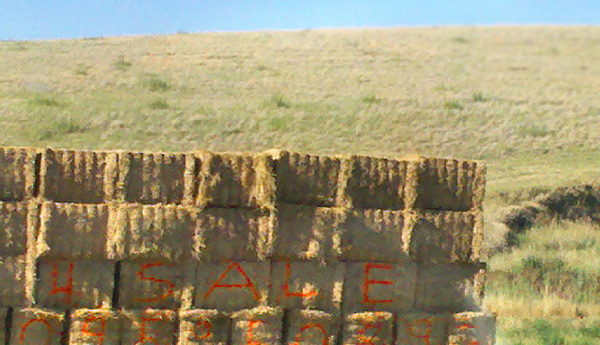
HAYBALES-FOR-SALE
A clear sans serif always gets the message across.
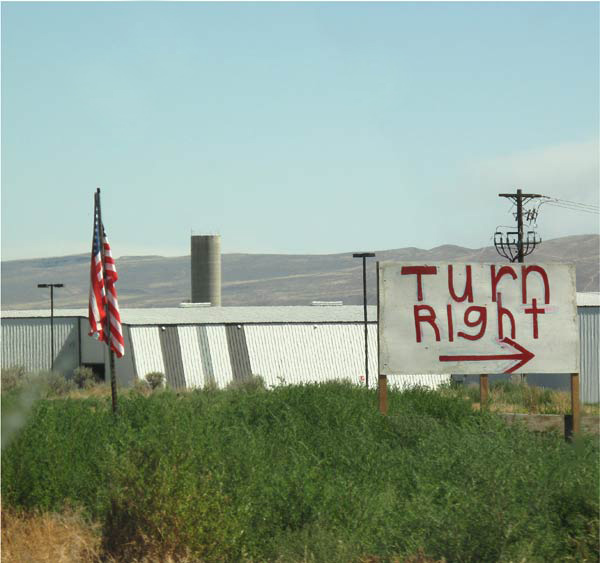
Turn_Right_Road_Signage
Directional Signage. This is not Canada.

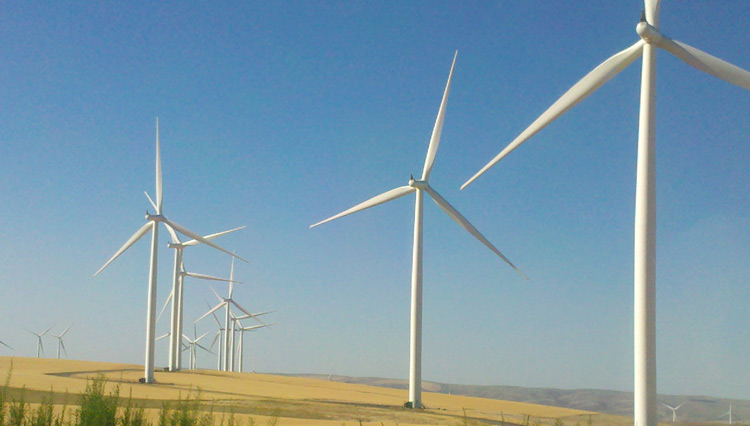
After a bit, beyond the too-big fruit stand that is now the only fruit stand, in the town of Thorp whose name seems too short and where the massive marquee offers “Antiques | Fruit” which just makes us think of raisins; after that bleak stretch where we think we’re not anywhere at all, we do reach The Road. Here finally is the ribbon of hills. The folding and unfolding waves of gold and green pivoting into creekbeads and scree and broken down things. Shimmering asphalt, blazing hairpins, the river, the barges, the Falls. White butterflies in pine trees. And a sudden leap into science fiction. When did the land become a wind factory? I turned my back and the Germans came and put these white giants, these three-armed industrial starfish on every horizon. What would Ray Bradbury think? Would he lie down beneath them in their protective mote of gravel and toast them with a glass of dandelion wine?
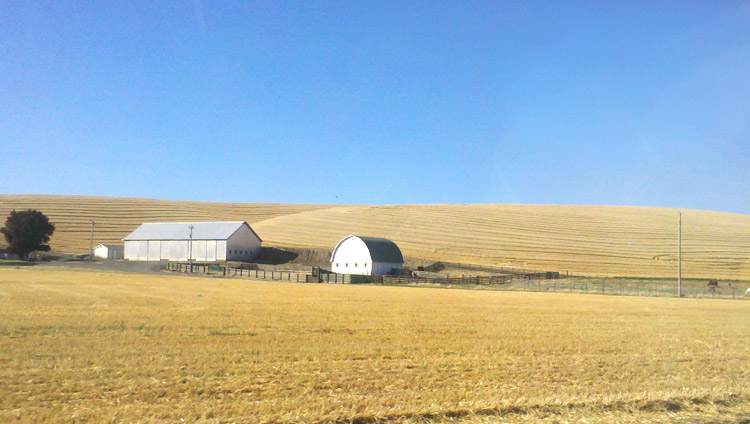
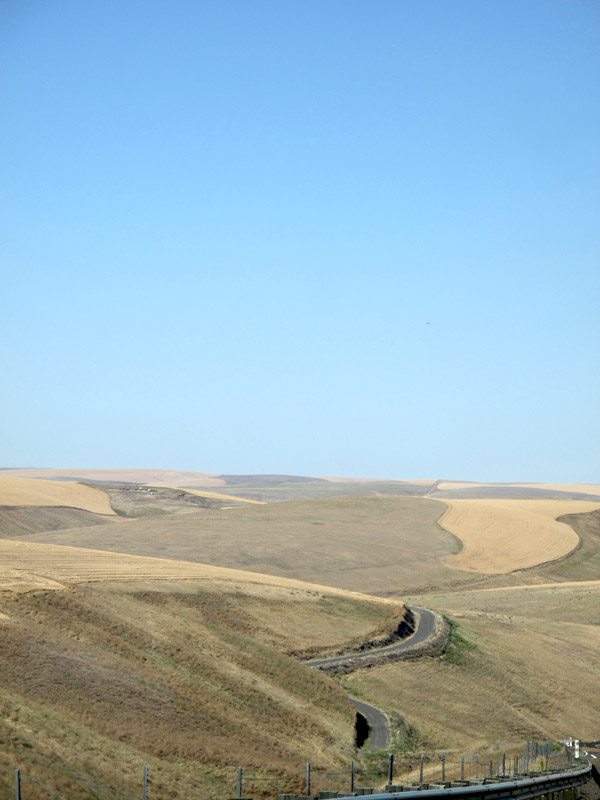
Two_Barns_PalouseThe_Road_PalouseThe_Old-Fashioned_WindmillThe_SciFi_Windmills_of_The_Palouse

Each windmill earns a farmer $10 thousand dollars a year. Each windmill powers 350 houses. Put that up against an idea,– a relic of an idea — of “landscape” or “natural beauty.” You’ll lose. And so we go farther east, to where the migration hasn’t taken hold, practicality and beauty are in harmony, and the highest best use of land is wheat and peas and these are just coincidentally lovely. [Read more…]
Filed Under: Photography, Road Trips, Travel Tagged With: Artist journal of the Palouse, Artist Roadtrip, Blue Mountain Artisans Guild, Eastern Washington Landscape trip, Jennifer Carrasco, Mary Flerchinger, notes from the road, Palouse journal, Paula Gill, Pomeroy Washington, road signs, road trip journal, Steptoe Butte, the East-West Divide, visit to a goat farm, visit to Steptoe Butte, writing about the west

Three Days in the Sun: Cyanotype Workshop at The Stables

July 29, 2012 by Iskra 9 Comments

Cyanotype_At_The_Stables
© Iskra Johnson

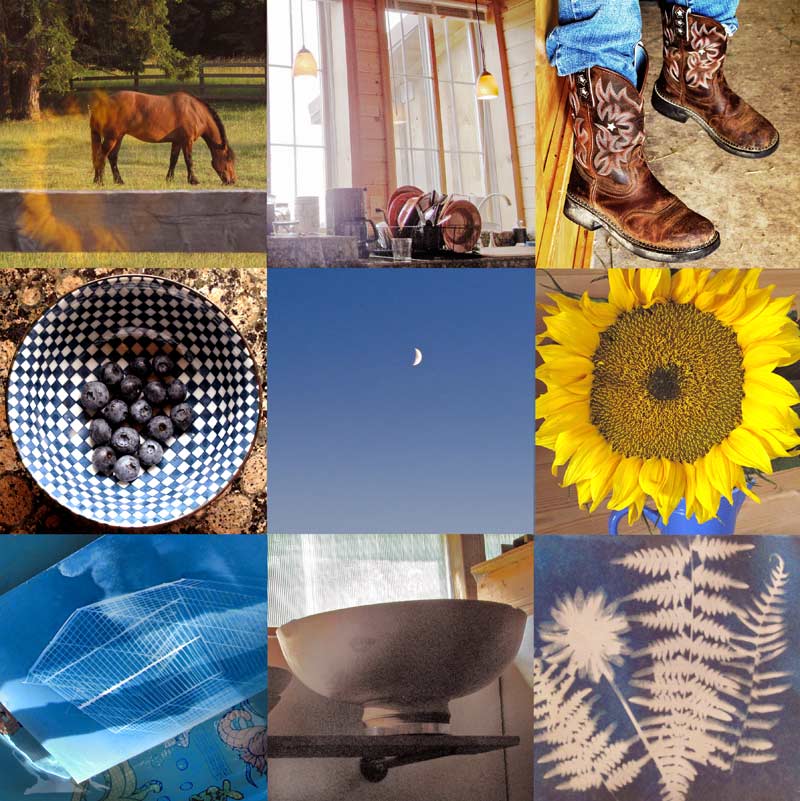
The Stables is the quietest place I have ever been. You can hear a twig drop in the woods, and a horse eating a buttercup. In between, complete, breathtaking stillness. Situated high on the southwest side of Orcas Island, this 25-acre ranch and creative compound hosts workshops in a variety of arts and crafts taught by the resident artists and invited guests. The simultaneous sense of vista and retreat makes for a very special place for art and reflection.

This July I signed on with my sister, Cassandra, and 17-yearold niece Zoë for a three-day workshop in cyanotype. My sister and I had spent early years growing up on a ranch, and to be together quite literally in a stables, sleeping in a loft above, sent us both into states of unexpected recollection. Every morning we looked out on two chestnut horses and followed their graceful ambulations across the pasture. The tooled leather and haymow, the 4-H, the riding rink, the coyotes under the moon and the back forty of our pasts tumbled into the present everywhere we turned. My niece, not yet of an age for elegies, lovely in pigtails and grave and hilarious by turns, focused on her senior year project in all things photographic. She proceeded to make one artlessly perfect composition after another. Note to self: make no helpful design suggestions when a true artistic gift is at hand.

ZoeTwoCyanotypesOneWithTea-Bath
Two of Zoë’s Prints, the lower one has been toned with tea

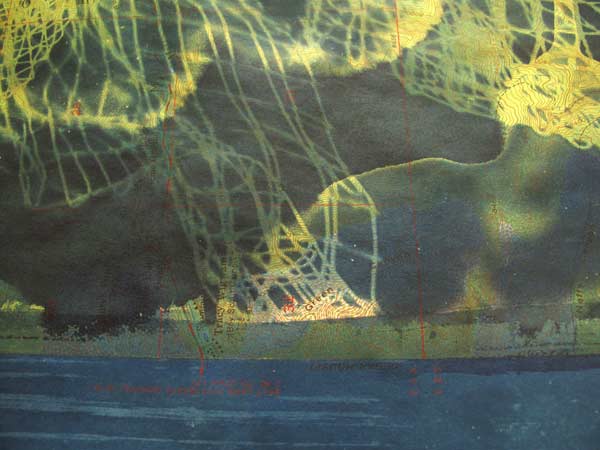
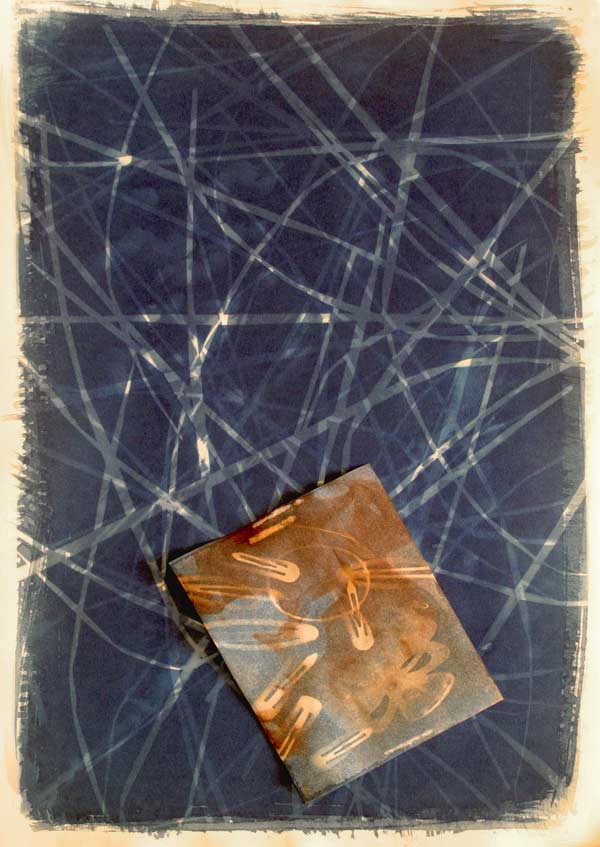
I had planned originally to work with my existing themes of architectural photography, and had spent days making negatives. At the last minute I threw two birdcages in the car. This turned out to be a very good idea. Within hours on the first day I could see that this process of cyanotype is an alive thing, a way to paint with the sun and your surroundings, an opportunity to toss out your preconceptions and open the door to the unexpected. Noted Seattle artist and cyanotype expert David Simpson taught us, and nudged and pushed us through three days of testing our limits. Although he had encouraged us to bring objects we also used what we found on site: crumpled wire, thistles, chainsaws, daisies, ferns. We laid these things on glass or directly on coated paper. Our fourth workshop member, printmaker Lynda Swenson, experimented with printing on maps and existing etchings and woodcuts.

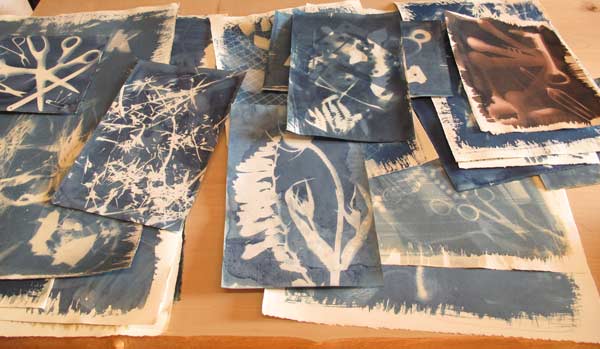
Cassandra_Cyanotypes_On_Various_Papers
Some of Cassandra’s prints.

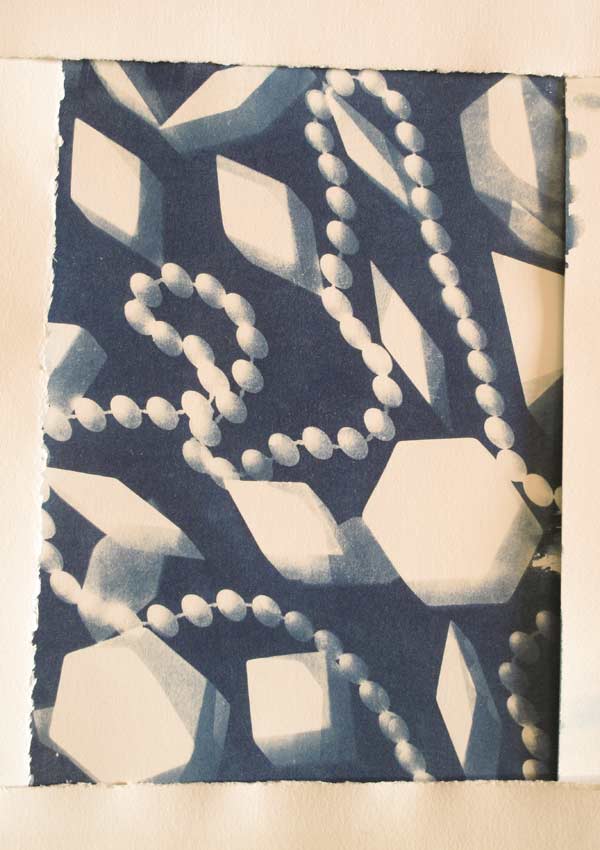
Upper right brown and black print shows how fabulously the Artistico works with tannic acid toning. Below, a composition with three dimensional blocks and pearls, testing cropping. The actual print is not this yellow. The photo was taken with warm light from the walls of the stables reflecting onto the surface. I would love a skirt with this printed on it!

Cassandra_Cyanotype_With_Pearls

Close-up_of_Linda_Swenson's_cyanotype_on_a_Map
Close-up of Lynda Swenson’s cyanotype on a map

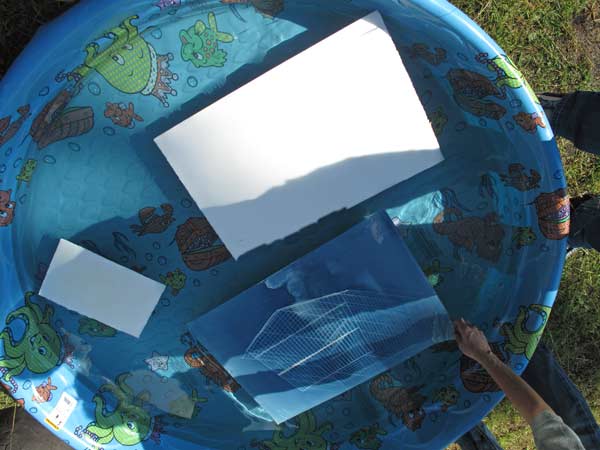
In the first step we coated our paper with solution in a darkened stable under a red safe-light. When ready we dashed from the darkroom to the outside laboratory where we slid the paper under existing arrangements or began lightning fast compositions, lifting or placing objects for different effects. We all had various timing devices, and at times it looked like a circus casino, or perhaps a camp for people with attention deficit disorder. We rushed in and out of the barn, lifted and placed objects, stared at our paper variously counting outloud, watching a cellphone or a wristwatch, or drifting into conversation — “What minute was I on???” And then (this was the best part) we threw the paper into a kiddie wading pool to fix and finish developing.

Art_In_The_Pool_Fixing_a_Cyanotype
Just accept the octopus into your heart…and agitate carefully to avoid the dreaded water bubble spots–they cannot be removed.

Some things I learned:

  1. Paper: Although many sites recommend Stonehenge as an ideal paper I would like to sell you a bridge to nowhere. I have fifty sheets of this stuff and we universally loathed it. No depth. A pale obnoxious blue. Also no watermark and cheap—what was I thinking??
  2. Rives BFK takes on odd shades of brown under some circumstances, which sometimes adds a pleasing element. The cyanotype solution tends to bead up and it is very hard to know if you have the edges of your paper covered in the semi dark.
  3. 400 pound Strathmore rag bristol mottles. It also can delaminate in the bath. But, you can then recoat the separated sheets and use the mottled tints as background to create lovely new images. Some of my sister’s best pieces were created this way. They have a wonderful vintage quality and tonal depth.
  4. Fabriano Artistico hotpress provides phenomenal fine grained exposures and takes toning elegantly, you can created a black and brown duotone with crisp luminous whites. I wish I had bought fifty sheets of THIS. Rives worked best with the few photo negatives I tried. I did test strips, and timing through clamped glass was one half to one third of that needed for objects (ie. For negatives, an average of four minutes in hot July sun.)
  5. Water: The Orcas water comes from a well and has minerals in it. This may be why certain prints took an amber cast after several coatings. Cyanotype is the art of variables. Washing and fixing prints in city water with chlorine could lead to completely different results. I had mysterious perfectly round spots on my first three or four prints, which appeared only after the water bath. It took a lot of detective work, but we finally figured out that it was bubbles formed by not immersing the paper fast enough and completely enough—and do immerse the paper face down.
  6. Adding peroxide to the water bath: you get blazing blues. We didn’t test definitively enough to know if the blues lasted and were as dark or darker than cured prints, but we decided it might be kind of a cheap trick.
  7. Time: Make no final decision on anything until prints have dried and oxidized for at least 24 hours. They can darken drastically.
  8. Random magic: Yes, you can expose while paper is still wet, and it leads to beautiful effects like watercolor. You can also paint with solution under the sun. The solution will change and change as you paint, losing potency as it is exposed. There is absolutely no need to take a meditation workshop or study impermanence with a master from the East. Just pour cyanotype onto paper under the sun and spend some days watching it dry. Change is the only constant.
Painting_With_Light_Cyanotype_Experiment
Painting with light, cyanotype experiment

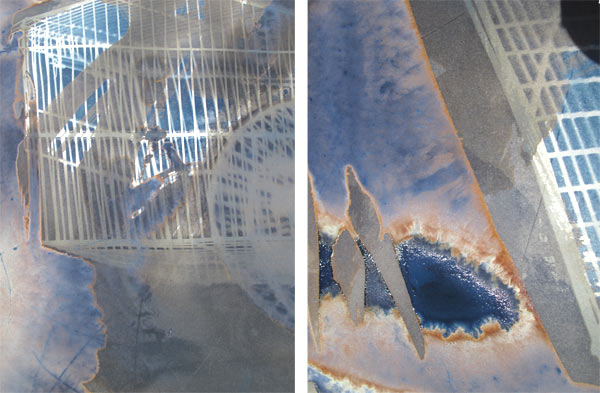
Above, a piece in progress. I painted under bright sun, adding new solution. As it dried it turned strange shades of rust and pink and two new shades of blue I hadn’t seen before. Then it all disappeared in the wading pool and became something else.

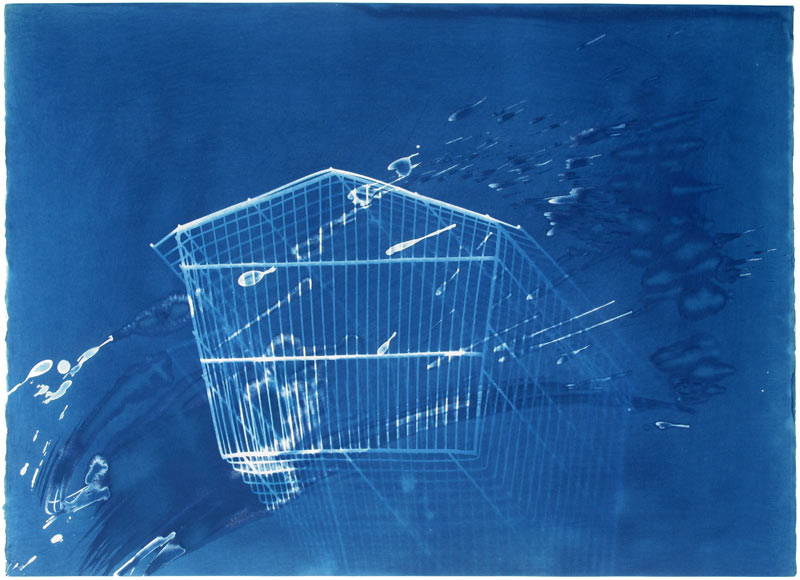
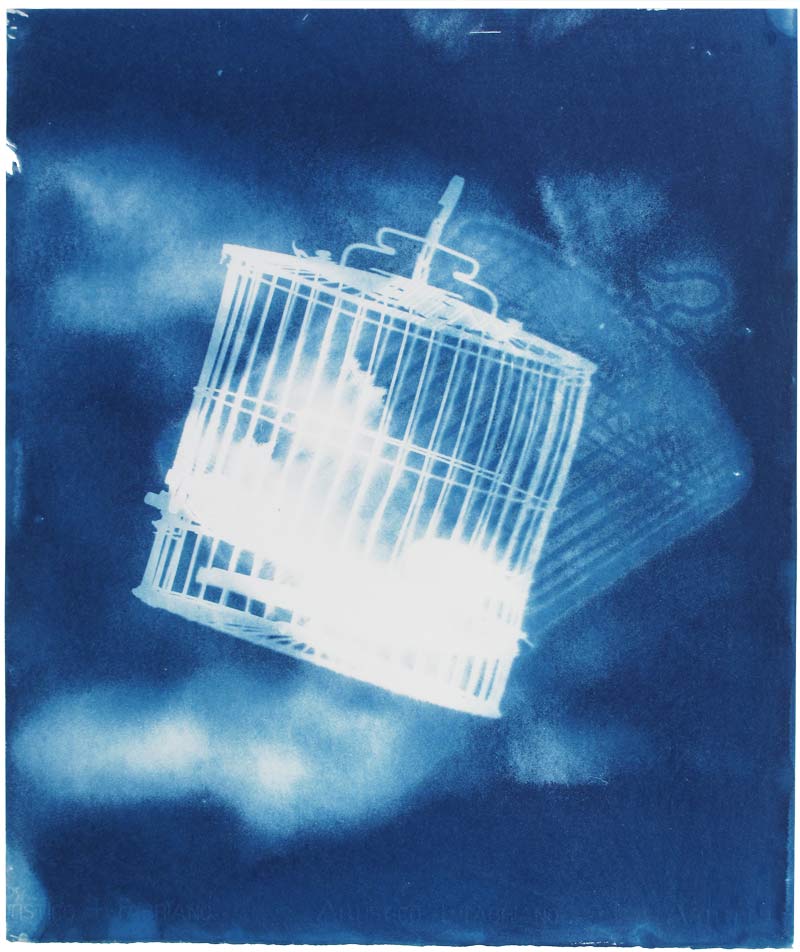
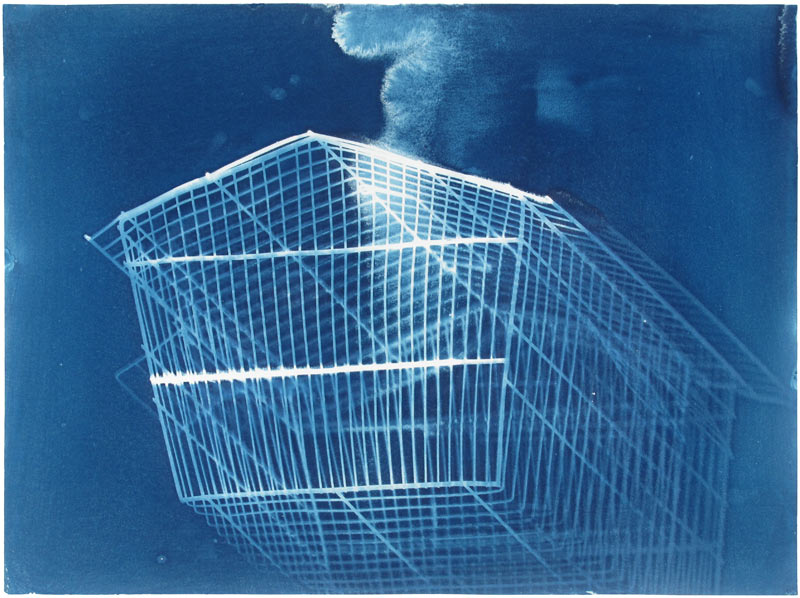
One of the most promising experiments I did involved folding paper while it was wet. I do wish I had figured out the cause of the mysterious round spots before I did “Origami Cage”, but I am including it here because I think it’s interesting. I can’t tell you how great it felt to completely beat up a piece of paper. When I wake up in the morning one of the first things I see when the sun is out is the shadow of birdcages cast onto the wall. I have tried off and on for ten years to capture them in some way. I think they finally found their home.

Bird_Cage_One_Cyanotype
Bird Cage 1, 16″ x 22″, Cyanotype on Fabriano Artistico © Iskra Johnson
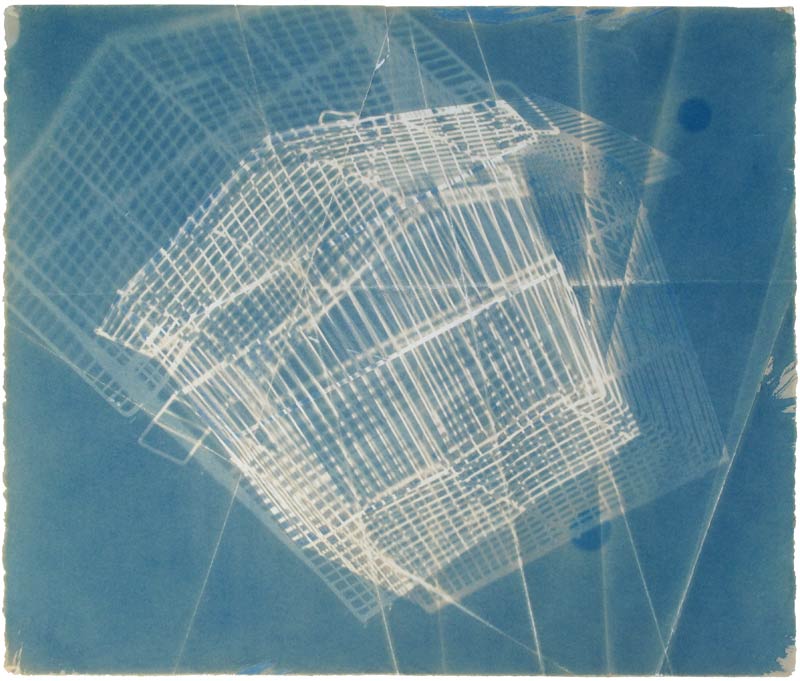
TiltedCageCyanotype
Tilted, 22″ x 16″, Cyanotype on Fabriano Artistico, © Iskra Johnson
Bird_Cage_Cyanotype_2
The Cloud, 22″ x 16″, Cyanotype on Fabriano Artisitico, © Iskra Johnson

Architectural-CyanotypeDetail

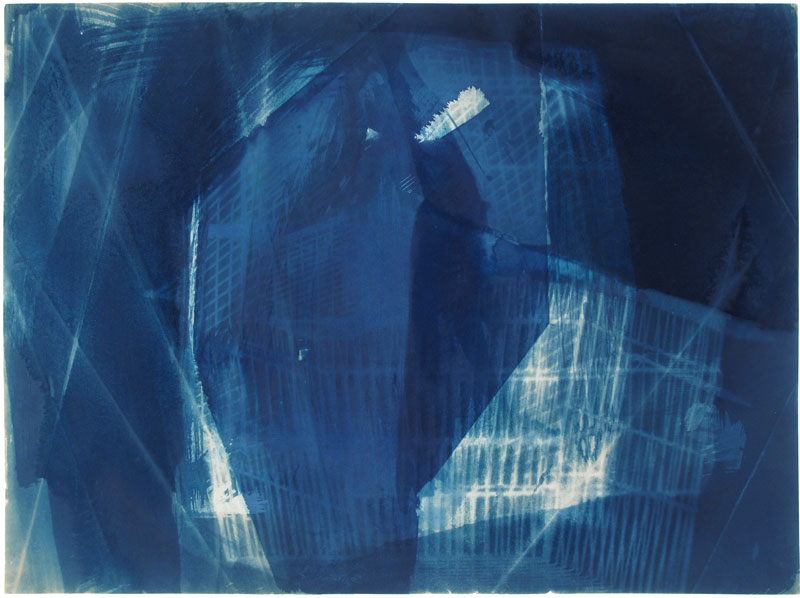
Origami_Cage_Cyanotype
Origami Cage, 16″ x 20″ Cyanotype on folded Rives BFK
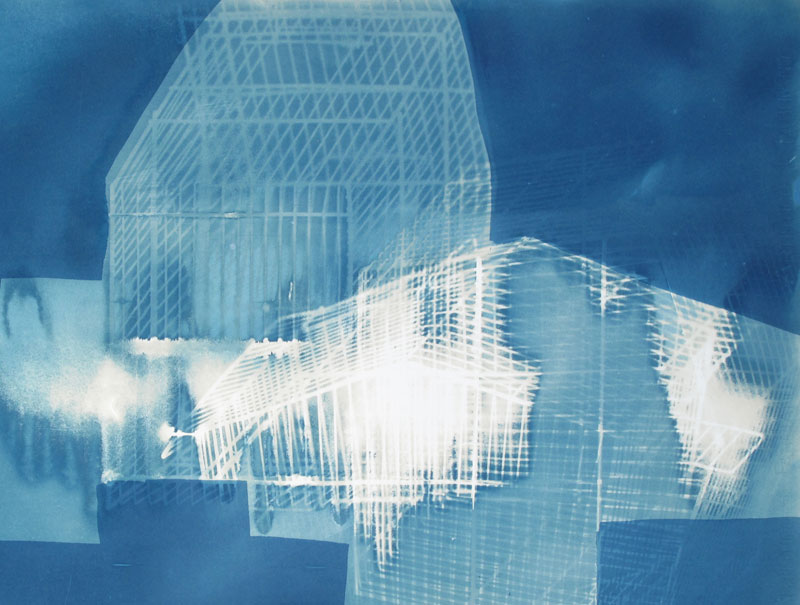
Deconstruction1_Cyanotype
Deconstruction, 17″ x 23″, Cyanotype on Fabriano Artistico, © Iskra Johnson

And, a couple of links. You can find out everything you ever want to know about cyanotype and alternative processes at Alternative Photography.com. And don’t miss David Simpson’s work at Photographic Wanderings at Lisa Harris Gallery opening August 2.

Filed Under: Photography Tagged With: alternative photography techniques, best papers for cyanotype, composing with objects, cyanotype workshop, Dvid Simpson, painting with light, The Stables on Orcas Island

Heading for a Blue World

July 23, 2012 by Iskra Leave a Comment

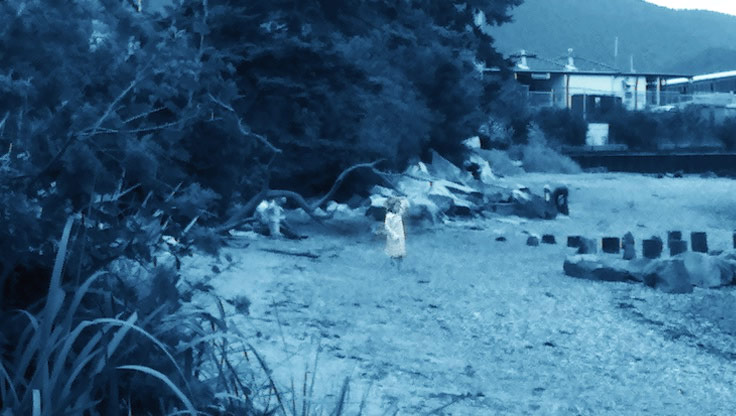
CyanotypeGirlAtTheShore

I took this picture from the beach while waiting for the ferry, heading out to Orcas Island for a three-day workshop in cyanotype. I had no idea my phone could see in blue, but I stumbled onto the filter and am getting a head start. The real thing soon!

Filed Under: Photography

Thoughts on Photography and History: Ken Rosenthal, Takashi Arai, the Real and the Unreal

July 15, 2012 by Iskra 2 Comments

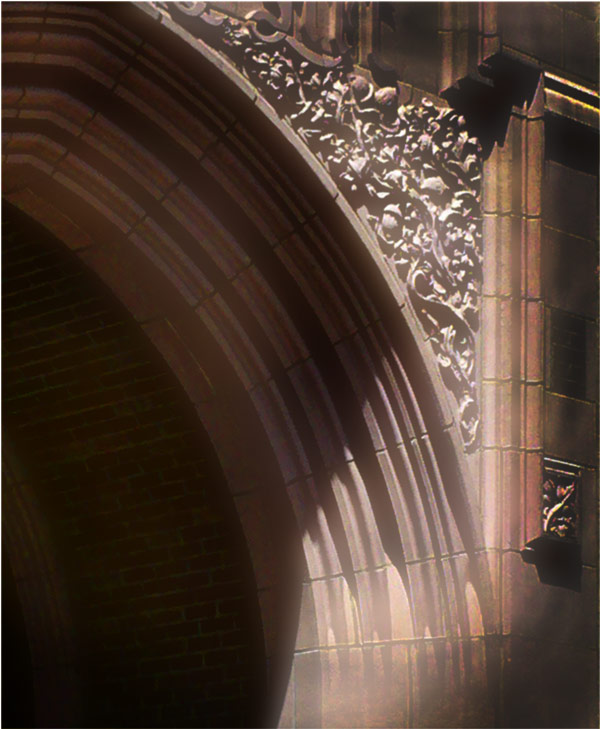
ArtLibraryEntryGothicArch
Entry to the Art Library, with artist-applied faux-historical “Instagem”™ effect © Iskra Johnson

“…the camera does more than just see the world; it is also touched by the world. Light bounces off an object or a body and into the camera activating a light-sensitive emulsion and creating an image.”–Geoffrey Batchen

“touch is the most demystifying of all senses, unlike sight, which is the most magical.” — Roland Barthe, Camera Lucida

On Friday I became an art history nun and went into the cloisters. The University art library is not the place I recall from decades ago, but imagining persists. I ignore the flourescent tubes and the blinds drawn against the natural light of the clerestories and am grateful at least for the shadows of leaves cast by the trees. I pretend these silhouettes are a vintage theorem painting being painted again and again by the wind and the sun. I inhale the Dewey decimal system and its attendant odor of pulp and glue, and feel a calm and translucent habit settle about my shoulders. In this funnel of starched linen, a scalloped awning above my eyes, I can sink into pictures and footnotes and the zigzag worry beads of the alphabet. Some call this reading.

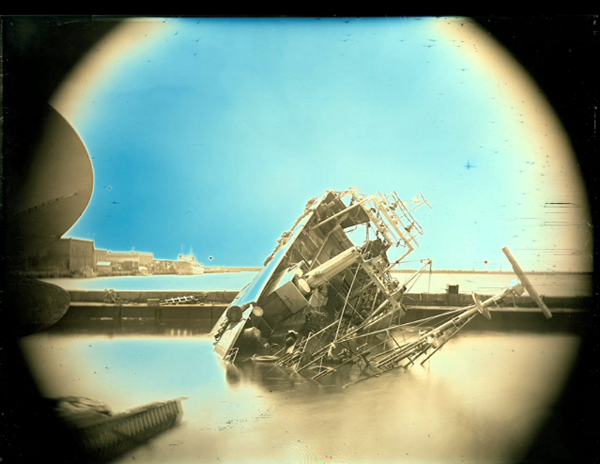
We live in a culture so laminated with derivation and appropriation that it is very easy to forget that at some point there was a “real” on which the derivations are based. An entire generation will grow up thinking that an Instagram is a photograph. “Snap a photo with your mobile phone, then choose a filter to transform the image into a memory to keep around forever.” “Retro” is a station on Pandora. “Retro” is, basically, a “filter.” But once long ago there were actual steam engines and eye glasses made of glass and men went under a tent of black canvas and made you sit still forever to get your one very precious portrait taken. I am so taken with these portraits. The person is dressed invariably in shades of umber, against an equally umber backdrop. She or he leans pensively, stiffly (whilst waiting an interminable ten to thirty minutes) until the exposure is complete. If you want to know what this sense of time is like, and how it sounds, take a peek at this extraordinary work by Takashi Arai.

Mirrors in Our Nights, Takashi Arai
From “Mirrors in Our Nights” by Takashi Arai, contemporary daguerreotypes of Japan immediately after the earthquake, with audio of the sounds heard during the very long exposures. You may need attention deficit medication while watching this ten minute video, but it is worth it.

In many historical daguerreotypes the sitter gazes at another daguerreotype in its lovely filigreed case, or poses the case facing out at the camera, creating a loop of self-referential mirrors. Is the person’s mouth twisted in a prematurely elderly grimace from the effort of trying to memorize the tiny image in their hand? Of trying to remember “who was this guy’s name who I might have been in love with at some point?” Or is it the tedium of south Dakota and the fly buzzing in the August heat and the fact that the pose must be held for half an hour? I find these pictures enchanting. The silver on glass does indeed cause the image to float, real and unreal, even in a reproduction.

Only later in the day, gazing at passersby at the Lake, am I startled to see that a glass case of identical size is being held by almost every person. And that they are gazing at this luminous device with rapt attention, admiration and even hypnotism, albeit in full technicolor and not sepia. They are also, in the style of modern liberations, moving their heads without concern, and emoting. And in many casts of light they are seeing their own face reflected over the latest status update on Facebook, which no doubt includes….Instagram photos. Talk about mirrors.

If a photograph was originally intended as an aid to memory, and as a document of the real, what is it now? How can you remember when you have no time in between images to forget? How many millions, trillions, billions of images will we be subjected to in our new modern lifetime? If we live in a world of endless mirrors, but without a mediating lense, light reflects but we do not necessarily absorb it, much less have the capacity to reflect upon it.

I have been dwelling on Batchen’s quote

“…the camera does more than just see the world; it is also touched by the world. Light bounces off an object or a body and into the camera activating a light-sensitive emulsion and creating an image.”

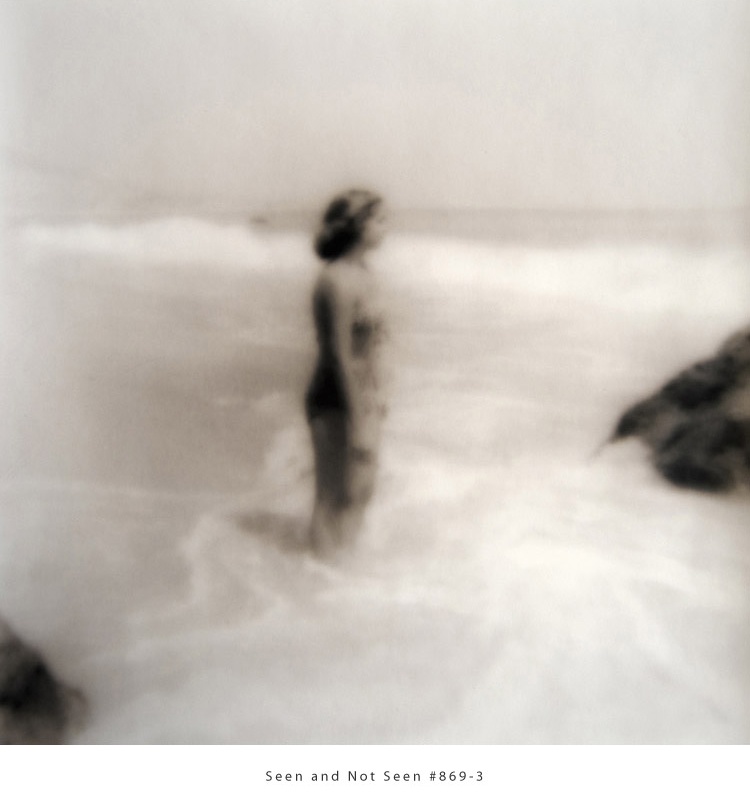
This idea remains magical. You can easily lose sight of it when you spend hour upon hour in front of a computer revisiting images that are now simply a pixel representation of a moment of touch. Most modern photography (and conversation about it) lacks attention to one elemental factor: emulsion. Invisible on screen or in digital prints, it is the thinnest of membranes, providing the alchemical medium between the world of touch and the world of sight. The essence of this was brought home to me during a lecture, “Seen and Not Seen,” I attended at the  Pacific Northwest Center for Photography on Friday. This enchanted evening in the dark viewing the work of Ken Rosenthal provided the perfect elaboration of everything I had absorbed in the library hours earlier. The primary body of Rosenthal’s photography looks backwards into memory, and is based on personal and historical photographs of his own family. All of the work until very recently relies on darkroom methods for printing. The sense of the physical and intimate path of light comes through very strongly.

SeenAndNotSeen#869-3
© Ken Rosenthal

His methods are exacting and customized, and not entirely revealed. When I see these images I feel transported not just to the past of the event documented, but into the laboratory in which the image was made. One of Roland Barthe’s essays which I read this week describes at length the sounds of a photograph. The verbal description alone, placed next to the seemingly inert photographic reproduction of a horse walking in fog, conveys a sense not just of sound but of air and smell and cinematic immediacy. As I write this, sitting at a computer, having spent all of yesterday “developing” photographs in Photoshop, the convergence of Barthe and Rosenthal, like the bite of a madeleine cake catapults me into another time. I am on the farm in the darkroom, my eight-year-old nose bumping my father’s elbow, watching as he develops prints of an Arabian horse. It is a summer day in July, and we are in the only cool place in the uninsulated farmhouse, in the basement where he tucked a bench and an enlarger in a narrow hall behind the washing machines. I can hear the rattle of the film canister, the click of the enlarger moving up and down, the huf-huff of the dust bellows, the tongs knocking against the developer tray. The red light is terribly mysterious and exciting, and I know at any moment I could ruin everything by opening a door. And then there is the moment when my father lifts me up and stands me on a chair so I can see the image emerge, ghostly, intangible, then gradually an eyelash, a glint of bridle, the unmistakeable ridge of a mane rising up white against a dark unclouded sky.

What Rosenthal achieves in his approach to his own very personal subject matter is not “just personal.” It is about memory and seeing itself.

And it resonates in a universal way with anyone who has ever held a family photograph in their hand, run their fingers along the scalloped edges and wondered about the slightly out of focus and scratched up ancestors buried in the surface. As technology changes, as emulsion and eventually even the memory of emulsion vanishes, as “family albums” come as pre-designed digital templates with faux photo-corners and can be “downloaded” in seconds, although never actually “held,” as vintage or as for that matter everything becomes a “look” referencing another “look” I wonder how his work will seem in twenty years. What filters will viewers see it through? The metaphoric facts of how we see will not change. Memory will “blur” fact.  The eye will continue to alternately focus on one thing and the whole, moving back and forth in time. Light will continue to refract, bounce, enter, transform. Perhaps the early technologies were closer to revealing the unseen than our modern ones in which part of the achievement is the pristine absence of gears and wheels. You will find many contemporary images mimicking the look of the ground-breaking running horse sequences of Muybridge but few of them mimic his idea, which was that he was showing something the eye could not see.

I feel a great solidarity with the artists today exploring alternative photographic processes. All of these methods attempt in some way to recapture the mystery of photography’s origins. Artifact, relic, moment, surface, presence. Something beyond the ever-unpluggable computer screen or the printed facsimile of the screen. An object that takes you believably into the moment both as you create it and as you witness its record. If we are using primarily digital technologies it is an open question if we can transcend them and find in the pixel a convincing fingerprint.

When I left Rosenthal’s lecture at nine o’clock the last of the Siberian forest fire sunsets still hung in the Seattle sky. Who would have guessed these translucent clouds and mesmerizing pinks come courtesy of Russia? The air shimmered with softness and unexpected warmth as I pulled my car over at a construction site. I propped the camera into chain link. Low light, no tripod. Under these  circumstances I don’t usually think about the physicality of light, of how the camera is “touched by the world,” I tend instead to curse the limits of resolution and sensors and my human hand. But for this lantern hour as I shot into the deepening dusk, I let those thoughts go. It could have been another time: the world was young.

ChineseGate_ConstructionSiteDocumentation
Site Documentation: The Chinese Gate © Iskra Johnson


Filed Under: Art Reviews, Photography Tagged With: alterntive photography, essays on photography, ken rosenthal, Takashi Arai, thoughts on dagerreotype

Construction Site Study, July 9

July 11, 2012 by Iskra Leave a Comment

Site-2-Construction-Site-Photograph
Site Study, 7:25, July 9

Filed Under: Construction/Reconstruction, Photography Tagged With: art about construction, construction site photography, photograph of a construction site

  • « Previous Page
  • 1
  • …
  • 7
  • 8
  • 9
  • 10
  • 11
  • …
  • 14
  • Next Page »

Join Iskra’s Mailing List

Don't miss a thing! Subscribe to receive show announcements, first peek at new work and my semi-monthly blog by email. I primarily use the blog for news and updates but by signing up you will also receive the occasional newsletter and special offers for items in my shop.

Iskra Fine Art Blog

the creative process | conversations with artists | the contemplative impulse in art

Instagram

The photography show opening Friday, October 9th a The photography show opening Friday, October 9th at Slip Gallery is curated by my friend and fellow photographer, Scott Wipperman. This seemed like a good time to share his work and the story of our friendship on the road. Half the photographs are his and half are mine. This is an excerpt, and you can read the rest of it on my blog, see link tree in bio:

One of the rarest gifts in the life of an artist is finding a creative muse: someone who truly sees your work, and better yet, has a similar vision that is just enough different that you can collaborate without competing. In the often solitary studio life these connections can be difficult to find, but during pandemic, Instagram brought a new creative companion into my life. I do not know who started following who first. But in May 2020 I found myself sharing instant messages with a photographer working under the name “Concrete spaces“— a handle that immediately piqued my interest. Concrete has been one of my obsessions for years. Miraculously, there was someone out there who understood why I was working on a book called Parking Lot Floors Of North America. . .

©️Scott Wippermann

©️Scott Wippermann

©️Scott Wippermann

©️Scott Wippermann

©️Iskra Johnson

©️Iskra Johnson

©️Iskra Johnson

©️Scott Wippermann

©️Iskra Johnson
I am excited to be part of a show opening Friday, I am excited to be part of a show opening Friday, October 9th featuring eight Seattle  photographers and curated by Scott Wipperman @concretespaces at Slip Gallery. The theme of this show is complex and interesting: Intimate Structures. How the human body and human emotions connect with the built environment. And how the structures in our environment shape our lives, our relationships, and our possibilities. I will be showing industrial landscape as well as six pieces from the series “Immersions” based on tableaus of human relationship captured at Seattle’s waterlines. A diving platform is a stage, and the summer season a riveting drama of ever-shifting players. Most of these pieces have not been shown before.

I’m fascinated by the work of the seven other photographers, each one approaching the theme of the show from a completely different perspective, using both traditional photography and contemporary experimental techniques. Alienation, sublimation, meditation, connection:
Annie Regerson
Dimitri Wessendorf
Gillian Peckham
Iskra Johnson
Janis Mathieson
Mack Greene
Nina Bolger
Scott Wipperman
I hope to see you there!

The runs until the end of October. 
Thursday – Friday: 1:00 PM – 6:00 PM
Saturday – Sunday: 1:00 PM – 4:00 PM

Slip Gallery
2301 First Avenue in Belltown

Two Divers ©️Iskra Johnson

Guardian ©️Iskra Johnson
Morning Pages: Doors The first thing I saw when I Morning Pages: Doors

The first thing I saw when I woke up this morning was shadows on a door. Last night, I dreamt of an old building, one I have visited in dreams for years. It is a co-op apartment in some imaginary Canadian city, on a long steep hill above which are what appear to be the Swiss Alps. It was built in the early 1900’s and has grand staircases and balconies, huge rooms, bronze doorknobs and leaded glass windows. In my dreams, I interview with the board, I make an offer and I even buy an apartment— and then suddenly the door of my new home opens into a parking lot or a garage or someone else’s basement and I wake up and check my bank account, mystified by the power of this particular place, and how opening a door universally signals a new chapter in the story. 

Doors and windows are the most metaphoric parts of architecture. 100 years ago builders understood the attention they deserved. Now I live in a city where we have torn down historic churches, dumped the stained glass into a landfill and replaced these devotional structures with stacked box apartment complexes covered with Hardie Plank. I’m watching million dollar houses go up in my neighborhood with the cheapest vinyl windows from Home Depot, no eaves and often no roof— simply a flat lid to seal the box — and no trim at all. It is architecture as expedience, and it degrades the experience of how we see and experience the commons, and our human values, because, as Churchill noted, “We shape our buildings and afterward our buildings shape us.” 

We don’t look twice at these new houses, whereas I can look at this particular building somewhere in England for hours. Whoever built this wall took great care. They used the art of subtraction to add rather than to diminish. The vast flat wall of stone, the curved lintels, make the windows and doors speak. The doors and windows are not grand, but curiously condensed. They are portals through which one must squeeze with effort, which makes a person pause, and wonder. Later, they may find themselves dreaming of what is behind the walls.
Westminster Mall deconstruction project. I had to Westminster Mall deconstruction project. I had to go to the Department of Licensing this morning and stand in line and it gave me an opportunity to watch the Sears building come down. Sears was the last place left in the Seattle area where you could buy a vacuum cleaner from a man wearing creased polyester slacks, a tucked in shirt and an engraved name badge making a commission on the number of vacuum cleaner bags you bought to go with the Electrolux. I fondly remember my conversations about uprights versus canisters. This building is where I bought a snowsuit for a child that just barely fit me the day we had the epic snow and I was caught unprepared. I walked a mile on ice to get to Sears and then left looking like a nine year-old robot trying to get my knees to bend and move swaddled in 4 inches of poly blend padding. But I was warm! I doubt that anything that goes up this year in the Westminster Mall will last as long as Sears did. And there will be no catalogue unless I create one.
Excited tonight for the opening of Art and Steel a Excited tonight for the opening of Art and Steel at Youngstown Cultural Center! This is primarily a painting show from the Plein Air Watercolorists Association of Seattle (although I don’t think any of us were actually painting inside the mill on our tour!) I have been included as a photographer and mixed media artist, see last image in carousel, “Glide.” 

An exhibition of paintings telling the story of steel fabrication at NUCOR mill, hosted by Delridge Neighborhood Dev Association.

Friday, September 18 | 6:30 PM - 9:00 PM
Join us for a special evening celebrating art, industry, and community.

This exhibition features original paintings that tell the story of steel fabrication at the NUCOR Mill, presented by the Delridge Neighborhood Development Association (DNDA).
The evening will include a panel discussion, light refreshments, and an opportunity to learn more about the intersection of art, labor, and local history.

All donations made during the event will be matched and directed to DNDA’s Art Education Programs, helping support creative opportunities in our community.
Friday was my birthday. 9.11 is a day of remembran Friday was my birthday. 9.11 is a day of remembrance and national tragedy, and it seems bizarre to claim some kind of importance for having been being born on that day in the context of the event. 

Several days after, I allow myself reflection on the passage of time. This is me 15 years ago, with my Canon Powershot, which offers an astonishing naive pre-Cabrian 6 Mb image. It was much more kind than today's 24 MP iPhone, which not only captures the older me but turns that version into a character from Shakespeare with hi-def Bertrand Russel thought lines above my eyebrows and unforgiving evidence of allergies and time. 

On reflection I realize that 2011 was a very good year. I am going to allow myself to be that person for the month, and remember what that was like. The love of my life from the 8th grade had come to stay with me that summer. He took terrible photos of me that I now realize were not so bad. 99% of of the corrosive social media influences had not been invented yet. Women over whatever age was deemed desirable were not subjected to an ad every minute telling us that a new part of our face or body had gone south, and offering us a (discounted! on sale! watch the entire 30 minute video!!) $165 remedy on a monthly subscription to fix it. 

Now every day I look at the thinking and brooding lines above my eyebrows (which are also the lines caused by considering how funny some things can be even when crying) and ask myself what Bertrand Russel would say. If you are too young to know that name, AI is your ever-friend and will tell you how you too can become a "towering British philosopher, logician, mathematician, and social critic" and also how to fix those lines that come from considering things with your face. 

I think my romance with the iPhone is coming to a partial close. I want to go back to the idea of “glass.” It costs serious wages. It is made by Germans— Lately, (subtract the umlaut) Sony, the wizards of sand and heat and bending light to high high focus. I need to return to optics, f-stop, aperture, focal length— words that require frowning. 61 megapixels seems like the bare minimum. There is no cosmetic cure to being a lens-based artist:))

Featured Posts

  • Book Launch! The Water Tower Project from Iskra Fine Art
  • How to Purchase Artwork from Iskra Fine Art
  • About This Blog
  • New Directions in Contemplative Art: Conversations with Artists
  • What is a Transfer Print? (Artist Statement)

Categories

  • Abstract Calligraphy
  • Architecture & Sense of Place
    • Construction/Reconstruction
    • The Alaska Way Viaduct
    • The Water Tower Project
  • Art Reviews
  • Artist Studio Visits
    • The Mystic Muse: Artists Working in the Contemplative Traditions
  • Botanical Art
    • Botanical Art Cards
  • Collage
    • Digital Collage
  • Commissioned Art
  • Drawing
  • Essays
    • Object Lessons: Essays and images inspired by "A History of the World in 100 Objects."
  • Iskra Shows, Upcoming and Past
  • Iskra Sketchbooks & Journals
  • Living With Art
  • Meditation & Buddhism
  • Mixed Media
  • Painting
  • Photocollage
  • Photography
    • American West Landscape Photography
  • Print Sale
  • Prints
    • Transfer Prints
  • Seattle Iconic Landscape Prints
  • Social Media for Artists
    • The 100 Day Projects
  • The Garden
    • The Gardener's Almanac of Irreproducible Phenomena
  • The Spiritual in Art
  • Travel
    • Road Trips
  • Uncategorized

Archives

Search

Connect on Facebook

Iskra Fine Art Facebook Page

Creative Inspiration

  • Alternative Photography
  • An Artist's Retreat
  • Anonymous Chinese Textile Genius: Moo Won
  • Chocolate Is A Verb
  • Contemplative Art Process: Danila Rumold
  • Eva Isaksen
  • Old Industrial Japan
  • The Altered Page
  • The Heart Sutra Loop
  • The Patra Passage

Galleries for Contemplative Art

  • ArtXchange Gallery
  • Seattle Asian Art Museum

Links

  • CollageArt.org
  • Iskra at SAM Gallery
  • Iskra Fine Art on Houzz
  • Seattle Art Museum Blog
  • Seattle Artist League
  • Seattle Print Arts
  • Seeing Fresh: Contemplative Photography
  • The Painter's Keys

What I'm Reading: Online Magazines and Books I Love

  • 16 mi.
  • Essays by David Whyte
  • Evening Will Come: Poetry
  • Hyperallergic
  • Painter's Table
  • Shu: Reinventing Books in Contemporary Chinese Art
  • Streetsy
  • The Original Van Gogh's Ear Anthology
  • Tricycle Magazine
  • Unincorporated Persons in the Late Honda Dynasty
  • Vanguard

Let’s Connect

  • Contact Iskra
  • How to purchase artwork
  • Iskra Fine Art Blog : The creative process, conversations with artists, the contemplative impulse in art
  • Facebook
  • Instagram
  • Pinterest
  • Twitter

All Images Copyright © 2026  Iskra Johnson · Site by LND · WordPress