Iskra Fine Art

  • Prints
    • The Tarmac Residency: Airport Landscapes
    • Immersions | At The Shore
    • ColorBath: Images of the Harbor
    • The Floating World
    • Industrial Strength | Urban Industrial Landscape
    • The Scaffold
    • Industrial Pastorale: The Rural/Urban Landscape
    • Botanical Prints | The Natural World
    • Construction | Reconstruction : Urban Landscape
    • Infrastructure
  • Drawings
    • Pencil Drawings: Pandemic Pause
    • Drawings in Dust 1
    • Signs & Symbols (Archive)
    • Botanical Drawings (Archive)
  • Photography
    • Nucor Steel Industrial Landscape Photography
    • New Work Inspired by England
    • Seattle Waterfront Park Photography
    • Architectural Photography | Construction Sites
    • American West Landscape Photography
  • Mixed Media
    • Modern Botanical | Mixed Media on Plaster
    • From the Sea | Water Paintings
    • Sleep Studies
  • Wabi Sabi Abstract
    • Minimalist Modern
    • Ink Painting Abstractions
  • Shop
    • The Water Tower Project
  • About
    • Contact
  • Blog
You are here: Home / Archives for Prints

Cranes in the Mist: A Visual Homage to Terminal 46

February 5, 2013 by Iskra Leave a Comment

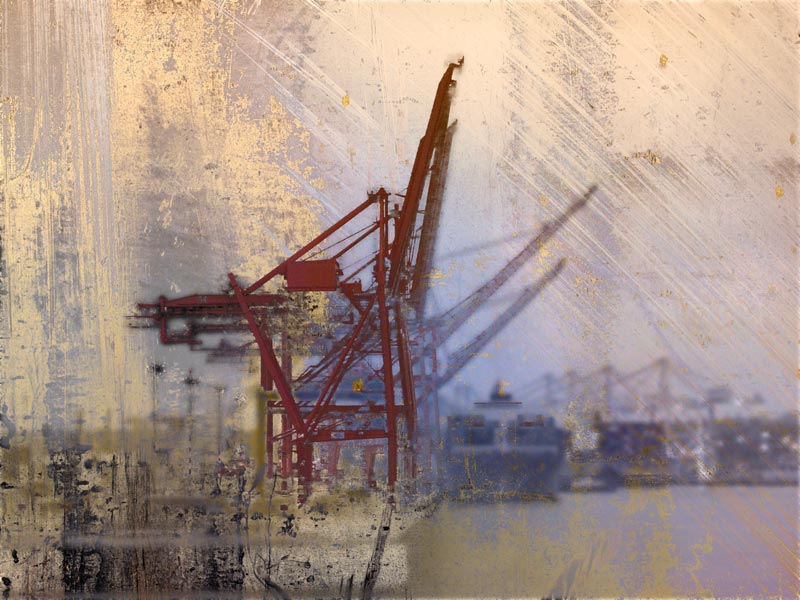
The Port Morning

The Port, Morning, Digital Mixed Media Collage, 20″ x 27″

This piece from the new series in progress on Infrastructure is an appreciation of the cranes at Terminal 46 at the Port of Seattle. I took a photo with my phone in terrible lighting from the ferry as I was heading to Bainbridge Island. The very terribleness turned out to be exactly what I was looking for when I started working, although it took awhile for me to figure that out. I was drawn first to the collision of atmosphere and industry, and the elegiac sense of voyage and retrospect that the view from the ferry inspires. Then I fought for several weeks as I visited and revisited the image — fought with the very ‘industrialness’ that I loved in the first glimpse — exactly how bright do you want the floodlights to be anyway?? Aren’t those lights just basically ugly compared to the Rosy Dawn and the Dusky Gloaming? Along the way I have been learning a lot about what I’m actually looking at. (For instance, here you will learn everything you’ve ever wondered about the Terminal 46 lighting retrofit, and “foot candles” and pick up the term “light trespass.”) Embedded in this image are the textures of place collected from the Terminal and its surroundings.

The terminals are a place at the heart of recent controversies. The Port has pushed back on a proposal for a new third stadium in SODO, questioning the effect of yet another sports arena on the ability of the Port to get its trucks and trains through traffic. Simultaneously, coal trains could be coming soon if the coal port is approved at Cherry Point, with as many as 18 additional trains a day passing through the waterfront area and adding an estimated 90 minutes of traffic delays to an already congested area. If you would like to participate in what is sure to be a rousing civic event you may want to attend the panel discussion on the coal train proposal coming up at Town Hall on February 13th.

It is easy, if you are not a longshoreman or employed at the Port, to take the waterfront and a humming industrial infrastructure for granted. But as I did more research on Seattle’s maritime industry I came across remarkable stories and archival photographs documenting a history of upheaval. The site where crane number 54 sits once hosted Seattle’s own Hooverville. Between 1931 and 1941 over a thousand men called this home, living in a state of what a sociology student of the time termed “insane disorder.” This fascinating site documenting the Great Depression in Seattle tells the story. I stumbled across a fabulous image bank when I entered “Skinner and Eddy Shipyard 1918” in google. The link is too long to accurately place, but if you go to the image search you will find a trove of historical photographs of the waterfront, several of which have the epic quality of the opening scene of “Les Miserables.” The Port of Seattle website shows fascinating glimpses of the brutal labor history of our state with a portrait of Terminal 91 and The Battle of Smith Cove. WTO was just one in a long history of eruptions and disruptions. In spite of the Northwest’s stupefying natural beauty the people don’t seem to be pacified by it, and they don’t take social and economic change lying down.

Art that is about sense of place is inevitably also about history. If you capture place you enter a field of echoes.  The thousands of accumulated abrasions, erasures, collisions, decisions, accidents and intentions, the changing weather of time’s passage, is embedded in everything you see. This is close cousin to “patina,” and you can find the loveliness of surface imperfection mass manufactured at Pottery Barn or the aptly named Pier 1. But it is also real, and it is everywhere around us in what is useful and working and necessary. It is a door into time.
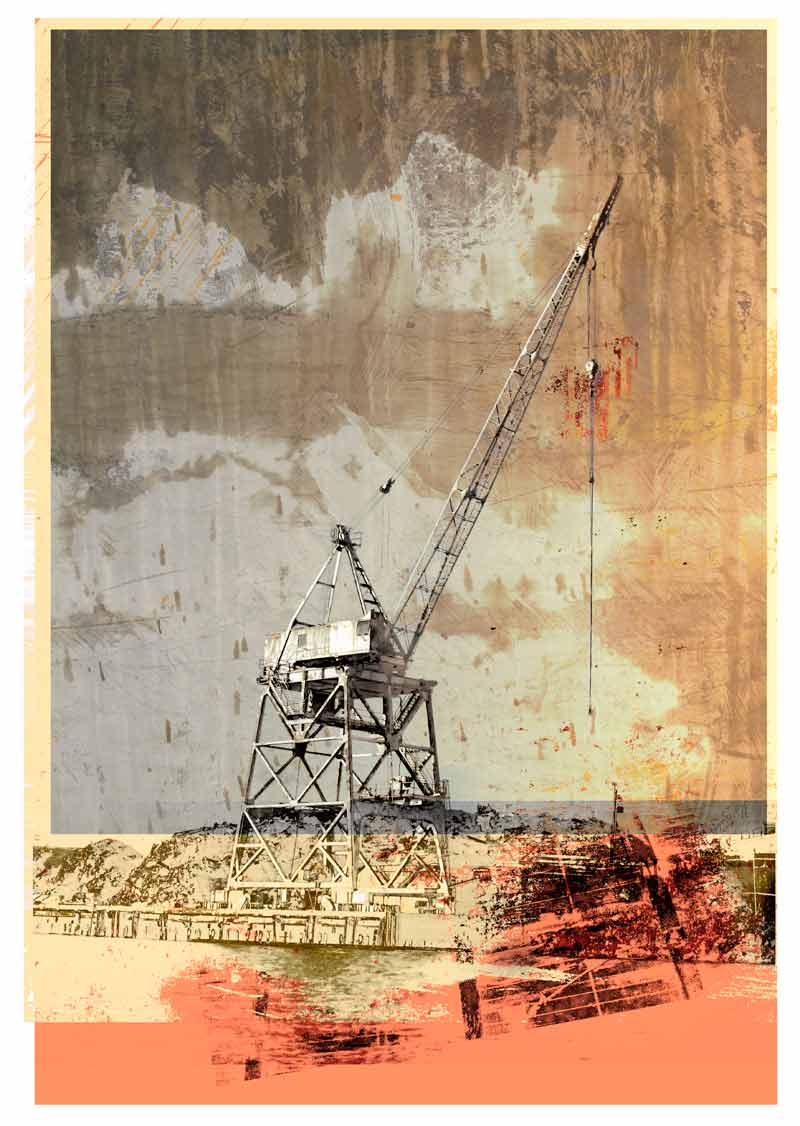
Duwamish 2
Duwamish 2, Mixed Media Digital Collage, 30″ x 22

This morning I delivered a set of new large prints to the Seattle Art Museum Gallery, including “The Port” above. The framed prints range from 32 x 40 to slightly smaller, and will be up at the gallery in the next few days. In printing larger pieces it has been a wonderful experience to work with The Color Group. The ink on the new Canon 9400 has really breath-taking vibrance, and particularly on Hahnemuhle German Etching this printer takes the medium beyond what I’ve seen before, with a unique blending of surface qualities similar to silkscreen or traditional lithography. I hope you will stop in to see the work in person. *Update: the work seems to be flying out the door, so go soon! These are editions of 20 so if a piece is gone that you like you can contact me about additional prints. The Pale Cranes might be my favorite, and it went out before it even got up on the wall.
Filed Under: Prints Tagged With: atmosphere and industry, cranes in the mist, cranes on Waterfront, mixed media print of infrastructure, Port of Seattle, seattle maritime history, Terminal 46

Conversation With Myself (while I waited for you to make up your mind….)

December 12, 2012 by Iskra Leave a Comment

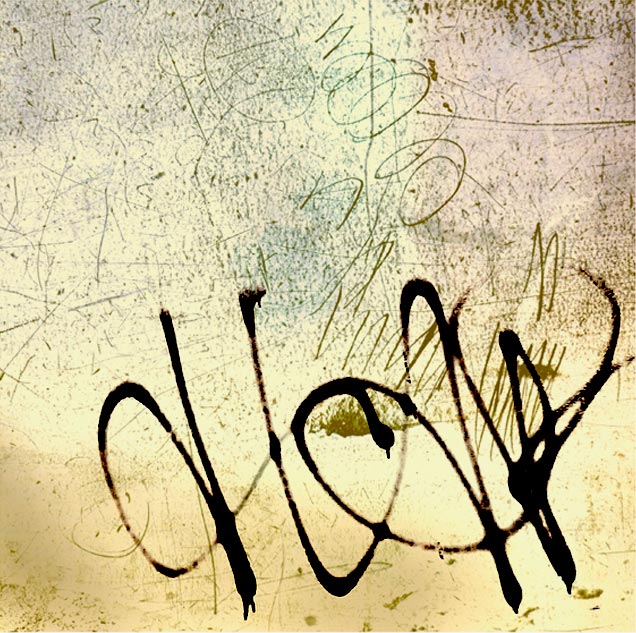
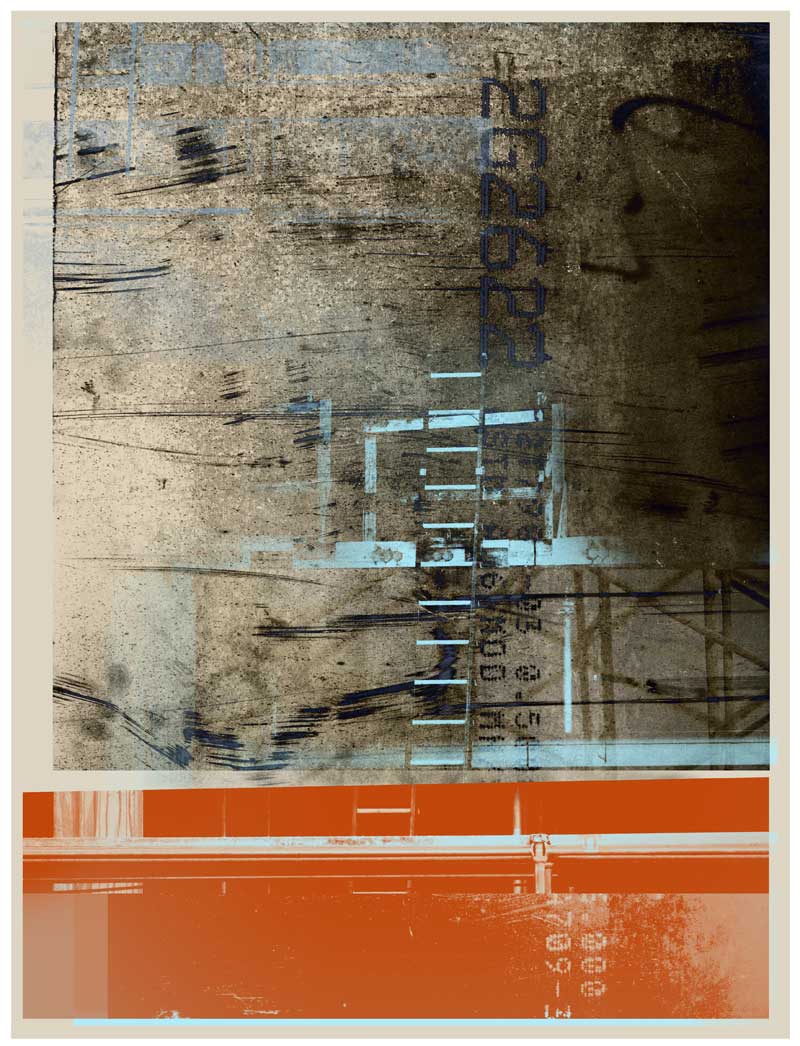
Conversation With Myself

“Conversation With Myself, While I Waited for You to Make up Your Mind…..” © Iskra Johnson

This is the first in a new series about urban language. Composition assembled from the broken sentences around me: re-purposing. RE-listening, taking back the marks on the random public/private canvas.  Rewinding that David Byrne movie “Stop Making Sense.” I think I’ll call it The Wailing Wall. People just can’t stop talking.

Filed Under: Digital Collage, Prints Tagged With: digital collage, found poetry, street poetry

Viktoria Viktoria Site Study: Future Residential on Second Avenue

October 5, 2012 by Iskra 4 Comments

It is exhilarating beyond measure to be alive in Seattle during this endless Indian Summer. (By the way, before using this phrase, this being the city of all things politically correct, I spent an hour researching whether in fact it is politically okay to use this phrase. I am going to go with this: As the American Indians were reportedly the first to notice the loveliness of this time and to celebrate the harvest by looking at the light and perhaps smoking a pipe rather than engaging in more frantic scurrying, worrying and stacking of crops in the barn (as the pale settlers were wont), when the phrase is invoked by a non-Indian person caught up in the intoxicating Autumnal rhapsodies it is in fact an homage to the wisdom of the First Nations, and understood as such.) Whew.

So I walk around, temporarily off the hook, and I can’t help but notice but the city is damn fine beautiful. I am sure nature is also doing something, but the construction sites are in their prime, as in primary colors, none of this faded pink of cosmos and hydrangeas and plum feather grass. Give me the street, the baylight glinting on scaffolds and glass, the scattered jump rope song of grafitti and the fifteen people gathered to watch the man in the Mercedes try to park his car in the the lot on Second Avenue with one-sixteenth inch margin of error and a flawless polish on that fender. Pretty much anytime of day is good light, because we actually have light which makes, yes, shadow. If you live here, you know.

Here is a piece that will probably go through another fifty iterations, but which has landed here, comfortably, for the moment. The rule for this series, (thank you John Cage for pointing out how necessary rules are in your fine book Silence) are simple. All elements of photographic evidence must come from an actual construction site. Paint and other elements layered into the work may come from my drawing table.

ViktoriaViktoria_Construction_Project_Photocollage
ViktoriaViktoria, 24 x 19 inches, photocollage, © Iskra Johnson


Filed Under: Construction/Reconstruction, Digital Collage, Photocollage, Prints Tagged With: construciton site collage, construciton site photography, digital collage of construction site, photocollage of building

What is a Transfer Print? (Artist Statement)

April 26, 2012 by Iskra 4 Comments

In a transfer print the plate is created by printing files from a computer imaging program like Photoshop onto an acetate carrier sheet. For initial output I use an Epson 3800 with archival ink. After the carrier sheet is sprayed with a solvent  the ink becomes liquified enough to transfer to paper or another surface through careful burnishing. Alternatively the plate is pressed by hand or roller onto a sheet of paper that has been soaked with gel alcohol, a solvent that transfers the ink to the paper without harming the paper’s surface. Each paper takes the ink completely differently. Soft watercolor or printmaking papers may absorb the ink with a fair amount of predictability, while others react with magical surface qualities that have a life of their own. The effects range from the dry paper-texture of letterpress to a granulation similar to aquatint or the watery translucency of traditional monoprints.

It takes a great deal of repetition and attention to detail to pull one successful print. I have learned that timing, humidity, pressure, and subtle overprinting or vandalism of the same plate multiple times can all have an effect on the image and whether it succeeds. In many ways the moment of printing is like calligraphy in its exactitude, physicality and openness to the accidents of the moment.

The photographic transfer process allows me to work with the full-color lushness of photographic reality. Like traditional printmaking there is a plate, and it is hands on, but unlike traditional processes you can print all colors at once. I’m really trying to figure out where a photograph lives in the world now. I love the luminous intensity of photography when seen on screen, but when the computer shuts off the image is gone. Photographs on paper don’t have the same back-lit radiance, and unless they are very carefully printed on fine paper, they may feel less like a “print” and more like “output.” In some ways, with the dazzling improvements in retina display, the computer monitor version of a photograph may begin to feel more like the “original” and the paper print the lesser reproduction.  Our world now has trillions of images, with more being born every second, an endless stream of brilliant photographic candy flowing across our monitors and phones. The sheer volume and immediacy of images, the constant now leaves no time for absorption (or what used to be called “meaning”) and threatens to wear out our collective synapses. What can a print, a fixed piece of paper, offer in this new world?

I am interested in artifact, object, a thing of presence that arrests you, makes you pause, and puts you back in human-centered time. But I also think the human brain is being reconfigured by new technologies, and they can’t really be ignored. The way Photoshop builds images mirrors our minds and how we remember and layer experience. Photoshop also mirrors a printing press, with the ability to stack “plates” in layers, with each layer affecting the one below in truly magical ways that can only be done with this tool. What interests me is how the new media can be integrated with the old, the tactile with the digital.

The transfer process is time intensive and very sensual. Every inch of the image is transferred by the pressure of my hand as the damp paper takes the ink from the plate. It can take up to a dozen prints to get one that has just the right balance of subtle surface texture and ink density, and each print takes about an hour to completely transfer. The images layered into the final plate merge digital photographic elements, enlargements of older analog prints, and the other media I work in, such as powdered pigment and paint. It’s exciting to feel that two very different worlds can be integrated. Older ways of making are not “obsolete” — they can be revisioned and combined with the new in ways that reflect the complexity of what it is to be alive in this time.

Filed Under: Transfer Prints Tagged With: about transfer prints, digital printing, modern printing methods, monoprint, photographicness, photography, the camera's eye, the street, what is a transfer print?, work about the camera

Still Life with History and Industry

April 23, 2012 by Iskra

Still Life With History and Industry
Still Life with History and Industry, transfer print, © Iskra Johnson

Filed Under: Photography, Transfer Prints Tagged With: harbor island, industrial landscape, transfer print

  • « Previous Page
  • 1
  • …
  • 8
  • 9
  • 10
  • 11
  • 12
  • …
  • 16
  • Next Page »

Join Iskra’s Mailing List

Don't miss a thing! Subscribe to receive show announcements, first peek at new work and my semi-monthly blog by email. I primarily use the blog for news and updates but by signing up you will also receive the occasional newsletter and special offers for items in my shop.

Iskra Fine Art Blog

the creative process | conversations with artists | the contemplative impulse in art

Instagram

The photography show opening Friday, October 9th a The photography show opening Friday, October 9th at Slip Gallery is curated by my friend and fellow photographer, Scott Wipperman. This seemed like a good time to share his work and the story of our friendship on the road. Half the photographs are his and half are mine. This is an excerpt, and you can read the rest of it on my blog, see link tree in bio:

One of the rarest gifts in the life of an artist is finding a creative muse: someone who truly sees your work, and better yet, has a similar vision that is just enough different that you can collaborate without competing. In the often solitary studio life these connections can be difficult to find, but during pandemic, Instagram brought a new creative companion into my life. I do not know who started following who first. But in May 2020 I found myself sharing instant messages with a photographer working under the name “Concrete spaces“— a handle that immediately piqued my interest. Concrete has been one of my obsessions for years. Miraculously, there was someone out there who understood why I was working on a book called Parking Lot Floors Of North America. . .

©️Scott Wippermann

©️Scott Wippermann

©️Scott Wippermann

©️Scott Wippermann

©️Iskra Johnson

©️Iskra Johnson

©️Iskra Johnson

©️Scott Wippermann

©️Iskra Johnson
I am excited to be part of a show opening Friday, I am excited to be part of a show opening Friday, October 9th featuring eight Seattle  photographers and curated by Scott Wipperman @concretespaces at Slip Gallery. The theme of this show is complex and interesting: Intimate Structures. How the human body and human emotions connect with the built environment. And how the structures in our environment shape our lives, our relationships, and our possibilities. I will be showing industrial landscape as well as six pieces from the series “Immersions” based on tableaus of human relationship captured at Seattle’s waterlines. A diving platform is a stage, and the summer season a riveting drama of ever-shifting players. Most of these pieces have not been shown before.

I’m fascinated by the work of the seven other photographers, each one approaching the theme of the show from a completely different perspective, using both traditional photography and contemporary experimental techniques. Alienation, sublimation, meditation, connection:
Annie Regerson
Dimitri Wessendorf
Gillian Peckham
Iskra Johnson
Janis Mathieson
Mack Greene
Nina Bolger
Scott Wipperman
I hope to see you there!

The runs until the end of October. 
Thursday – Friday: 1:00 PM – 6:00 PM
Saturday – Sunday: 1:00 PM – 4:00 PM

Slip Gallery
2301 First Avenue in Belltown

Two Divers ©️Iskra Johnson

Guardian ©️Iskra Johnson
Morning Pages: Doors The first thing I saw when I Morning Pages: Doors

The first thing I saw when I woke up this morning was shadows on a door. Last night, I dreamt of an old building, one I have visited in dreams for years. It is a co-op apartment in some imaginary Canadian city, on a long steep hill above which are what appear to be the Swiss Alps. It was built in the early 1900’s and has grand staircases and balconies, huge rooms, bronze doorknobs and leaded glass windows. In my dreams, I interview with the board, I make an offer and I even buy an apartment— and then suddenly the door of my new home opens into a parking lot or a garage or someone else’s basement and I wake up and check my bank account, mystified by the power of this particular place, and how opening a door universally signals a new chapter in the story. 

Doors and windows are the most metaphoric parts of architecture. 100 years ago builders understood the attention they deserved. Now I live in a city where we have torn down historic churches, dumped the stained glass into a landfill and replaced these devotional structures with stacked box apartment complexes covered with Hardie Plank. I’m watching million dollar houses go up in my neighborhood with the cheapest vinyl windows from Home Depot, no eaves and often no roof— simply a flat lid to seal the box — and no trim at all. It is architecture as expedience, and it degrades the experience of how we see and experience the commons, and our human values, because, as Churchill noted, “We shape our buildings and afterward our buildings shape us.” 

We don’t look twice at these new houses, whereas I can look at this particular building somewhere in England for hours. Whoever built this wall took great care. They used the art of subtraction to add rather than to diminish. The vast flat wall of stone, the curved lintels, make the windows and doors speak. The doors and windows are not grand, but curiously condensed. They are portals through which one must squeeze with effort, which makes a person pause, and wonder. Later, they may find themselves dreaming of what is behind the walls.
Westminster Mall deconstruction project. I had to Westminster Mall deconstruction project. I had to go to the Department of Licensing this morning and stand in line and it gave me an opportunity to watch the Sears building come down. Sears was the last place left in the Seattle area where you could buy a vacuum cleaner from a man wearing creased polyester slacks, a tucked in shirt and an engraved name badge making a commission on the number of vacuum cleaner bags you bought to go with the Electrolux. I fondly remember my conversations about uprights versus canisters. This building is where I bought a snowsuit for a child that just barely fit me the day we had the epic snow and I was caught unprepared. I walked a mile on ice to get to Sears and then left looking like a nine year-old robot trying to get my knees to bend and move swaddled in 4 inches of poly blend padding. But I was warm! I doubt that anything that goes up this year in the Westminster Mall will last as long as Sears did. And there will be no catalogue unless I create one.
Excited tonight for the opening of Art and Steel a Excited tonight for the opening of Art and Steel at Youngstown Cultural Center! This is primarily a painting show from the Plein Air Watercolorists Association of Seattle (although I don’t think any of us were actually painting inside the mill on our tour!) I have been included as a photographer and mixed media artist, see last image in carousel, “Glide.” 

An exhibition of paintings telling the story of steel fabrication at NUCOR mill, hosted by Delridge Neighborhood Dev Association.

Friday, September 18 | 6:30 PM - 9:00 PM
Join us for a special evening celebrating art, industry, and community.

This exhibition features original paintings that tell the story of steel fabrication at the NUCOR Mill, presented by the Delridge Neighborhood Development Association (DNDA).
The evening will include a panel discussion, light refreshments, and an opportunity to learn more about the intersection of art, labor, and local history.

All donations made during the event will be matched and directed to DNDA’s Art Education Programs, helping support creative opportunities in our community.
Friday was my birthday. 9.11 is a day of remembran Friday was my birthday. 9.11 is a day of remembrance and national tragedy, and it seems bizarre to claim some kind of importance for having been being born on that day in the context of the event. 

Several days after, I allow myself reflection on the passage of time. This is me 15 years ago, with my Canon Powershot, which offers an astonishing naive pre-Cabrian 6 Mb image. It was much more kind than today's 24 MP iPhone, which not only captures the older me but turns that version into a character from Shakespeare with hi-def Bertrand Russel thought lines above my eyebrows and unforgiving evidence of allergies and time. 

On reflection I realize that 2011 was a very good year. I am going to allow myself to be that person for the month, and remember what that was like. The love of my life from the 8th grade had come to stay with me that summer. He took terrible photos of me that I now realize were not so bad. 99% of of the corrosive social media influences had not been invented yet. Women over whatever age was deemed desirable were not subjected to an ad every minute telling us that a new part of our face or body had gone south, and offering us a (discounted! on sale! watch the entire 30 minute video!!) $165 remedy on a monthly subscription to fix it. 

Now every day I look at the thinking and brooding lines above my eyebrows (which are also the lines caused by considering how funny some things can be even when crying) and ask myself what Bertrand Russel would say. If you are too young to know that name, AI is your ever-friend and will tell you how you too can become a "towering British philosopher, logician, mathematician, and social critic" and also how to fix those lines that come from considering things with your face. 

I think my romance with the iPhone is coming to a partial close. I want to go back to the idea of “glass.” It costs serious wages. It is made by Germans— Lately, (subtract the umlaut) Sony, the wizards of sand and heat and bending light to high high focus. I need to return to optics, f-stop, aperture, focal length— words that require frowning. 61 megapixels seems like the bare minimum. There is no cosmetic cure to being a lens-based artist:))

Featured Posts

  • Book Launch! The Water Tower Project from Iskra Fine Art
  • How to Purchase Artwork from Iskra Fine Art
  • About This Blog
  • New Directions in Contemplative Art: Conversations with Artists
  • What is a Transfer Print? (Artist Statement)

Categories

  • Abstract Calligraphy
  • Architecture & Sense of Place
    • Construction/Reconstruction
    • The Alaska Way Viaduct
    • The Water Tower Project
  • Art Reviews
  • Artist Studio Visits
    • The Mystic Muse: Artists Working in the Contemplative Traditions
  • Botanical Art
    • Botanical Art Cards
  • Collage
    • Digital Collage
  • Commissioned Art
  • Drawing
  • Essays
    • Object Lessons: Essays and images inspired by "A History of the World in 100 Objects."
  • Iskra Shows, Upcoming and Past
  • Iskra Sketchbooks & Journals
  • Living With Art
  • Meditation & Buddhism
  • Mixed Media
  • Painting
  • Photocollage
  • Photography
    • American West Landscape Photography
  • Print Sale
  • Prints
    • Transfer Prints
  • Seattle Iconic Landscape Prints
  • Social Media for Artists
    • The 100 Day Projects
  • The Garden
    • The Gardener's Almanac of Irreproducible Phenomena
  • The Spiritual in Art
  • Travel
    • Road Trips
  • Uncategorized

Archives

Search

Connect on Facebook

Iskra Fine Art Facebook Page

Creative Inspiration

  • Alternative Photography
  • An Artist's Retreat
  • Anonymous Chinese Textile Genius: Moo Won
  • Chocolate Is A Verb
  • Contemplative Art Process: Danila Rumold
  • Eva Isaksen
  • Old Industrial Japan
  • The Altered Page
  • The Heart Sutra Loop
  • The Patra Passage

Galleries for Contemplative Art

  • ArtXchange Gallery
  • Seattle Asian Art Museum

Links

  • CollageArt.org
  • Iskra at SAM Gallery
  • Iskra Fine Art on Houzz
  • Seattle Art Museum Blog
  • Seattle Artist League
  • Seattle Print Arts
  • Seeing Fresh: Contemplative Photography
  • The Painter's Keys

What I'm Reading: Online Magazines and Books I Love

  • 16 mi.
  • Essays by David Whyte
  • Evening Will Come: Poetry
  • Hyperallergic
  • Painter's Table
  • Shu: Reinventing Books in Contemporary Chinese Art
  • Streetsy
  • The Original Van Gogh's Ear Anthology
  • Tricycle Magazine
  • Unincorporated Persons in the Late Honda Dynasty
  • Vanguard

Let’s Connect

  • Contact Iskra
  • How to purchase artwork
  • Iskra Fine Art Blog : The creative process, conversations with artists, the contemplative impulse in art
  • Facebook
  • Instagram
  • Pinterest
  • Twitter

All Images Copyright © 2026  Iskra Johnson · Site by LND · WordPress