Iskra Fine Art

  • Prints
    • The Tarmac Residency: Airport Landscapes
    • Immersions | At The Shore
    • ColorBath: Images of the Harbor
    • The Floating World
    • Industrial Strength | Urban Industrial Landscape
    • The Scaffold
    • Industrial Pastorale: The Rural/Urban Landscape
    • Botanical Prints | The Natural World
    • Construction | Reconstruction : Urban Landscape
    • Infrastructure
  • Drawings
    • Pencil Drawings: Pandemic Pause
    • Drawings in Dust 1
    • Signs & Symbols (Archive)
    • Botanical Drawings (Archive)
  • Photography
    • New Work Inspired by England
    • Seattle Waterfront Park Photography
    • Architectural Photography | Construction Sites
    • American West Landscape Photography
  • Mixed Media
    • Modern Botanical | Mixed Media on Plaster
    • From the Sea | Water Paintings
    • Sleep Studies
  • Wabi Sabi Abstract
    • Minimalist Modern
    • Ink Painting Abstractions
  • Shop
    • The Water Tower Project
  • About
    • Contact
  • Blog
You are here: Home / Meditation & Buddhism / Object Lessons: The Television Buddha

Object Lessons: The Television Buddha

August 15, 2012 by Iskra 1 Comment

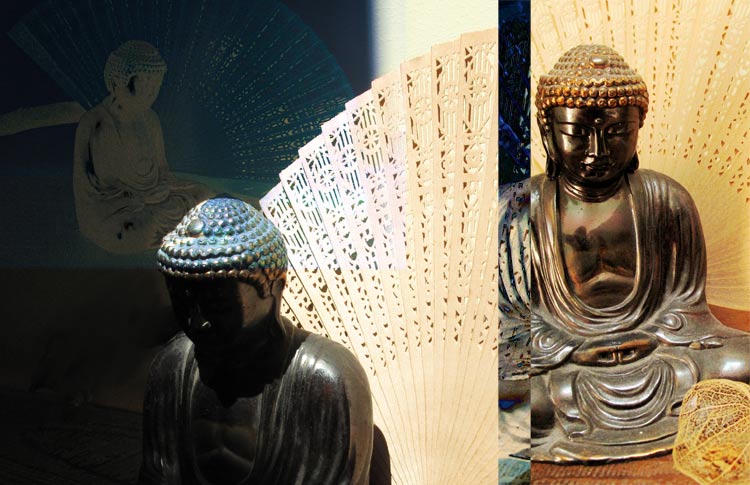
Television_Buddha_Digital_Collage
The Television Buddha © Iskra Johnson

The Black Buddha, otherwise known as the “television Buddha” sat for years on my step-grandmother’s TV, his head unironically posed between two silver antennae. Even as a child who had not yet been taught the niceties of good taste I could tell that this statue, although hollow like my milk chocolate Easter bunny, was a Prince among objects. Where the black paint had rubbed away copper glinted. His robes had the sharp cast and sheen only found in metal, and when I picked him up and set him down I could tell he belonged to a different family of dolls.

At some point in my late teens, after reading a book or two by Alan Watts and becoming instantly hip and knowing, which I eagerly confused with being enlightened, it occurred to me that this object belonged in my life. Did I steal it? Did I stand in front of the television as though mesmerized by the cheap print of VanGogh sunflowers and off-handedly tuck the Buddha into my coat? I have a vague memory of light on a dusty window, of the pine tree outside, of family noise and clatter and a moment of rationalization. I hope I asked.

This Buddha has gone with me to every room I have lived in, presided over my inkstone and rice paper and the copying of sutras and 4 AM yoga sessions and detours into Gurdjieff, Guru Mai, and Yogananda. He has never gained or lost weight, or criticized me for being delusional, or asked for water, or offered a word of advice. For years at a time I have not actually looked at him; I’ve even lost him on occasion– buried in a box under the bed. Then I will find him and the fact of him starts all over again. The Buddha is a resonant object, and my mind changes when I look at him.

I puzzle over this quite a bit. What is this alchemy of the object? The historical and real person of Siddhartha, who became the Buddha, never asked to be made into a figurine. In fact the Buddha himself discouraged this as dangerous close-cousin to the worship of idols. Only the image of his footsteps was allowed or perhaps the trace of a wave on the shore, or a hand.  Yet today I doubt that any Buddhist anywhere meditates without some image in their mind of –not the breathing, sweating actual human being — but the statue.  Leave it to the Greeks to ruin a good thing, the void and the imagination, and to supplant it with idealized form. And now you can buy a guy in a robe with snails on his head anywhere, online next to blinking ads for a flat belly, or in an import store or from a catalogue full of clocks that wake you up with the sound of the ocean.

Through hundreds of years and thousands of places of manufacture, the significant details of the sitting Buddha rarely change. The graceful sloping of the shoulders, the relaxed ease and the simultaneous sense of absolute focus, the circuit of small spheres along the head. And form is important. The shape of the saints is common, but it is not ordinary. The power of shape is a mystery, devotional practice equally so.
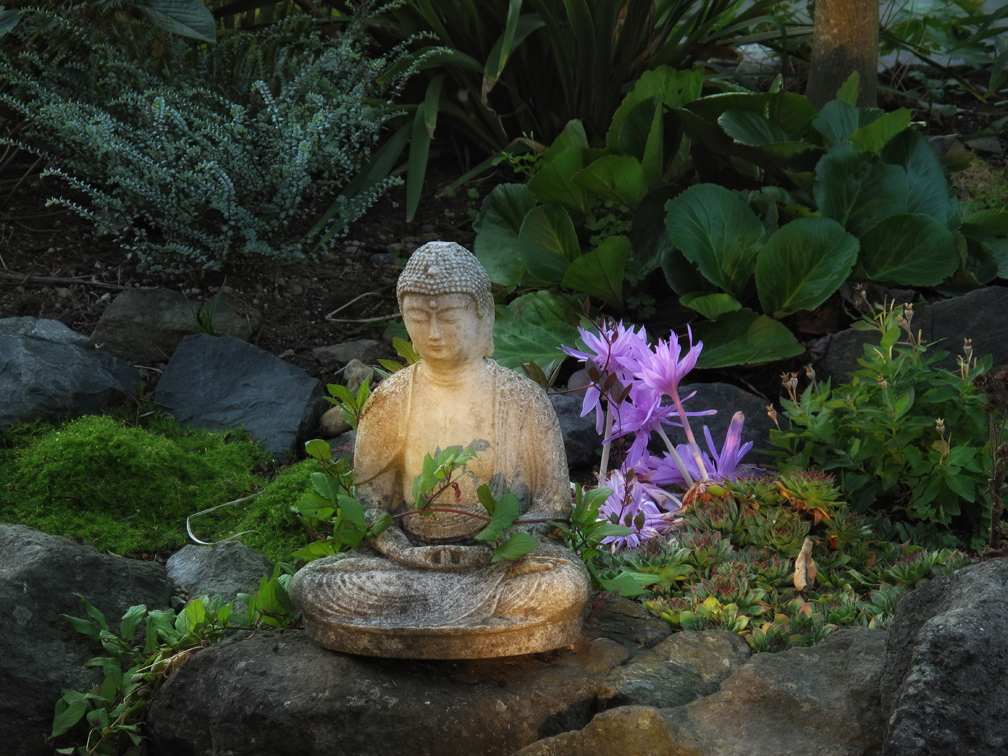
Buddha_Garden_Statue
The Standard Concrete Garden Buddha

I have a second Buddha, a pale gray version mass produced and bought at a nursery twenty years ago. He has sat long enough in my garden to acquire the iridescent sheen of actual snails across his knees. Together both statues, indoor and outdoor, do a fine job of gentle reproach as I plunder time and waste it in mindless daily orbit. You would think two would be enough. However, I was seized this spring with a sudden overwhelming desire for a new Buddha, something life-size. I became completely obsessed with the idea that a statue was waiting for me and I had to find it right now. So abandoning my other obligations for a day I scoured every Asian import store in the city. The closest I came to my imagined find was a graceful, stupefyingly beautiful Thai god (god of what, I’m not sure) made of fragile wood and $15,000.87 out of my price range. As I started to leave the shop, my obsession defeated, I noticed the chairs. Simple, magnetically so, projecting a deadpan stoic humor and covered with the patina of decades in an outdoor cinema. If one wanted a reminder to “sit” what could be more potent than a chair, after all? I sat. In spite of the barracks-style severity the chair was surprisingly comfortable. And you can bargain for chairs, although you would never bargain for a Buddha.
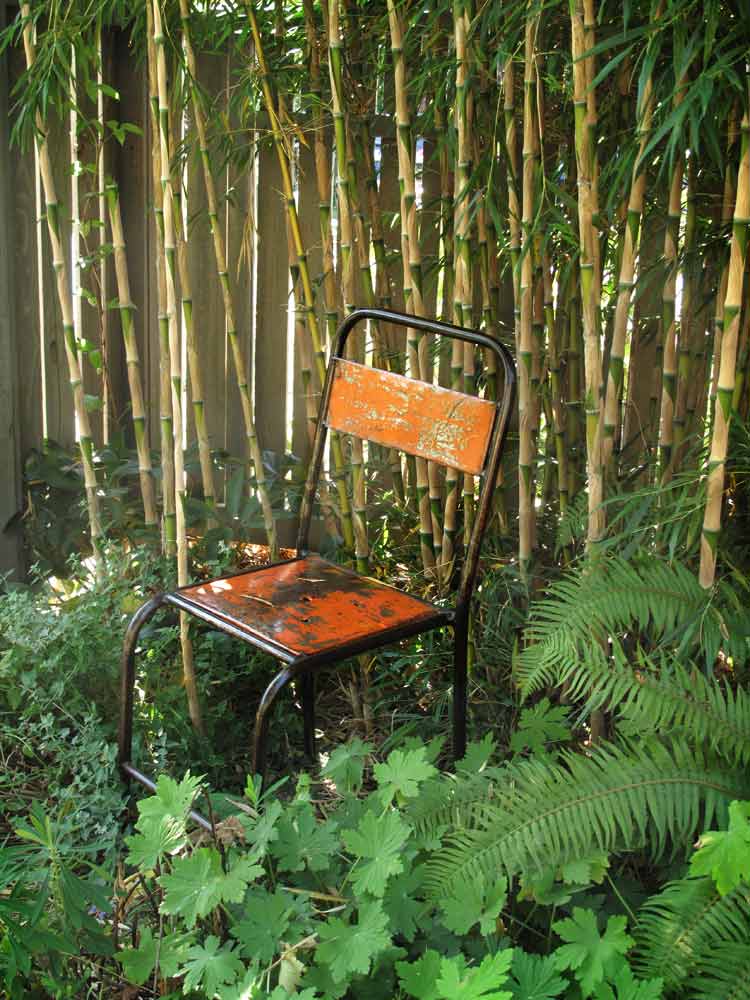
The-Sitting-Chair
The Sitting Chair © Iskra Johnson

This is my new garden statue, for now. It lives in the bamboo reminding me to be still, to just sit.

__________________________________________

This is the first in an upcoming series of essays on Buddhist iconography in art and daily life. I will be featuring interviews with artists who work in a variety of contemplative paths, ranging from traditional devotional art to contemporary improvisations, in media ranging from painting and drawing to sculpture, music and video. If you are interested in the subject of the object as a source of contemplation you may want to visit the section of my blog that focuses on response to the book “A History of the World in 100 Objects.”

Filed Under: Meditation & Buddhism, Object Lessons: Essays and images inspired by "A History of the World in 100 Objects.", The Garden, The Spiritual in Art Tagged With: Buddha statues, devotional practice, devotional statues, objects of meditation, the Black Buddha, The Television Buddha

Trackbacks

  1. Reflections on Buddha statutes and Iskra’s chair – Secular Buddhist Network says:
    August 10, 2019 at 6:28 am

    […] a recent blog post, Object Lessons: The Television Buddha, Seattle artist Iskra Johnson wrote about the statue which sat on top of her step-grandmother’s […]

    Reply

Leave a Reply Cancel reply

Your email address will not be published. Required fields are marked *

This site uses Akismet to reduce spam. Learn how your comment data is processed.

Join Iskra’s Mailing List

Don't miss a thing! Subscribe to receive show announcements, first peek at new work and my semi-monthly blog by email. I primarily use the blog for news and updates but by signing up you will also receive the occasional newsletter and special offers for items in my shop.

Iskra Fine Art Blog

the creative process | conversations with artists | the contemplative impulse in art

Instagram

At 18, in my first year in class at Cornish, Charl At 18, in my first year in class at Cornish, Charles Stokes said: “To be an artist, first you must learn to visualize. Your assignment is to go home, close your eyes, and visualize an apple. Rotate it and observe how it looks from every direction, as though you were God and you had just designed this fruit. Then imagine cutting it into pieces and turn each piece in your mind’s eye. If you need to get in the bathtub, do.” A year later, my skin had turned permanently pink from baths, but I was beginning to be able to See. That moment when I really could imagine the apple from above, below, the side, and visualize the slices falling away was a revelation. The cherubim cheered. Today I can shut my eyes in any moment of boredom and see the apple rotate like a muffin on a dim sum tray, round and round, the highlights glinting.

Apples also nearly killed me. When I was 19, I worked for a month in the orchards of Orondo, and slept under the trees in a sleeping bag and little else. Each morning I woke to the drone of crop dusters and the pale white incandescence of pesticides sifting through the leaves. My water came from a galvanized pipe fed directly by the irrigation ditch. Me and Caesar Chavez? Solidaridad. I came back from the orchard with a stomach malady that defeated every doctor I saw. Over the ten years following I lost 32 pounds, and I had been slender to start. At 27 I came within three weeks of death. Over that decade I was tested for everything, and my body claimed an allergy to every food except the pinto bean. No amount of antibiotics or enzymes or the primitive curatives of those days worked. After this inexplicable and punishing siege on my health it took years to get back to food as a good idea. I lived on boiled carrots and rice. The one possible argument to inexplicable: every alternative medicine healer found indications of arsenic, a prime ingredient of pesticides and known disruptor of the digestive tract. (Continued in next comment, complete essay at link in bio.)
Exquisite work by @christinegedye @fountainheadgal Exquisite work by @christinegedye @fountainheadgallery.
Experiments in juxtaposition. Yesterday I worked Experiments in juxtaposition. 

Yesterday I worked in the studio to some kind of divine mix of Raga and drone and hand pan drum and returned to the state of mind I’m here for. 

This study of an eggshell is only incidentally an eggshell; it is any fragile thing regarded with love. I think of the days when there was an antique shop on every block and I would haunt them and find among the watering cans and spoons and rusted winches a lace handkerchief starched and embroidered with imagined daisies by some woman crossing the country in a covered wagon with a packet of seeds. I held the cloth up and watched clerestory light fall from the rafters and transform its quiet folds into something burning, heard the sounding bells of ships in the harbor, the train rumbling in the tunnel, people stumbling and laughing on the boardwalk. 

Light is the keeper of history. As we walked out of the steel plant last week, steam mingled with clouds and enveloped the massive structures around us in softness. Just before my camera died, I took this picture of a steel door. On its face, the flag of an imagined country, stripped of warp and weft and left with only traces. As the world hangs on the edge, held by the flimsiest of props, each day aims another missile at certainty. We still have memory, and that may save us.

#TheFragilityProject
Slow Art. The beat helps tune out the Everything E Slow Art. The beat helps tune out the Everything Else Going On. . .#graphitepencil
I am excited to be part of the annual open studio I am excited to be part of the annual open studio tour for 
Spotlight North 2026, Noon to 5 May 16+17! 
Meet the artists of Shoreline, North Seattle, 
and Lake Forest Park in their native habitat: 

Robin Arnitz, Anna Wetzel Artz, Laura Brodax, Shruti Ghatak, Eva Isaksen, Amanda Knowles, Sarah Norsworthy, Paul Leavitt, Paul Lewing, Iskra Johnson, Dale Lindman, and Shoko Zama.

I will be showing new drawings and paintings influenced by nature and place, as well as ongoing print work, and several new card series. Many people have told me they would love to collect more but their walls are full, or they are moving into smaller spaces. In response, I have created new tiny works you can set on your desk or slip into the spice rack between the oregano and the thyme. I have always loved the intimacy of small work: It is the quietest most personal of conversations. These three pieces are from the hundreds of media studies I do to see “what happens if,” in an experimental state of mind. They are made with a combination of liquid graphite, pencil and paint, and presented like tiny one-of-a kind etchings. Contact me if you are interested in pre-purchase.
Link in bio to the Spotlight North Website. The map will be posted soon!
First glimpse of the Nucor Steel Plant. Probably t First glimpse of the Nucor Steel Plant. Probably the most amazing photo shoot I have ever been on. It will take me months to know what to do with the hundreds of images from this amazing day. Thank you Seattle plein air painters for this rare opportunity. Thank God we had dedicated minders to keep us from falling off the stairs and to help us adjust to the three layers of gear, hard hat, ear coverings, goggles, vest (hint: you need all of them!)

Featured Posts

  • Book Launch! The Water Tower Project from Iskra Fine Art
  • How to Purchase Artwork from Iskra Fine Art
  • About This Blog
  • New Directions in Contemplative Art: Conversations with Artists
  • What is a Transfer Print? (Artist Statement)

Categories

  • Abstract Calligraphy
  • Architecture & Sense of Place
    • Construction/Reconstruction
    • The Alaska Way Viaduct
    • The Water Tower Project
  • Art Reviews
  • Artist Studio Visits
    • The Mystic Muse: Artists Working in the Contemplative Traditions
  • Botanical Art
    • Botanical Art Cards
  • Collage
    • Digital Collage
  • Commissioned Art
  • Drawing
  • Essays
    • Object Lessons: Essays and images inspired by "A History of the World in 100 Objects."
  • Iskra Shows, Upcoming and Past
  • Iskra Sketchbooks & Journals
  • Living With Art
  • Meditation & Buddhism
  • Mixed Media
  • Painting
  • Photocollage
  • Photography
    • American West Landscape Photography
  • Print Sale
  • Prints
    • Transfer Prints
  • Seattle Iconic Landscape Prints
  • Social Media for Artists
    • The 100 Day Projects
  • The Garden
    • The Gardener's Almanac of Irreproducible Phenomena
  • The Spiritual in Art
  • Travel
    • Road Trips
  • Uncategorized

Archives

Search

Connect on Facebook

Iskra Fine Art Facebook Page

Creative Inspiration

  • Alternative Photography
  • An Artist's Retreat
  • Anonymous Chinese Textile Genius: Moo Won
  • Chocolate Is A Verb
  • Contemplative Art Process: Danila Rumold
  • Eva Isaksen
  • Old Industrial Japan
  • The Altered Page
  • The Heart Sutra Loop
  • The Patra Passage

Galleries for Contemplative Art

  • ArtXchange Gallery
  • Seattle Asian Art Museum

Links

  • CollageArt.org
  • Iskra at SAM Gallery
  • Iskra Fine Art on Houzz
  • Seattle Art Museum Blog
  • Seattle Artist League
  • Seattle Print Arts
  • Seeing Fresh: Contemplative Photography
  • The Painter's Keys

What I'm Reading: Online Magazines and Books I Love

  • 16 mi.
  • Essays by David Whyte
  • Evening Will Come: Poetry
  • Hyperallergic
  • Painter's Table
  • Shu: Reinventing Books in Contemporary Chinese Art
  • Streetsy
  • The Original Van Gogh's Ear Anthology
  • Tricycle Magazine
  • Unincorporated Persons in the Late Honda Dynasty
  • Vanguard

Let’s Connect

  • Contact Iskra
  • How to purchase artwork
  • Iskra Fine Art Blog : The creative process, conversations with artists, the contemplative impulse in art
  • Facebook
  • Instagram
  • Pinterest
  • Twitter

All Images Copyright © 2026  Iskra Johnson · Site by LND · WordPress