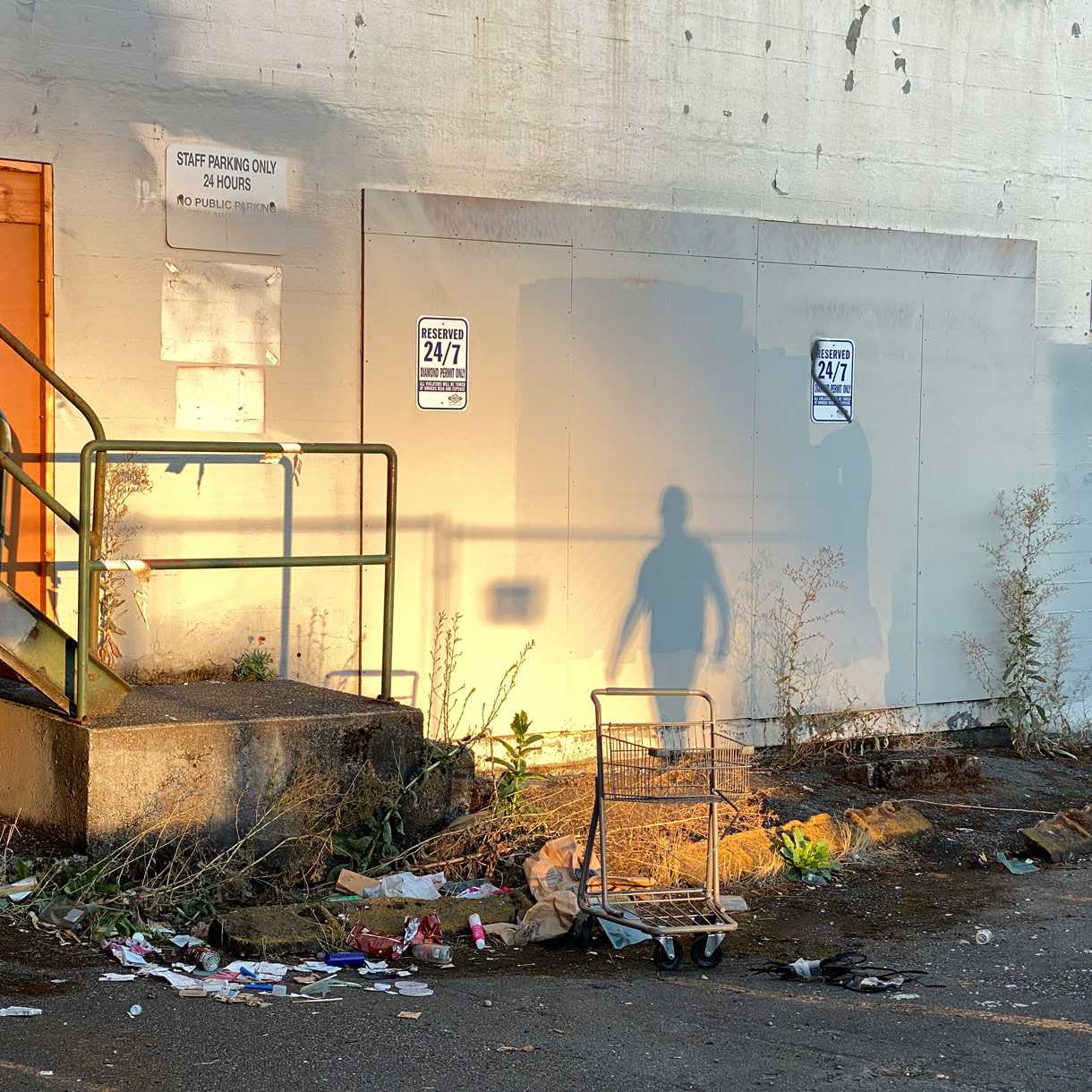
One of the rarest gifts in the life of an artist is finding a creative muse: someone who truly sees your work, and better yet, has a similar vision that is just enough different that you can collaborate without competing. In the often solitary studio life these connections can be difficult to find, but during pandemic, Instagram brought a new creative companion into my life. I do not know who started following who first. But in May 2020 I found myself sharing instant messages with a photographer working under the name “Concrete spaces“— a handle that immediately piqued my interest. Concrete has been one of my obsessions for years. Miraculously, there was someone out there who understood why I was working on a book called Parking Lot Floors Of North America.
In the cesspool of political conspiracies and rage-posting that drove social media during pandemic, my connection with this stranger was a lifeline. I would find myself at midnight, sharing notes with him about photographic inspirations, cameras, paper, printers, and the places we loved to wander with a camera. As it is when someone becomes a muse, I found myself wondering what he was seeing at any given moment. One night on a sunset walk in my neighborhood I photographed the full moon and sent him a text. He was on a railroad track in SODO photographing the same moon from a tripod on the top of his car. Over time we began to hold each other to account in our work. Over the many months we wrote before we met, my invisible friend’s silence to some of my images would tell me they were dangerously romantic or sentimental, and my silence back to his might make him wonder, did I see something here or is it just too random, not just bleak, but empty of meaning?
Scott Wippermann and I are certainly not the first two people to fall in love with the edge zones or the beauty of bleakness, and that territory can be treacherous. Is it opportunistic to document the detritus of other people’s lives and broken places? Is it heartless to look at ruins— whether of a person or of a building as pure abstraction? When is photography of society’s failures and abandonments “art“ and when is it exploitation, or simply journalism with a shorter caption? [Read more…]