Iskra Fine Art

  • Prints
    • The Tarmac Residency: Airport Landscapes
    • Immersions | At The Shore
    • ColorBath: Images of the Harbor
    • The Floating World
    • Industrial Strength | Urban Industrial Landscape
    • The Scaffold
    • Industrial Pastorale: The Rural/Urban Landscape
    • Botanical Prints | The Natural World
    • Construction | Reconstruction : Urban Landscape
    • Infrastructure
  • Drawings
    • Pencil Drawings: Pandemic Pause
    • Drawings in Dust 1
    • Signs & Symbols (Archive)
    • Botanical Drawings (Archive)
  • Photography
    • New Work Inspired by England
    • Seattle Waterfront Park Photography
    • Architectural Photography | Construction Sites
    • American West Landscape Photography
  • Mixed Media
    • Modern Botanical | Mixed Media on Plaster
    • From the Sea | Water Paintings
    • Sleep Studies
  • Wabi Sabi Abstract
    • Minimalist Modern
    • Ink Painting Abstractions
  • Shop
    • The Water Tower Project
  • About
    • Contact
  • Blog
You are here: Home / Archives for Documenting Westlake

Politics and Sense of Place: Perhaps Artists Have a New Mandate

September 10, 2012 by Iskra 2 Comments

A recent piece in Rolling Stone by Matt Taibbi has been on my mind. It is a long and exhaustive political analysis that has caused quite a stir. I won’t go into the partisan issues here. What struck me most was this, which pertains to all factions:

“…..Americans like their politicians to sound like they’re from somewhere, to be human symbols of our love affair with small towns, the girl next door, the little pink houses of Mellencamp myth. Most of those mythical American towns grew up around factories – think chocolate bars from Hershey, baseball bats from Louisville, cereals from Battle Creek. Deep down, what scares voters in both parties the most is the thought that these unique and vital places are vanishing or eroding – overrun by immigrants or the forces of globalism or both, with giant Walmarts descending like spaceships to replace the corner grocer, the family barber and the local hardware store, and 1,000 cable channels replacing the school dance and the gossip at the local diner.”

Being from somewhere. Having a sense of place. As Taibbi frames this the idea of place becomes not just personal, but political. It is much larger than an individual’s nostalgia, more than a sentimentalist’s hymn to a bygone time or a weakness of the populace to be exploited by speech-writers. And art about place takes on a different significance. The day after I read the article I went down to a remaining outpost of the merchant village, a physical “shop” in a “place” where you can buy a camera from a person who will show you how to use it. The block on which Glazer’s sits is in a part of the city undergoing massive, drastic deconstruction and construction. The days of remembering what was here are gone; history has been almost completely erased. On this visit to Westlake I tumbled into the present.
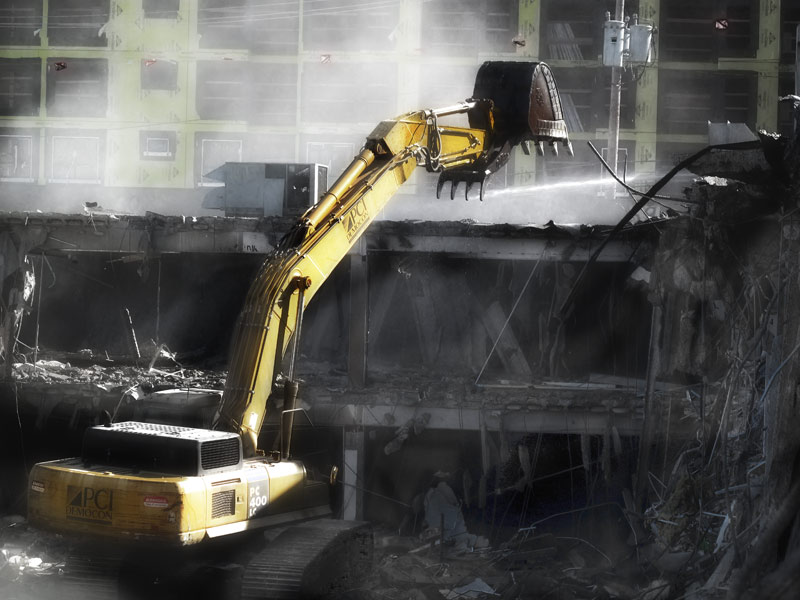
Demolition_Machine_Construction_Site

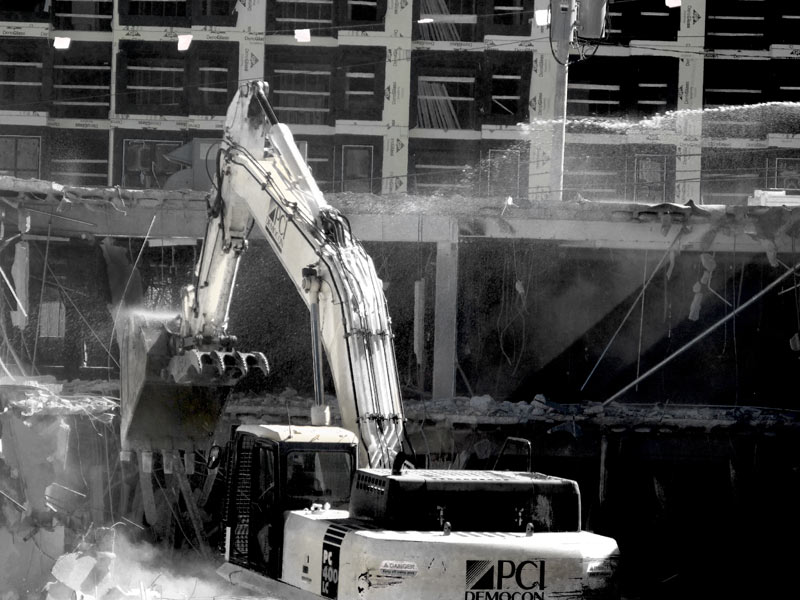
Demolition_Documentation_Westlake Construction Site

As I leaned over the pit water from the hoses drifted over the chain link fence and onto my arms. The air smelled of wet concrete and the first rains of autumn. Between the roar of traffic on one side and the grinding of machinery below I felt caught in a kind of still white noise in which all movement seemed precise and graceful as butoh. One man drove the excavator and one hosed from above, and it appeared that it takes only two men and one machine to dismantle what was an entire office building. I can’t weep for gargoyles or terracotta fleur de lis or bricks from the Great Seattle Fire. I have no feeling for this building. I have no idea what it looked like when it was a living breathing organism where some version of organized commerce took place beneath the now tangled guts of overhead lighting and heating ducts.
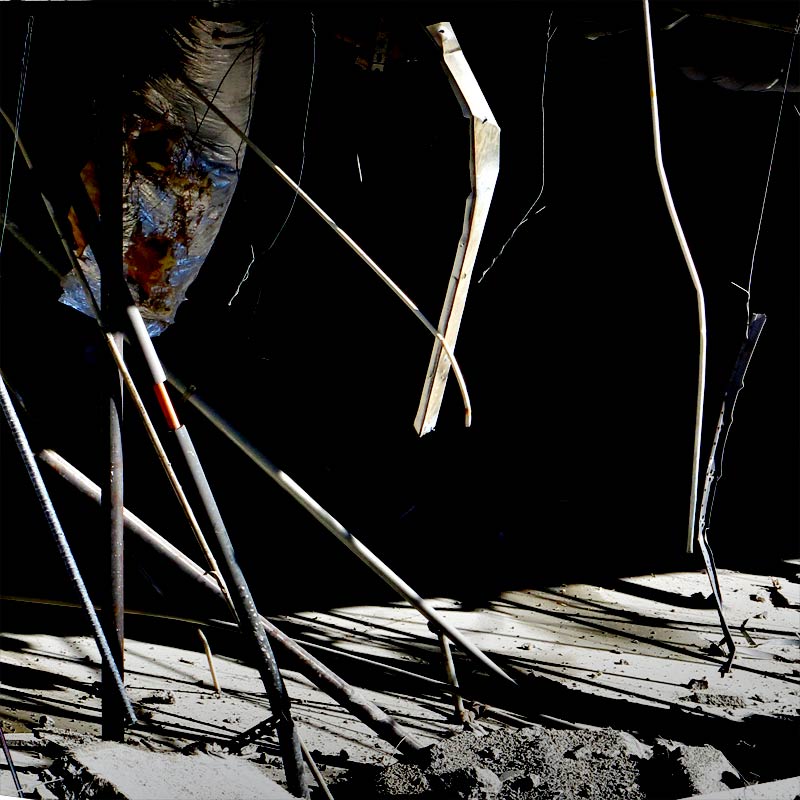
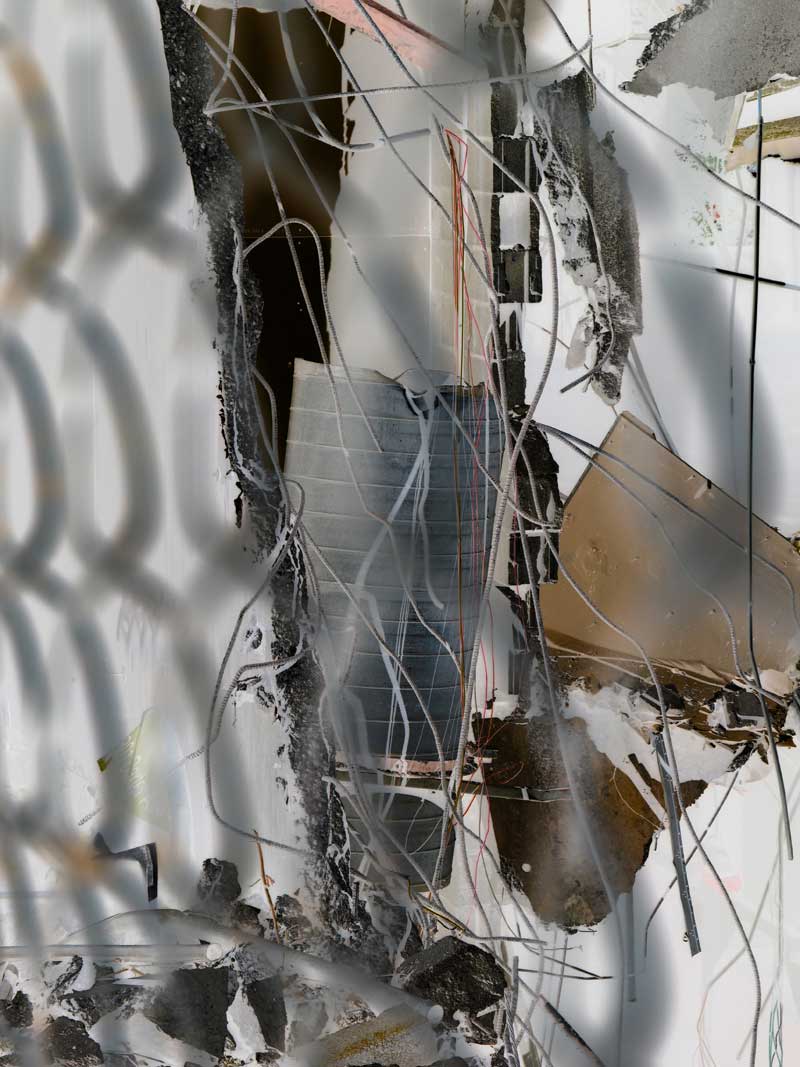
Cropped_Infrastructure_Westlake_Construction_Site

Decontruction_Infrastructure

On the other side of the street, from a building close to completion, I could hear the shouts of men operating a crane, hoisting huge stacks of wallboard to the twelfth floor.
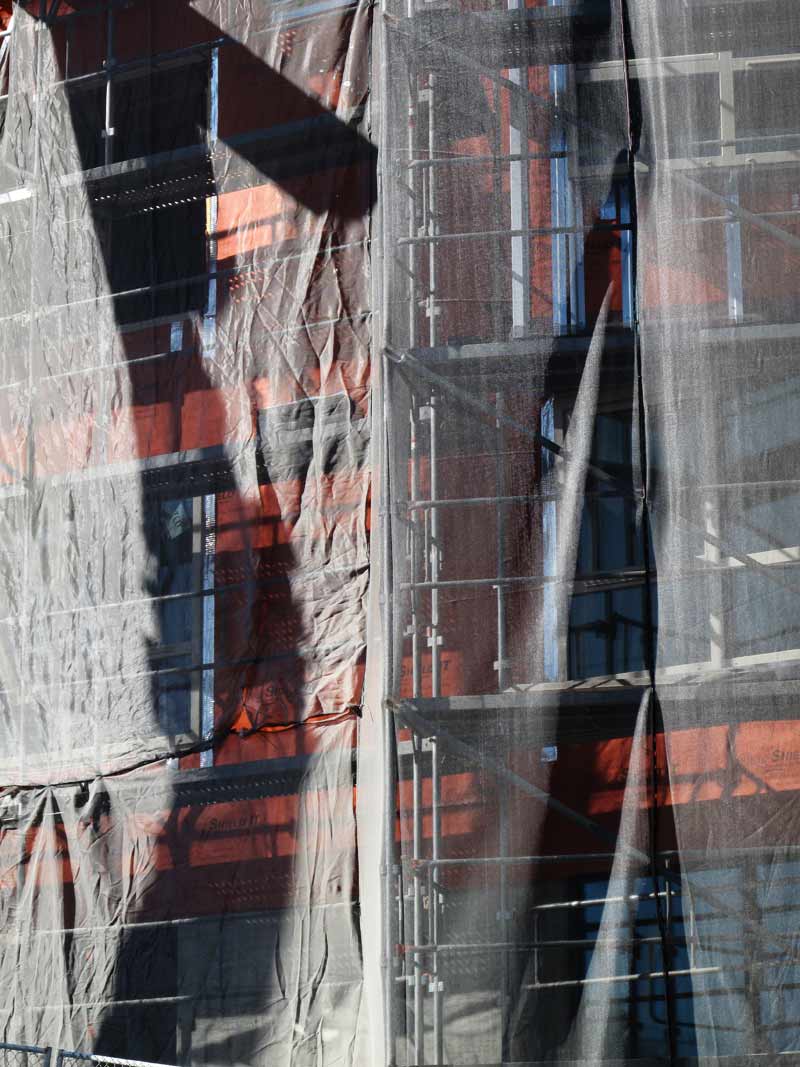
Drape_Scaffold_Construction_Site

Extreme change is a place and a story of its own. As society futurizes at a breathtaking pace I look alternately backwards and forwards, each glance more wrenching and extreme. I want to push pause. And I want to know if anybody else is in this with me. The Rolling Stone article makes me look through a new lens at trends in all kinds of art — visual, written, performance. In particular I wonder about spoken word. As I drive through the city my soundtrack is the radio. It seems to me I hear the art of storytelling evolving in very particular and exciting ways. Listen sometime to the dazzling and surprising Snap Judgement, Story Corps, and of course, the grand daddy, This American Life. In keeping with Taibbi’s point, these programs reach for a sense of the particular and the personal, the epiphanies of place and the equally poignant negotiations with its absence.  These storytellers are not packaging a by-gone era to sell it back to us as mood perfume or decoration. This is for real.

One day as I started photographing a site on Greenwood a man in a hardhat approached with an air of authority and asked for my papers. After some discussion I acquired permission to stand on the sidewalk and watch the ruins of one of Seattle’s last bowling lanes re-emerge as an apartment complex. We got to talking. The man had just come from working in Wyoming, in the fracking boom. He shook his head. “It’s a catastrophe in the making. We’re polluting the water, ruining the land and I couldn’t be part of it, I had to quit.” His passion and conviction surprised me. I gladly abandoned whatever preconceptions I might have about men at work.

I have been focused on the abstract beauty of construction and deconstruction, and the human stories had not really entered my mind. Perhaps I’ve been playing Brahms on the battlefield, and  seeing only the slanting light, without considering the soldiers. I’ll leave you with another view. Call it a figure study, in orange.
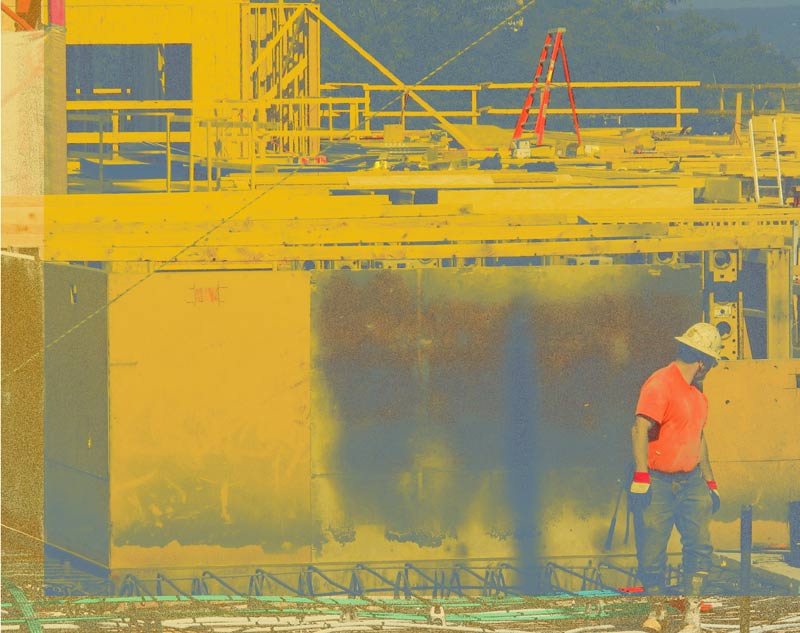
Construction_Worker

All photos and text © Iskra Johnson

Filed Under: Construction/Reconstruction, Photography Tagged With: architectural photography, art & politics, art about place, construction site photography, Documenting Westlake, Matt Taibbi, radio shows about storytelling, Rolling Stone, Snap Judgement, Story Corps, This American Life

Join Iskra’s Mailing List

Don't miss a thing! Subscribe to receive show announcements, first peek at new work and my semi-monthly blog by email. I primarily use the blog for news and updates but by signing up you will also receive the occasional newsletter and special offers for items in my shop.

Iskra Fine Art Blog

the creative process | conversations with artists | the contemplative impulse in art

Instagram

Media studies. Addition and subtraction. Media studies. Addition and subtraction.
Somehow, between checking the news and the usual d Somehow, between checking the news and the usual distractions I managed to complete a drawing. Going back to the beginning: drawings in dust. 9.5 x 12” Charcoal powder, compressed charcoal, charcoal pencil on Moleskine. I feel peaceful for the first time in weeks.
The train tracks that go along Golden Gardens and The train tracks that go along Golden Gardens and pause briefly at the locks create a rupture in the city landscape. When the trains go by, the roar and squeal is like a thousand wild animals let out of their cage, and the ducks in the pond at the edge of the park shudder and dive under the water. A little farther north at Carkeek there is someone every year who steps in front of the train and whoever witnesses that is never the same. 

Sometimes the cargo containers are filled with coal, uncovered, and I have been part of demonstrations, which included polar bears and Orcas, objecting to that. Now, as we are being asked to casually accept nuclear reactors on every block as the price of having artificial intelligence, coal and its simple visible dust might look a little more friendly. The train brings with it economics and politics and life and death and class and all the people on the beach are just trying to have a moment in the sun. And the boaters at the marina, if they have finished polishing and descaling and mending the sails are lying back with a guitar and getting lost in the mountains. If you are willing to live right next to the train tracks, you can pay a much lower price for your home, but your dreams will change. I have lived next to the train tracks when I was very, very small and every night I woke up screaming and ran across the floor in the beams of the streetlight looking for safety. I have woken up in a train yard on a bed of cardboard and gotten on the train in the dark. Only when you do that, do you know just how hard metal is.

I’ve been drawing recently from life and this study was done from a photograph. It drove me crazy trying to see details that I couldn’t really see and feel them with the pencil. I’ve abandoned the drawing for now, but I learned a great deal about perseverance and obliteration and re-perseverance. Also how machines pretend that they are perfectly symmetrical and are not. And when you don’t draw them with perfection, they look just plain wrong so you have to make them more perfect than they are, at least when they are in perspective.
Tonight’s abandoned bird. The next one will be bet Tonight’s abandoned bird. The next one will be better. I’ve never tried to draw a Robin before. I’ve been obsessed with them since David Lynch sent them over to my childhood house, where they spent day and night getting drunk on the holly berries outside the kitchen window. And if you don’t know what I’m talking about google Laura Dern, Blue Velvet. And the Robin. It’s a hymnal to the good and the normal, done absolutely abnormally. I am learning all kinds of amazing things about how Robins build their nests. They start with mud. I did not know this. And in a drought, they will drag straw into a birdbath to get it wet and then drag the straw over a wormhole. Robins build their nests in the most unlikely places: drain spouts, highway overpasses, really bad motel parking lots. It’s kind of like how people find third place in community, even in the bleakest places. A franchise McDonald’s where people become regulars and always get the fries and just the fries because that’s all they can afford is a similar statement of naive valor: people talking to strangers and becoming known and taking shelter where they can. And if they leave a shredded napkin out there by their car, it will end up woven in with the straw and the leaves and the cigarette butts perched up there in the nest on the backside of the billboard.
Waking up. Waking up.
What if there were no mistakes? What if there were What if there were no mistakes?
What if there were just infinite possibilities?. . .

Featured Posts

  • Book Launch! The Water Tower Project from Iskra Fine Art
  • How to Purchase Artwork from Iskra Fine Art
  • About This Blog
  • New Directions in Contemplative Art: Conversations with Artists
  • What is a Transfer Print? (Artist Statement)

Categories

  • Abstract Calligraphy
  • Architecture & Sense of Place
    • Construction/Reconstruction
    • The Alaska Way Viaduct
    • The Water Tower Project
  • Art Reviews
  • Artist Studio Visits
    • The Mystic Muse: Artists Working in the Contemplative Traditions
  • Botanical Art
    • Botanical Art Cards
  • Collage
    • Digital Collage
  • Commissioned Art
  • Drawing
  • Essays
    • Object Lessons: Essays and images inspired by "A History of the World in 100 Objects."
  • Iskra Shows, Upcoming and Past
  • Iskra Sketchbooks & Journals
  • Living With Art
  • Meditation & Buddhism
  • Mixed Media
  • Painting
  • Photocollage
  • Photography
    • American West Landscape Photography
  • Print Sale
  • Prints
    • Transfer Prints
  • Seattle Iconic Landscape Prints
  • Social Media for Artists
    • The 100 Day Projects
  • The Garden
    • The Gardener's Almanac of Irreproducible Phenomena
  • The Spiritual in Art
  • Travel
    • Road Trips
  • Uncategorized

Archives

Search

Connect on Facebook

Iskra Fine Art Facebook Page

Creative Inspiration

  • Alternative Photography
  • An Artist's Retreat
  • Anonymous Chinese Textile Genius: Moo Won
  • Chocolate Is A Verb
  • Contemplative Art Process: Danila Rumold
  • Eva Isaksen
  • Old Industrial Japan
  • The Altered Page
  • The Heart Sutra Loop
  • The Patra Passage

Galleries for Contemplative Art

  • ArtXchange Gallery
  • Seattle Asian Art Museum

Links

  • CollageArt.org
  • Iskra at SAM Gallery
  • Iskra Fine Art on Houzz
  • Seattle Art Museum Blog
  • Seattle Artist League
  • Seattle Print Arts
  • Seeing Fresh: Contemplative Photography
  • The Painter's Keys

What I'm Reading: Online Magazines and Books I Love

  • 16 mi.
  • Essays by David Whyte
  • Evening Will Come: Poetry
  • Hyperallergic
  • Painter's Table
  • Shu: Reinventing Books in Contemporary Chinese Art
  • Streetsy
  • The Original Van Gogh's Ear Anthology
  • Tricycle Magazine
  • Unincorporated Persons in the Late Honda Dynasty
  • Vanguard

Let’s Connect

  • Contact Iskra
  • How to purchase artwork
  • Iskra Fine Art Blog : The creative process, conversations with artists, the contemplative impulse in art
  • Facebook
  • Instagram
  • Pinterest
  • Twitter

All Images Copyright © 2026  Iskra Johnson · Site by LND · WordPress