Iskra Fine Art

  • Prints
    • The Tarmac Residency: Airport Landscapes
    • Immersions | At The Shore
    • ColorBath: Images of the Harbor
    • The Floating World
    • Industrial Strength | Urban Industrial Landscape
    • The Scaffold
    • Industrial Pastorale: The Rural/Urban Landscape
    • Botanical Prints | The Natural World
    • Construction | Reconstruction : Urban Landscape
    • Infrastructure
  • Drawings
    • Pencil Drawings: Pandemic Pause
    • Drawings in Dust 1
    • Signs & Symbols (Archive)
    • Botanical Drawings (Archive)
  • Photography
    • New Work Inspired by England
    • Seattle Waterfront Park Photography
    • Architectural Photography | Construction Sites
    • American West Landscape Photography
  • Mixed Media
    • Modern Botanical | Mixed Media on Plaster
    • From the Sea | Water Paintings
    • Sleep Studies
  • Wabi Sabi Abstract
    • Minimalist Modern
    • Ink Painting Abstractions
  • Shop
    • The Water Tower Project
  • About
    • Contact
  • Blog
You are here: Home / Archives for how printmaking is like calligraphy

Registering a Transferprint (Or how I came to realize the true sisterhood of calligraphy and printmaking.)

October 25, 2011 by Iskra Leave a Comment

This summer I did a lot of experiments with mounting transferprints on panels and sealing them with with every varnish, glaze and UV protectant ever invented. And in the end, wondering why I was trying to make paper be something other than what it is, I’ve gone back to tradition: the print floating in a pristine field of luscious, deckled rag white.

I realize why I had avoided it. It’s ridiculously difficult! The Arches is soaking wet with gel alcohol, the plate is flimsy and wants to buckle, and it is ready to deliver ink the second it touches down. You can’t hinge the plate to the paper because usually it is smaller than the paper, and tape will tear the surface anyway. I recalled from my other life as a calligrapher that one cannot do the character for Mujo perfectly without doing several thousand imperfect ones and throwing them away. And one can’t load the brush without ink, which must be ground, and then one must meticulously prepare the workspace with felt and weights so the fragile ricepaper does not fly away. All this preparation may take an hour. And without it, torn and blotted paper, ink that dries to pale whispers, and a profound sense of being out-of-groove.
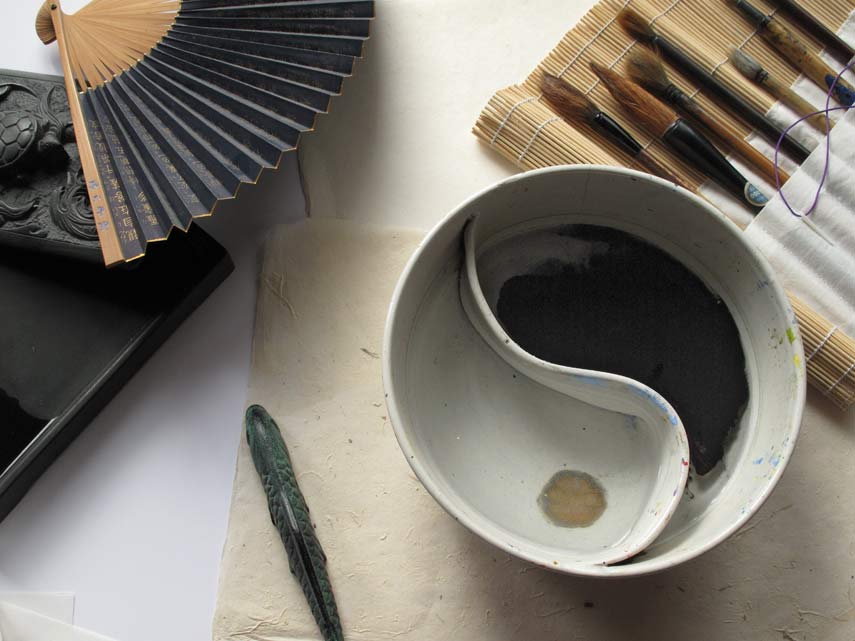
Tools Of Zen Calligraphy
Tools of Zen Calligraphy © Iskra Johnson

Printmaking groove requires the same precision and attention. Several years ago I visited Stephen Hazel at his Studio Blu, and the laboratory glare of perfection made me gasp. I don’t think there was dust anywhere in his zipcode. Thank you Stephen, for reminding me of the importance of order. Process = product.

To deal with the problem of the plates being smaller than the paper I bought large sheets of frosted mylar, which I hinged to my drafting table (which I covered with large sheet of plex.) I then drew various grids on the frosted side so I could position the plates, face up, to flop into correct position with even borders. I made an egregious technical error on one set-up, which was to place the plate on the frosted side, so the frosted mylar came into contact with the gel alcohol. The finish comes off over time and leaves a strange matte residue on the paper. 

Hinging solves a lot of problems but not all. The deckle of a full sheet allows for some out-of-square possibilites, and I have to be very careful about how the paper lines up along the edge of the carrier sheet. The only tape I found that could reliably hold the hinge without going out of square after awhile was blue painter’s tape. Masking tape peels off the plexiglass and acetate too easily. And then…there is dirt. Hairs from the brush. Eyelashes, flywings, whatever can fall on that damp border of white paper will. I believe this is why the word “edition” means “pain” in certain languages, just as “danger” is supposed to equal “opportunity” at least according to those t-shirts at duty-free shops in Tokyo. Below, a finished print on the left, lined up to register with hinged plate on mylar on the right. *This was a quick photo and the finished print is placed upside down. It should mirror the plate.
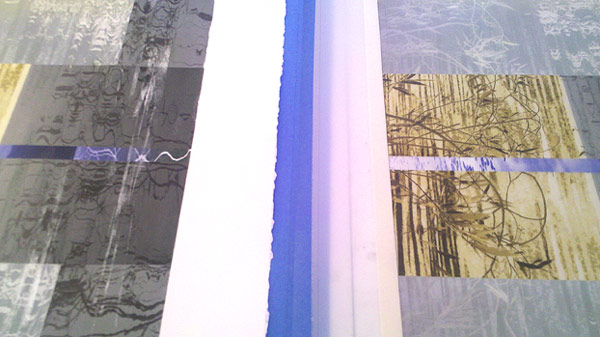
Transfer-Print-Registration

Here is the first print done this way, not perfectly even borders, but getting close:


© Iskra Johnson, “Ode to StudioBlu”

Filed Under: Transfer Prints Tagged With: how printmaking is like calligraphy, how to make a transfer print, How to register a transferprint, printing without a press, registration without a press, Stephen Hazel StudioBlu

Join Iskra’s Mailing List

Don't miss a thing! Subscribe to receive show announcements, first peek at new work and my semi-monthly blog by email. I primarily use the blog for news and updates but by signing up you will also receive the occasional newsletter and special offers for items in my shop.

Iskra Fine Art Blog

the creative process | conversations with artists | the contemplative impulse in art

Instagram

Media studies. Addition and subtraction. Media studies. Addition and subtraction.
Somehow, between checking the news and the usual d Somehow, between checking the news and the usual distractions I managed to complete a drawing. Going back to the beginning: drawings in dust. 9.5 x 12” Charcoal powder, compressed charcoal, charcoal pencil on Moleskine. I feel peaceful for the first time in weeks.
The train tracks that go along Golden Gardens and The train tracks that go along Golden Gardens and pause briefly at the locks create a rupture in the city landscape. When the trains go by, the roar and squeal is like a thousand wild animals let out of their cage, and the ducks in the pond at the edge of the park shudder and dive under the water. A little farther north at Carkeek there is someone every year who steps in front of the train and whoever witnesses that is never the same. 

Sometimes the cargo containers are filled with coal, uncovered, and I have been part of demonstrations, which included polar bears and Orcas, objecting to that. Now, as we are being asked to casually accept nuclear reactors on every block as the price of having artificial intelligence, coal and its simple visible dust might look a little more friendly. The train brings with it economics and politics and life and death and class and all the people on the beach are just trying to have a moment in the sun. And the boaters at the marina, if they have finished polishing and descaling and mending the sails are lying back with a guitar and getting lost in the mountains. If you are willing to live right next to the train tracks, you can pay a much lower price for your home, but your dreams will change. I have lived next to the train tracks when I was very, very small and every night I woke up screaming and ran across the floor in the beams of the streetlight looking for safety. I have woken up in a train yard on a bed of cardboard and gotten on the train in the dark. Only when you do that, do you know just how hard metal is.

I’ve been drawing recently from life and this study was done from a photograph. It drove me crazy trying to see details that I couldn’t really see and feel them with the pencil. I’ve abandoned the drawing for now, but I learned a great deal about perseverance and obliteration and re-perseverance. Also how machines pretend that they are perfectly symmetrical and are not. And when you don’t draw them with perfection, they look just plain wrong so you have to make them more perfect than they are, at least when they are in perspective.
Tonight’s abandoned bird. The next one will be bet Tonight’s abandoned bird. The next one will be better. I’ve never tried to draw a Robin before. I’ve been obsessed with them since David Lynch sent them over to my childhood house, where they spent day and night getting drunk on the holly berries outside the kitchen window. And if you don’t know what I’m talking about google Laura Dern, Blue Velvet. And the Robin. It’s a hymnal to the good and the normal, done absolutely abnormally. I am learning all kinds of amazing things about how Robins build their nests. They start with mud. I did not know this. And in a drought, they will drag straw into a birdbath to get it wet and then drag the straw over a wormhole. Robins build their nests in the most unlikely places: drain spouts, highway overpasses, really bad motel parking lots. It’s kind of like how people find third place in community, even in the bleakest places. A franchise McDonald’s where people become regulars and always get the fries and just the fries because that’s all they can afford is a similar statement of naive valor: people talking to strangers and becoming known and taking shelter where they can. And if they leave a shredded napkin out there by their car, it will end up woven in with the straw and the leaves and the cigarette butts perched up there in the nest on the backside of the billboard.
Waking up. Waking up.
What if there were no mistakes? What if there were What if there were no mistakes?
What if there were just infinite possibilities?. . .

Featured Posts

  • Book Launch! The Water Tower Project from Iskra Fine Art
  • How to Purchase Artwork from Iskra Fine Art
  • About This Blog
  • New Directions in Contemplative Art: Conversations with Artists
  • What is a Transfer Print? (Artist Statement)

Categories

  • Abstract Calligraphy
  • Architecture & Sense of Place
    • Construction/Reconstruction
    • The Alaska Way Viaduct
    • The Water Tower Project
  • Art Reviews
  • Artist Studio Visits
    • The Mystic Muse: Artists Working in the Contemplative Traditions
  • Botanical Art
    • Botanical Art Cards
  • Collage
    • Digital Collage
  • Commissioned Art
  • Drawing
  • Essays
    • Object Lessons: Essays and images inspired by "A History of the World in 100 Objects."
  • Iskra Shows, Upcoming and Past
  • Iskra Sketchbooks & Journals
  • Living With Art
  • Meditation & Buddhism
  • Mixed Media
  • Painting
  • Photocollage
  • Photography
    • American West Landscape Photography
  • Print Sale
  • Prints
    • Transfer Prints
  • Seattle Iconic Landscape Prints
  • Social Media for Artists
    • The 100 Day Projects
  • The Garden
    • The Gardener's Almanac of Irreproducible Phenomena
  • The Spiritual in Art
  • Travel
    • Road Trips
  • Uncategorized

Archives

Search

Connect on Facebook

Iskra Fine Art Facebook Page

Creative Inspiration

  • Alternative Photography
  • An Artist's Retreat
  • Anonymous Chinese Textile Genius: Moo Won
  • Chocolate Is A Verb
  • Contemplative Art Process: Danila Rumold
  • Eva Isaksen
  • Old Industrial Japan
  • The Altered Page
  • The Heart Sutra Loop
  • The Patra Passage

Galleries for Contemplative Art

  • ArtXchange Gallery
  • Seattle Asian Art Museum

Links

  • CollageArt.org
  • Iskra at SAM Gallery
  • Iskra Fine Art on Houzz
  • Seattle Art Museum Blog
  • Seattle Artist League
  • Seattle Print Arts
  • Seeing Fresh: Contemplative Photography
  • The Painter's Keys

What I'm Reading: Online Magazines and Books I Love

  • 16 mi.
  • Essays by David Whyte
  • Evening Will Come: Poetry
  • Hyperallergic
  • Painter's Table
  • Shu: Reinventing Books in Contemporary Chinese Art
  • Streetsy
  • The Original Van Gogh's Ear Anthology
  • Tricycle Magazine
  • Unincorporated Persons in the Late Honda Dynasty
  • Vanguard

Let’s Connect

  • Contact Iskra
  • How to purchase artwork
  • Iskra Fine Art Blog : The creative process, conversations with artists, the contemplative impulse in art
  • Facebook
  • Instagram
  • Pinterest
  • Twitter

All Images Copyright © 2026  Iskra Johnson · Site by LND · WordPress