Iskra Fine Art

  • Prints
    • The Tarmac Residency: Airport Landscapes
    • Immersions | At The Shore
    • ColorBath: Images of the Harbor
    • The Floating World
    • Industrial Strength | Urban Industrial Landscape
    • The Scaffold
    • Industrial Pastorale: The Rural/Urban Landscape
    • Botanical Prints | The Natural World
    • Construction | Reconstruction : Urban Landscape
    • Infrastructure
  • Drawings
    • Pencil Drawings: Pandemic Pause
    • Drawings in Dust 1
    • Signs & Symbols (Archive)
    • Botanical Drawings (Archive)
  • Photography
    • New Work Inspired by England
    • Seattle Waterfront Park Photography
    • Architectural Photography | Construction Sites
    • American West Landscape Photography
  • Mixed Media
    • Modern Botanical | Mixed Media on Plaster
    • From the Sea | Water Paintings
    • Sleep Studies
  • Wabi Sabi Abstract
    • Minimalist Modern
    • Ink Painting Abstractions
  • Shop
    • The Water Tower Project
  • About
    • Contact
  • Blog
You are here: Home / Meditation & Buddhism / Taking Refuge: An Evening at the Seattle Asian Art Museum

Taking Refuge: An Evening at the Seattle Asian Art Museum

March 25, 2015 by Iskra Leave a Comment

“Thus we live in a world that first existed inside the heads of others, a world built up through innumerable sustained acts of intentionality, a world where everything speaks not of nature and her processes but of its makers in their resistance to those processes. In a very real sense we can be described as living inside the heads of others, in an excess of interiority that obliterates our own relation to material origins, to biologies, to our bodies. In some way, making was intended to override the givens of nature, to create a world; that world has itself become a given whose terms are more limited in their scope for imagination and act. The world is so thoroughly made it calls for no more making, but for breaching its walls and tracing its processes to their origins. “Taking apart” has become the primary metaphor and “backward” the most significant direction: the creative act becomes an unraveling, recouping the old rather than augmenting the new. ” –Rebecca Solnit
https://iskrafineart.com/wp-content/uploads/2015/03/Porecelain-Pillow1.jpg

Seattle’s Asian Art Museum sits in a stately Art Deco building nestled among trees in Volunteer Park. Known for its extensive collection of Asian art, SAAM also hosts visiting scholars and exhibits of contemporary Asian artists. The park and the building create an exquisite setting for contemplation. Although as a long-time student of Asian calligraphy I used to go there often, over the years the habit has left me. I think I tell myself everything in the museum is just too old, the artists are dead, and I already know it all. If I’ve seen one brush stroke I’ve seen them all. And if I want a review of Asian art there is Google…..

I can tell myself all kinds of things about museums and deadness and irrelevance. And then one day real death comes to the museum and jolts me out of complacency. Antiquities I took for granted, knowing they would be forever in the cultural vault, are blasted in a few hours into rubble. Human beings are mowed down by zealots who have captured eternal instant replay on television while the art itself, and the sacrificed human beings, vanish. This must be in the back of my mind when I make a turn into the park one evening with no forethought or planning or any special reason at all. I am on my way somewhere, I have something important to do, but instead I stand in the twilight above the reservoir in front of the museum and breathe deeply the air of the day before spring. Plum blossoms fall into the little pond that had two swans when I was a child. The door to the museum is open and the graceful Art Deco windows fill with amber light.

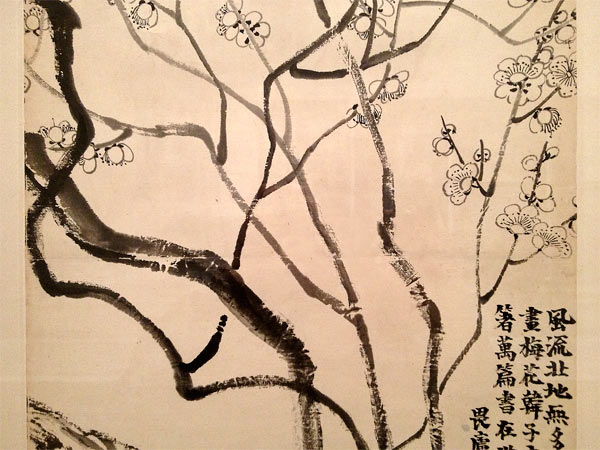
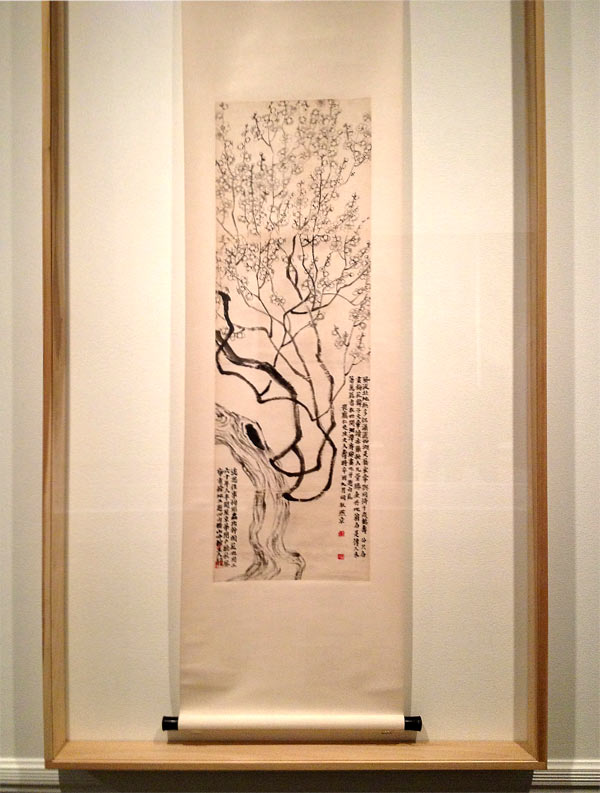
Inside I can turn right to see Mr.’s Japanese hyper-now pink and neon Neo-Pop or go left and backward in time. I turn left and realize immediately that I know nothing, that I have never seen anything here before and that every brush stroke is a new event. It is a Thursday evening, and only a handful people are in the museum. The quiet is luxurious. I can take as long as I want to to stare at small things. Like how the paper on this long scroll of plum blossoms by Qi Baishi is done in pieces and glued together, in a set of ascending stutters and near-misses as the brush stroke continues from one sheet to the next:
Plum-blossoms-interrupted

Rice paper shrinks and expands on contact with ink. It is a formidable challenge to push and pull a brush to the sky, stopping and starting at the edge of each branch in just the way a tree grows so that the plum itself is not offended by the effort.
Hanging-plum-scroll

This piece alone changes my heart rate. I have stepped one layer back in time.

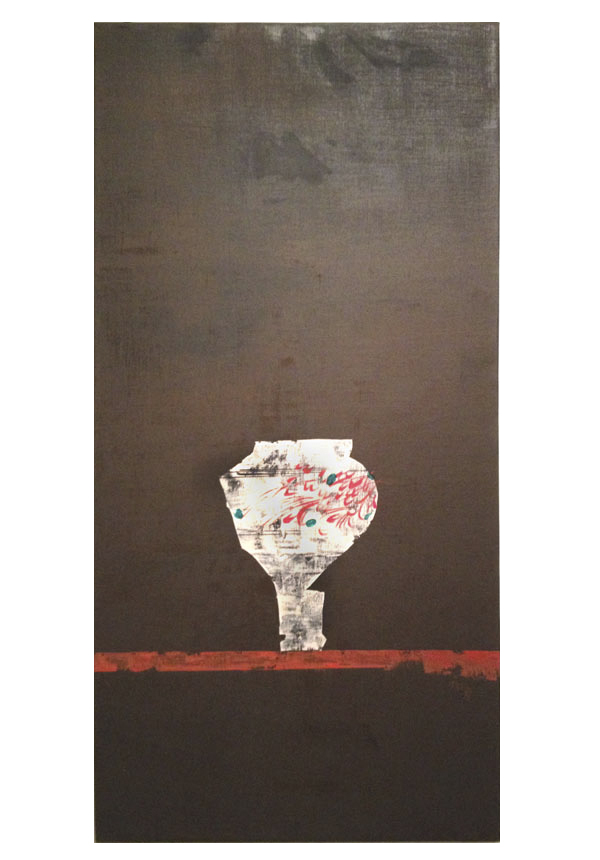
The exhibit is called “Conceal Reveal: Making Meaning in Chinese Art, ” and old is mixed with new. I stop in front of this painting by contemporary Chinese artist Wang Huaiqing:
Wang-Huaiqing-vase

“Here the artist plays with layers of symbolic meanings by setting a meiping vase upside down on a red table, alluding to the overturning of the past as well as expressing the auspicious message that peace has arrived. In Chinese, the word “vase” (ping) is a homophone with the word for “peace,” and the word for “table” (an) is a word that means stability and harmony.By turning the vase on its head, Wang alludes to the Chines word for upside-down, (dao), a homophone for “ to arrive.”

In other words a reminder that the past was not a bowl of cherries and people have been beheading and invading and cultural revolutionizing since the beginning of time. If we upend the vase and start over is it more or less peaceful? Ask the man who wrote The Better Angels of Our Nature. He seems to think we are on an upswing and that human beings are becoming less violent with the passage of time. We are conversing more and peaceably exchanging world views.
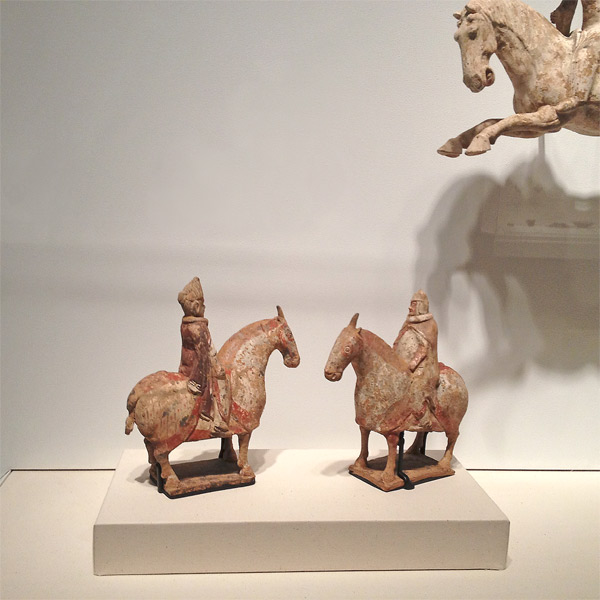
Men-On-horses-talking

And standing up for our better natures. Or at least trying.
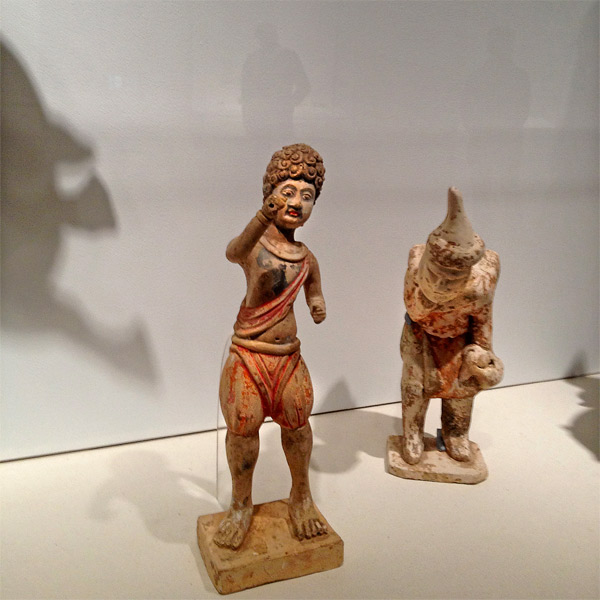
fighting-the-good-fight

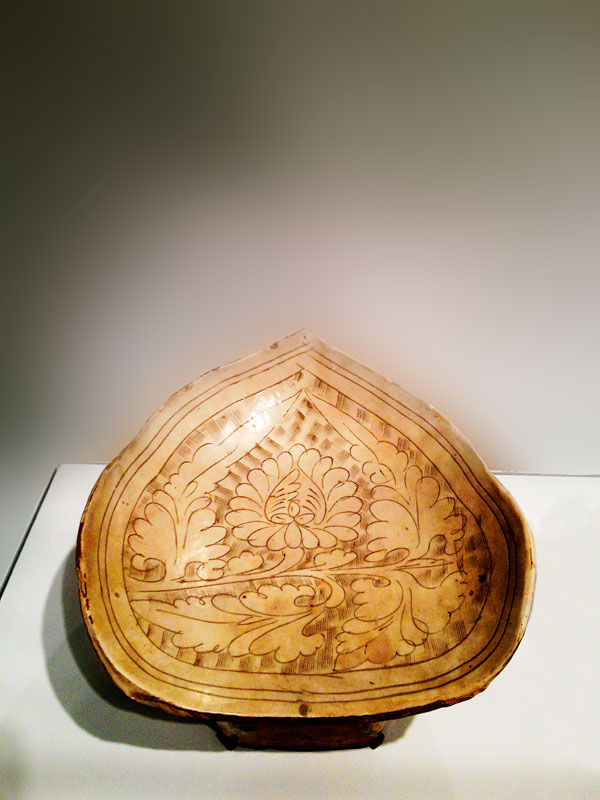
I would like to dress in a nine dragon summer robe, and sleep on a pillow made of white earth, where the dreams arrive carrying love notes on trays and the lotus always rises from the mud by noon. I would like to be an Arhat and inspire the sculptor who built this face of hemp and lacquer, layer after layer laid over wood or clay.
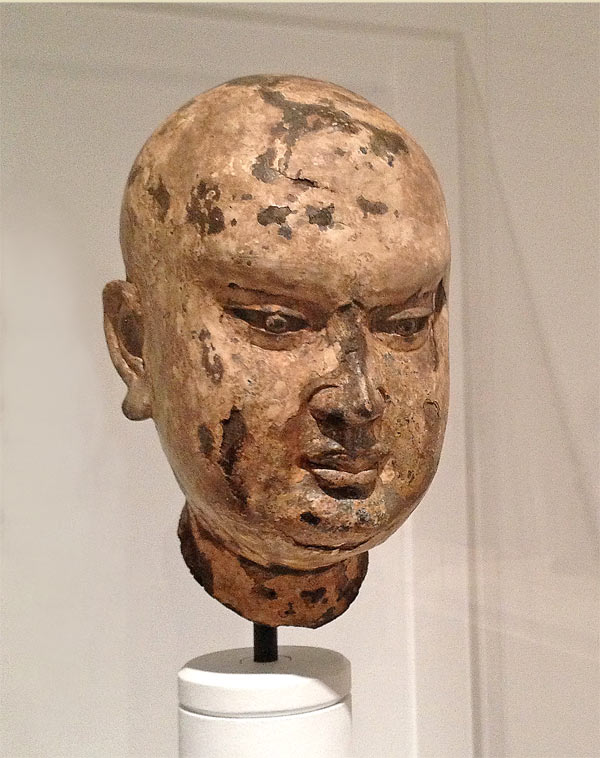
Arhat_Seattle_Asian_Art-Museum

I emerge from history to more history, the skylit central courtyard ringed with Indian statuary, the space making me dizzy with its height and purely secular, graceful beauty. Through the doorway I can glimpse Mr’s nightmarish vision of adolescent school girls and Fukishima, tiny televisions and random detritus spilled into a towering installation in the south wing. Another time, for that. I am full and at peace, and grateful. Maybe contemporary art is supposed to disturb me, unravel my paradigm and make me fret even more than I usually do, but for now I’ll take refuge in what remains of tradition, and in institutions devoted to preserving culture and civilization. For an hour or so I will turn my face up and live in museum light.

The quotation from Rebecca Solnit it courtesy of a wonderful talk given by artist Michael Cherney at the Seattle Asian Art Museum the following weekend as part of Asia Week. Do take a look at his work, it is phenomenal. All images above were photographed at the current exhibit at the Seattle Asian Art Museum.

Filed Under: Meditation & Buddhism Tagged With: art as refuge, Asian Art, being in culture, contemplative art, museum, REbecca Solnit, seattle art museum, Seattle Asian Art Museum, volunteer park

Leave a Reply Cancel reply

Your email address will not be published. Required fields are marked *

This site uses Akismet to reduce spam. Learn how your comment data is processed.

Join Iskra’s Mailing List

Don't miss a thing! Subscribe to receive show announcements, first peek at new work and my semi-monthly blog by email. I primarily use the blog for news and updates but by signing up you will also receive the occasional newsletter and special offers for items in my shop.

Iskra Fine Art Blog

the creative process | conversations with artists | the contemplative impulse in art

Instagram

I have been obsessed for well over a decade by the I have been obsessed for well over a decade by the line between the photographic and the drawn. This is simply a media test, or an “under drawing“ for something else, but it gave me pause. It suggests so many different qualities of mood: Foreboding, calm, dichotomy, a family photo poorly developed, the cloudy skies of the Pacific Northwest, or the fugue state one falls into after turning the pages of our days as a failing empire. “Our“ refers to those of us who live in the USA although now it should be called the DU USA, as in disunited United States. That disunity is a powerful disruptive pain that I feel daily. Also, as we phase out medicine, research, medical care, and with that presumably self-care, this was created, for those who are curious, with a cotton ball by #JohnsonAndJohnson (my father’s Swedish ancestors) on a Talens sketchbook. As I said, I’m testing. How much of the world can I take in before I shut the door and become an art nun and don’t look up until the last minute?
Sunday concentration drawing, testing a new notebo Sunday concentration drawing, testing a new notebook( and my attention span. . .)
Today’s mood, from the morning walk. Today’s mood, from the morning walk.
A metaphysical idea waiting to become a drawing. A A metaphysical idea waiting to become a drawing. All day I have been studying graphite, the most evanescent of mediums. Fragility. Once you break the egg, scatter the nest, leave the children without family on an abandoned beach, what then? 

I have spent the day drawing. In the background, which becomes foreground with one click, is the news of the rounding up of another thousand or so human beings by bounty hunters given a quota, thrown into concrete cages and disappeared because someone decided that America is no longer the home of the #huddledmasses.

The plaque on the Statue of Liberty says:

“Here at our sea-washed, sunset gates shall stand
A mighty woman with a torch, whose flame
Is the imprisoned lightning, and her name
Mother of Exiles. From her beacon-hand
Glows world-wide welcome; her mild eyes command
The air-bridged harbor that twin cities frame.
“Keep, ancient lands, your storied pomp!” cries she
With silent lips. “Give me your tired, your poor,
Your huddled masses yearning to breathe free,
The wretched refuse of your teeming shore.
Send these, the homeless, tempest-tost to me,
I lift my lamp beside the golden door!”

Noem and Holman have not, apparently, run their hands over these words.

How do you continue making art at a time like this? You chase the metaphor. There is always a constant truth beneath the chaos.
Media studies. Addition and subtraction. Media studies. Addition and subtraction.
Somehow, between checking the news and the usual d Somehow, between checking the news and the usual distractions I managed to complete a drawing. Going back to the beginning: drawings in dust. 9.5 x 12” Charcoal powder, compressed charcoal, charcoal pencil on Moleskine. I feel peaceful for the first time in weeks.

Featured Posts

  • Book Launch! The Water Tower Project from Iskra Fine Art
  • How to Purchase Artwork from Iskra Fine Art
  • About This Blog
  • New Directions in Contemplative Art: Conversations with Artists
  • What is a Transfer Print? (Artist Statement)

Categories

  • Abstract Calligraphy
  • Architecture & Sense of Place
    • Construction/Reconstruction
    • The Alaska Way Viaduct
    • The Water Tower Project
  • Art Reviews
  • Artist Studio Visits
    • The Mystic Muse: Artists Working in the Contemplative Traditions
  • Botanical Art
    • Botanical Art Cards
  • Collage
    • Digital Collage
  • Commissioned Art
  • Drawing
  • Essays
    • Object Lessons: Essays and images inspired by "A History of the World in 100 Objects."
  • Iskra Shows, Upcoming and Past
  • Iskra Sketchbooks & Journals
  • Living With Art
  • Meditation & Buddhism
  • Mixed Media
  • Painting
  • Photocollage
  • Photography
    • American West Landscape Photography
  • Print Sale
  • Prints
    • Transfer Prints
  • Seattle Iconic Landscape Prints
  • Social Media for Artists
    • The 100 Day Projects
  • The Garden
    • The Gardener's Almanac of Irreproducible Phenomena
  • The Spiritual in Art
  • Travel
    • Road Trips
  • Uncategorized

Archives

Search

Connect on Facebook

Iskra Fine Art Facebook Page

Creative Inspiration

  • Alternative Photography
  • An Artist's Retreat
  • Anonymous Chinese Textile Genius: Moo Won
  • Chocolate Is A Verb
  • Contemplative Art Process: Danila Rumold
  • Eva Isaksen
  • Old Industrial Japan
  • The Altered Page
  • The Heart Sutra Loop
  • The Patra Passage

Galleries for Contemplative Art

  • ArtXchange Gallery
  • Seattle Asian Art Museum

Links

  • CollageArt.org
  • Iskra at SAM Gallery
  • Iskra Fine Art on Houzz
  • Seattle Art Museum Blog
  • Seattle Artist League
  • Seattle Print Arts
  • Seeing Fresh: Contemplative Photography
  • The Painter's Keys

What I'm Reading: Online Magazines and Books I Love

  • 16 mi.
  • Essays by David Whyte
  • Evening Will Come: Poetry
  • Hyperallergic
  • Painter's Table
  • Shu: Reinventing Books in Contemporary Chinese Art
  • Streetsy
  • The Original Van Gogh's Ear Anthology
  • Tricycle Magazine
  • Unincorporated Persons in the Late Honda Dynasty
  • Vanguard

Let’s Connect

  • Contact Iskra
  • How to purchase artwork
  • Iskra Fine Art Blog : The creative process, conversations with artists, the contemplative impulse in art
  • Facebook
  • Instagram
  • Pinterest
  • Twitter

All Images Copyright © 2026  Iskra Johnson · Site by LND · WordPress