Iskra Fine Art

  • Prints
    • The Tarmac Residency: Airport Landscapes
    • Immersions | At The Shore
    • ColorBath: Images of the Harbor
    • The Floating World
    • Industrial Strength | Urban Industrial Landscape
    • The Scaffold
    • Industrial Pastorale: The Rural/Urban Landscape
    • Botanical Prints | The Natural World
    • Construction | Reconstruction : Urban Landscape
    • Infrastructure
  • Drawings
    • Pencil Drawings: Pandemic Pause
    • Drawings in Dust 1
    • Signs & Symbols (Archive)
    • Botanical Drawings (Archive)
  • Photography
    • Nucor Steel Industrial Landscape Photography
    • New Work Inspired by England
    • Seattle Waterfront Park Photography
    • Architectural Photography | Construction Sites
    • American West Landscape Photography
  • Mixed Media
    • Modern Botanical | Mixed Media on Plaster
    • From the Sea | Water Paintings
    • Sleep Studies
  • Wabi Sabi Abstract
    • Minimalist Modern
    • Ink Painting Abstractions
  • Shop
    • The Water Tower Project
  • About
    • Contact
  • Blog
You are here: Home / Essays / A Night at the Opening of the Seattle Asian Art Museum (Snow Moon)

A Night at the Opening of the Seattle Asian Art Museum (Snow Moon)

February 17, 2020 by Iskra Leave a Comment

There is a perfume called Museum, available at discreet boutiques. When you daub it behind your ears pearls attach, shimmering and pendant from tiny diamonds. Your neck grows long and swans into the darkness of evening above a silk dress sewn from the sky of early dusk. Every word spoken, from the mouth delicately suspended above the long white neck, has the quality of pronouncement. What your eyes light upon is anointed, pedigreed, and placed on a pedestal. This girl with the pearl is the ultimate docent. She has ridden alongside the robber barons and hauled the world’s worth home, there to catalog objects that always aspired (without knowing it!) to become artifact. She finds it charming to be confused with the girl in the Vermeer, the girl hanging in the Louvre and adored by millions.

Because of the internet, which appears in the palm of my hand every five minutes, I cannot help but compare myself to that Girl. Behind my ears is simply the after-scent of shampoo from Walgreens. I wear jeans and a puffy jacket, and sterling silver ornaments, buried in unstyled hair. If I was to de-acquisition a chunk of statuary and remove it from its pedestal for my personal collection I would be hauled off to jail and my friends would leave me. Nothing says have and have-not like a museum.

The Seattle Asian Art Museum tries to meet this situation head on, so to speak, while being appropriately oblique. In the Room of the Beheaded Buddhas, each head of the half-dozen is clearly displayed as a trophy. The only thing missing is the bloodied chisel. Says the placard: These fragments of figures also reflect the difficult reality that the historical art market supplied such small, portable and alluring objects to collectors under the circumstances of colonial expansion and other forms of cultural imperialism. Explore our smartphone tour for further discussion. Should you flinch at the phrase “cultural imperialism,” remember that the museum is not running for higher office. It is simply telling it like it is.

We see so many floating Buddha heads these days we may have forgotten that they used to belong to bodies. The garden magazine awards have stairways adorned with them, the Hell’s Angel has one welded to his fender, and your neighbor’s picnic table holds a head facing the eastern sun, surrounded by rocks and snailshells. Nothing says higher consciousness like a stone man with long ears, refusing to meet our gaze.
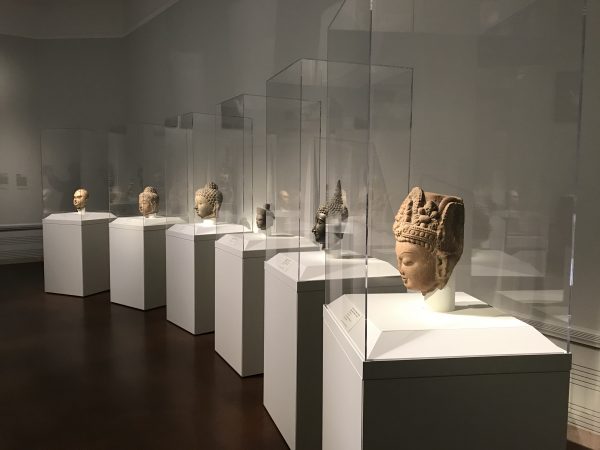
The Headless Buddhas SAAM

The row of heads in vitrines is deeply unsettling. I have been coming to the museum for many years, and I have treasured the moments of coming across a particular sculpture, the HEAD OF A LOHAN (ARHAT), Liao-Chin Dynasties, China, 10th – 13th century. Dry lacquer. H. 26.7cm. (10 1/2 inches). He was always alone, “without context” and partly by virtue of that, because of his lack of companions, I felt like he was someone I could sit with for a while. He did not look highly stylized, not like someone who had figured it all out and was there to teach, but like a pilgrim. Now he stars as the first in the lineup of colonialist scalps and our relationship is over. I should not have been surprised. We live in an age of supreme disembodiment. Our parts are critiqued, found wanting, and sold back to us with fewer wrinkles, stronger muscles, more Paleo authenticity. Why not do the same to the avatars?
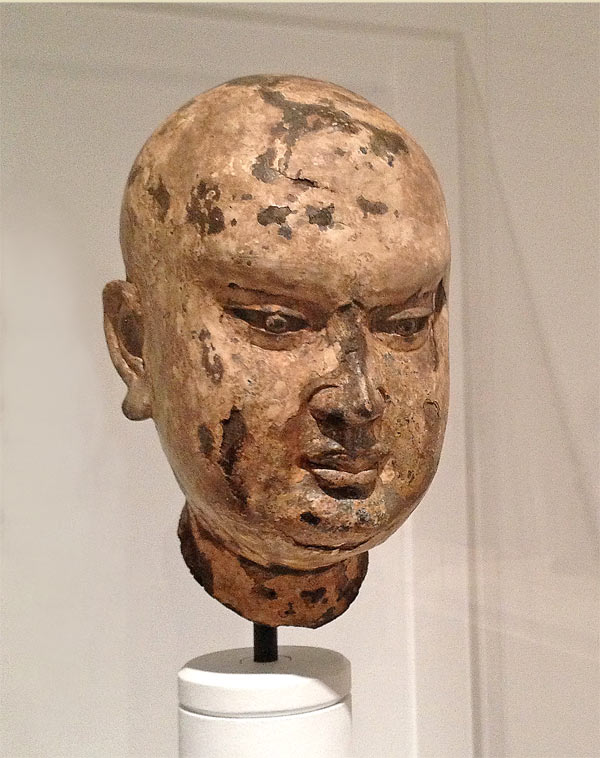
Arhat_Seattle_Asian_Art-Museum

I was relieved to walk away from the room of parts and step into the darkness of the Gallery of Awakened Ones. Here a black ceiling and dramatic lighting create the sense of being in a cave. Some of the life-sized figures are missing their hands, but they at least have something of their bodies, and can breathe. It feels, in this room, like the museum has surrendered the obsession with artifact to the experience of contemplation, and it is a transformative experience.
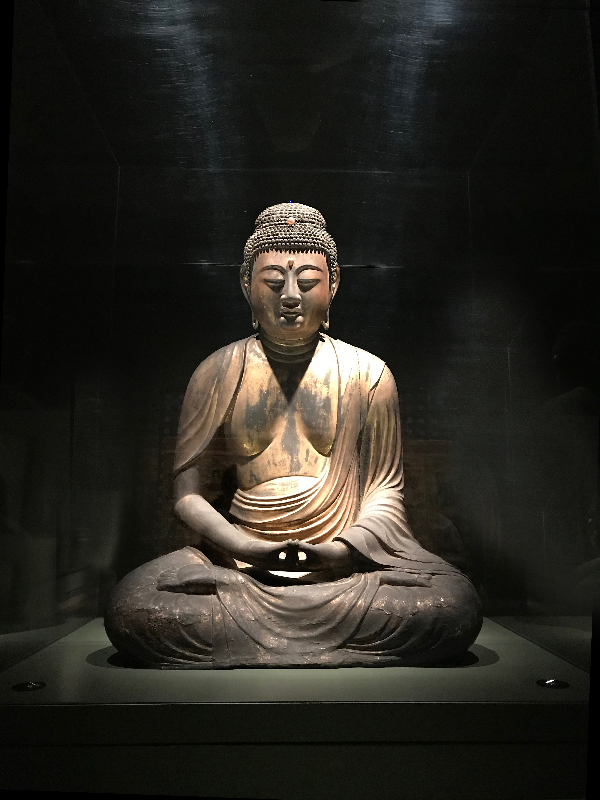
Buddha at Seattle Asian Ast Museum

I don’t think I have ever given conscious thought to the effect of scale in a museum. Moving from the room of disembodied to embodied jolted me into thinking about all the ways our own height mediates experience. The first time I went to the museum I was three feet tall, and my father took me there and lifted me up and set me on one stone camel while I like to think my mother was sitting on the other, facing me, though that is doubtful. By that year the family unit was fragmenting; it is more likely my father took me there alone to spite my mother by giving me culture behind her back. (Little did I know then that the camels were originally part of a “spirit way” leading to a tomb.) Later, when I was three feet eight inches (a door jam documented these things, in carpenters’ pencil), my father took me to see the snuff bottles. At this height I was eye-level with the pearly dragonfly caught in smoke. My father explained to me how they were painted from within. In my mind the painters were tiny people, tiny as ants, wielding brushes like brooms with one straw.
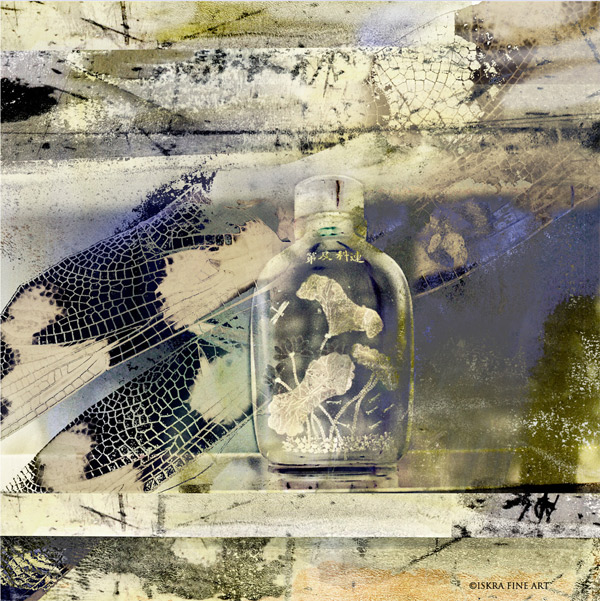
I have few criticisms of the new museum, but the fate of the snuff bottle collection is one of them. Is it just childish nostalgia that begs to know the collection would always be there, static, immoveable on its wall of glass shelves? How many years of my life did I visit the collection, in how many various states of Pacific Northwest melancholy? Perhaps someone at some point traded out the Rising Phoenix for the Two Fish and Lotus Leaves, but in my mind they were a fact, an arrangement of aesthetic logic as certain as the temperature of the ice caps. Now the snuff bottles are scattered here and there, and some are posed, most alarmingly, in a vitrine with modern wrist watches. If the watches were not painted from the inside with broom straw I frankly don’t want to see them here. Please, curators, get back to me and tell me: by what disruptive logic you did this?
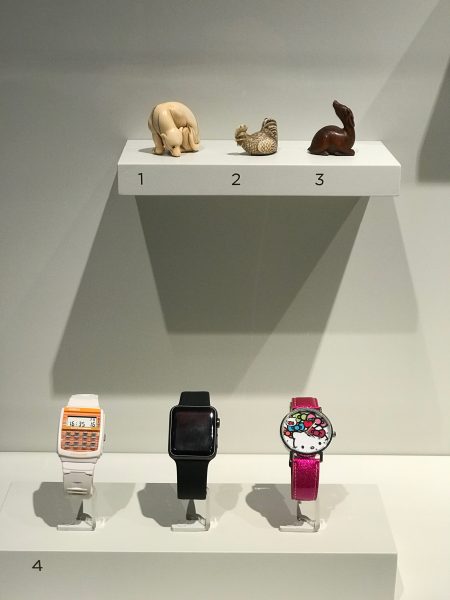
SAAM snuff bottles on display

The room of tiny snuff bottles originally faced onto the park. That is where, at nearly adult height, I learned to skip through sprinklers instead of sleeping through continuous progress algebra. Outside the walls of the museum the lawns rolled out in great velvet swaths, encircling sequoias and cedars that formed, in their dark skirts, giant private rooms. Here the 8th and 9th graders drank whiskey and beer and smoked whatever they could get their hands on. We could lean back in the tree rooms and look up at the clouds floating across the windows of the museum: it was our backyard, and we thought we owned it. In the afternoons my best friend and I would lie beneath the ancient maple on the western lawn and stare at the sun through the leaves as they moved in the wind. One day she said to me, “unpatterned patterns,” a phrase that has served as a numinous gem of ‘60’s wisdom throughout the rest of my life.
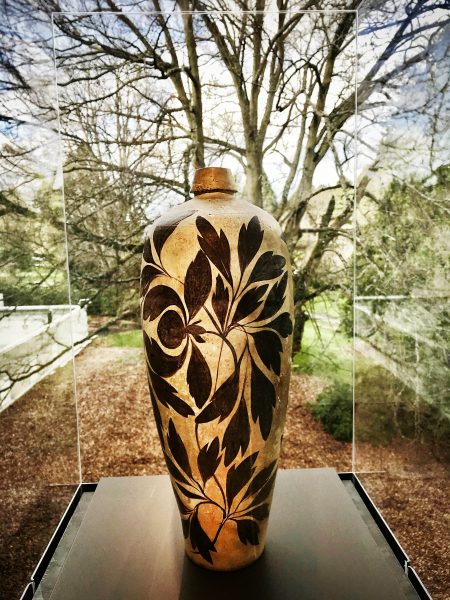
A Night at the Museum Vase with leaves
“All men know the use of the useful, but nobody knows the use of the useless,” Zhuangzi, ca 300 BCE.

It was this phrase that came to mind as I stood in the new east wing of the museum cantilevered out into the park of my childhood. The use of space in the Garden Court is recklessly wasteful if the goal is to exhibit more of the museum’s collections. In a long nearly empty rectangle a handful of vitrines stand before the soaring windows. On each pedestal is only one ceramic piece. The effect of this minimalism is quietly dazzling. All the contemplative power of the art within the museum’s dark cloisters now spills into the light, where nature and “artful artlessness,” the unpatterned patterns of decorative traditions, ornament the simplest of shapes. A vase swirling with new leaves faces a winter tree. Trees and sky reflect into the galleries and onto the glass in front of the artworks, merging outside and inside, outsider and insider. One can lean against the museum wall and imagine, framed in the windows’  floor to ceiling divisions, a Chinese landscape from the Song Dynasty.

The true value of art depends on an intangible aesthetic return, which varies with the knowledge and taste of each beholder,” –Dr. Eugene Fuller, founder of the Seattle Art Museum.

How daunting to be a museum curator, attempting to corral audience and shape its point of view. No amount of podcasts or labels orchestrated to describe time and causal relations can stand up to the anarchy of individual subjective experience.

Audiences do not behave.

I feel queasy as I allow the word “stoned” into my public memory of the museum and its park. We are a city in the midst of an addiction epidemic. How flippant, how shallow, to mention those days of teenage miscreance as though they could have any bearing on what the museum so studiously, with archival reverence, holds inside. Yet any timeline of Seattle cannot ignore the importance of Volunteer Park, and of the psychedelic ‘60’s, in the history of the city’s consciousness revolution. Volunteer Park was the site of Seattle’s first large Be-Ins. It is where I first heard Laurie Anderson play her violin, in an era when you could go to the Deluxe Tavern after, and have a star-struck daquiri with her. It is where world music tribes found each other, mixing Indian tabla with steel drum and anointing the anointed with jujubes, (which, if you just press hard enough in a warm western-sun moment, will stick to your forehead unassisted.) It is where countless underage girls found 20-something hipster boyfriends who took them on the back of motorcycles to communes. Where the disaffected found affection and the alienated found allegiance and everything was really fine.

Inside the museum we see the art of sages fueled by moments on high mountains and lesser sages fueled by saki seeking to put the plum blossom into the canon of higher beings. Yes, a wing of the museum is devoted to – (in modern PC parlance “decadent” and “classist”) – arts of the “Material World” – but in Asian art the material and the evanescent stand right next to each other, with a vocabulary that can seem indistinguishable.

I think again to the hard reflective fact of vitrines, how precious things must be enclosed to protect them, and how this vital barrier creates both a class division and an opportunity to see time and own the historical timeline of culture differently. When we look at an object encased in plexiglass we see through this cube to the next cube. Overlaid across gold leaf dragon flames and lacquered bamboo is the fleeting reflection of a woman’s faux leather handbag and a man holding up his phone. In the polished barricades of the vitrines present and past refract in a constant uncontrollable cinema that creates its own timeline.

So often we are encouraged to see time as a “time-line” as though you could divide it equidistantly with a sharp stick of charcoal on some wall with a beginning and an end. Ha. When I look at that wall I see it meandering pretty much forever, which puts you at some point stepping backwards into the Seine, (or some other stand-in for The River of Time) – and pretty much drowning. Time doesn’t work that way: it’s not linear. The stoners and the sages knew that time past and present are a fiction, that they are in fact uncountable layers of now. That is how you can bear to become a master of kintsugi, which takes ten years. You know that the time it takes to master the arts of antiquity is a kind of bendable present.

The moon’s sense of time is carefully charted, and so I know that when I went to the opening of the museum I was not imagining that the moon was full. It was full, and that particular kind of moon is called “Snow Moon” because in February it can coincide with drifts of snow over crocus. I left the museum calmed by the sense of deep reflection it offers. Somewhere in the museum’s many rooms, perhaps the room called “What is Precious?” or “Writing Images, Painting Poems,” I had had a conversation with a stranger. We both had stopped, stock still, in front of a particular piece from the 1630’s. He was half my age or less, perhaps Persian, and we locked eyes across the chalky cracked paper of the royal decree from Shah Jahan to his son.

“His father built the Taj Majal,” the young man said. “He was asking his son to report on the war.”

“Nothing changes, right?  But oh my god the signature!” and we had a long moment of silence, admiring the fact of this man writing to his son, in calligraphy so vivid and beautiful and real you could smell the ink.

On the way to my car I looked up into the bare branches of the chestnut trees by the water tower and stalked the beauty of the moon for quite awhile. It resisted me, always blurry and far too bright. Details disappeared. Just the light was left, there under the water tower. Perhaps that luminance is the enduring gift of the museum.
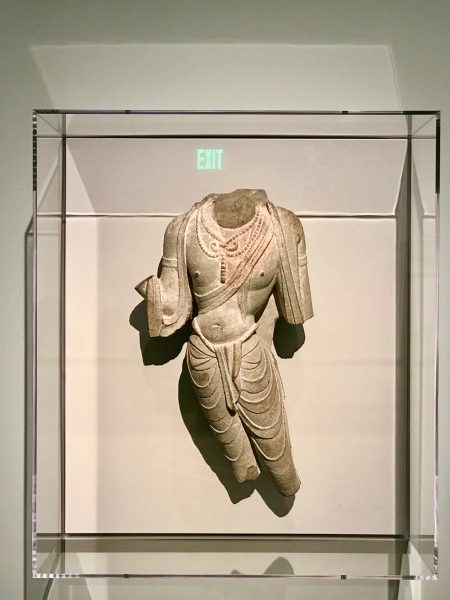
Avatar with Exit

Filed Under: Essays, Meditation & Buddhism, Object Lessons: Essays and images inspired by "A History of the World in 100 Objects." Tagged With: Chinese Snuff bottles, Contemplations of Asian Art, Iskra Review of Art and Culture, SAAM, SAAM opening night

Leave a Reply Cancel reply

Your email address will not be published. Required fields are marked *

This site uses Akismet to reduce spam. Learn how your comment data is processed.

Join Iskra’s Mailing List

Don't miss a thing! Subscribe to receive show announcements, first peek at new work and my semi-monthly blog by email. I primarily use the blog for news and updates but by signing up you will also receive the occasional newsletter and special offers for items in my shop.

Iskra Fine Art Blog

the creative process | conversations with artists | the contemplative impulse in art

Instagram

The photography show opening Friday, October 9th a The photography show opening Friday, October 9th at Slip Gallery is curated by my friend and fellow photographer, Scott Wipperman. This seemed like a good time to share his work and the story of our friendship on the road. Half the photographs are his and half are mine. This is an excerpt, and you can read the rest of it on my blog, see link tree in bio:

One of the rarest gifts in the life of an artist is finding a creative muse: someone who truly sees your work, and better yet, has a similar vision that is just enough different that you can collaborate without competing. In the often solitary studio life these connections can be difficult to find, but during pandemic, Instagram brought a new creative companion into my life. I do not know who started following who first. But in May 2020 I found myself sharing instant messages with a photographer working under the name “Concrete spaces“— a handle that immediately piqued my interest. Concrete has been one of my obsessions for years. Miraculously, there was someone out there who understood why I was working on a book called Parking Lot Floors Of North America. . .

©️Scott Wippermann

©️Scott Wippermann

©️Scott Wippermann

©️Scott Wippermann

©️Iskra Johnson

©️Iskra Johnson

©️Iskra Johnson

©️Scott Wippermann

©️Iskra Johnson
I am excited to be part of a show opening Friday, I am excited to be part of a show opening Friday, October 9th featuring eight Seattle  photographers and curated by Scott Wipperman @concretespaces at Slip Gallery. The theme of this show is complex and interesting: Intimate Structures. How the human body and human emotions connect with the built environment. And how the structures in our environment shape our lives, our relationships, and our possibilities. I will be showing industrial landscape as well as six pieces from the series “Immersions” based on tableaus of human relationship captured at Seattle’s waterlines. A diving platform is a stage, and the summer season a riveting drama of ever-shifting players. Most of these pieces have not been shown before.

I’m fascinated by the work of the seven other photographers, each one approaching the theme of the show from a completely different perspective, using both traditional photography and contemporary experimental techniques. Alienation, sublimation, meditation, connection:
Annie Regerson
Dimitri Wessendorf
Gillian Peckham
Iskra Johnson
Janis Mathieson
Mack Greene
Nina Bolger
Scott Wipperman
I hope to see you there!

The runs until the end of October. 
Thursday – Friday: 1:00 PM – 6:00 PM
Saturday – Sunday: 1:00 PM – 4:00 PM

Slip Gallery
2301 First Avenue in Belltown

Two Divers ©️Iskra Johnson

Guardian ©️Iskra Johnson
Morning Pages: Doors The first thing I saw when I Morning Pages: Doors

The first thing I saw when I woke up this morning was shadows on a door. Last night, I dreamt of an old building, one I have visited in dreams for years. It is a co-op apartment in some imaginary Canadian city, on a long steep hill above which are what appear to be the Swiss Alps. It was built in the early 1900’s and has grand staircases and balconies, huge rooms, bronze doorknobs and leaded glass windows. In my dreams, I interview with the board, I make an offer and I even buy an apartment— and then suddenly the door of my new home opens into a parking lot or a garage or someone else’s basement and I wake up and check my bank account, mystified by the power of this particular place, and how opening a door universally signals a new chapter in the story. 

Doors and windows are the most metaphoric parts of architecture. 100 years ago builders understood the attention they deserved. Now I live in a city where we have torn down historic churches, dumped the stained glass into a landfill and replaced these devotional structures with stacked box apartment complexes covered with Hardie Plank. I’m watching million dollar houses go up in my neighborhood with the cheapest vinyl windows from Home Depot, no eaves and often no roof— simply a flat lid to seal the box — and no trim at all. It is architecture as expedience, and it degrades the experience of how we see and experience the commons, and our human values, because, as Churchill noted, “We shape our buildings and afterward our buildings shape us.” 

We don’t look twice at these new houses, whereas I can look at this particular building somewhere in England for hours. Whoever built this wall took great care. They used the art of subtraction to add rather than to diminish. The vast flat wall of stone, the curved lintels, make the windows and doors speak. The doors and windows are not grand, but curiously condensed. They are portals through which one must squeeze with effort, which makes a person pause, and wonder. Later, they may find themselves dreaming of what is behind the walls.
Westminster Mall deconstruction project. I had to Westminster Mall deconstruction project. I had to go to the Department of Licensing this morning and stand in line and it gave me an opportunity to watch the Sears building come down. Sears was the last place left in the Seattle area where you could buy a vacuum cleaner from a man wearing creased polyester slacks, a tucked in shirt and an engraved name badge making a commission on the number of vacuum cleaner bags you bought to go with the Electrolux. I fondly remember my conversations about uprights versus canisters. This building is where I bought a snowsuit for a child that just barely fit me the day we had the epic snow and I was caught unprepared. I walked a mile on ice to get to Sears and then left looking like a nine year-old robot trying to get my knees to bend and move swaddled in 4 inches of poly blend padding. But I was warm! I doubt that anything that goes up this year in the Westminster Mall will last as long as Sears did. And there will be no catalogue unless I create one.
Excited tonight for the opening of Art and Steel a Excited tonight for the opening of Art and Steel at Youngstown Cultural Center! This is primarily a painting show from the Plein Air Watercolorists Association of Seattle (although I don’t think any of us were actually painting inside the mill on our tour!) I have been included as a photographer and mixed media artist, see last image in carousel, “Glide.” 

An exhibition of paintings telling the story of steel fabrication at NUCOR mill, hosted by Delridge Neighborhood Dev Association.

Friday, September 18 | 6:30 PM - 9:00 PM
Join us for a special evening celebrating art, industry, and community.

This exhibition features original paintings that tell the story of steel fabrication at the NUCOR Mill, presented by the Delridge Neighborhood Development Association (DNDA).
The evening will include a panel discussion, light refreshments, and an opportunity to learn more about the intersection of art, labor, and local history.

All donations made during the event will be matched and directed to DNDA’s Art Education Programs, helping support creative opportunities in our community.
Friday was my birthday. 9.11 is a day of remembran Friday was my birthday. 9.11 is a day of remembrance and national tragedy, and it seems bizarre to claim some kind of importance for having been being born on that day in the context of the event. 

Several days after, I allow myself reflection on the passage of time. This is me 15 years ago, with my Canon Powershot, which offers an astonishing naive pre-Cabrian 6 Mb image. It was much more kind than today's 24 MP iPhone, which not only captures the older me but turns that version into a character from Shakespeare with hi-def Bertrand Russel thought lines above my eyebrows and unforgiving evidence of allergies and time. 

On reflection I realize that 2011 was a very good year. I am going to allow myself to be that person for the month, and remember what that was like. The love of my life from the 8th grade had come to stay with me that summer. He took terrible photos of me that I now realize were not so bad. 99% of of the corrosive social media influences had not been invented yet. Women over whatever age was deemed desirable were not subjected to an ad every minute telling us that a new part of our face or body had gone south, and offering us a (discounted! on sale! watch the entire 30 minute video!!) $165 remedy on a monthly subscription to fix it. 

Now every day I look at the thinking and brooding lines above my eyebrows (which are also the lines caused by considering how funny some things can be even when crying) and ask myself what Bertrand Russel would say. If you are too young to know that name, AI is your ever-friend and will tell you how you too can become a "towering British philosopher, logician, mathematician, and social critic" and also how to fix those lines that come from considering things with your face. 

I think my romance with the iPhone is coming to a partial close. I want to go back to the idea of “glass.” It costs serious wages. It is made by Germans— Lately, (subtract the umlaut) Sony, the wizards of sand and heat and bending light to high high focus. I need to return to optics, f-stop, aperture, focal length— words that require frowning. 61 megapixels seems like the bare minimum. There is no cosmetic cure to being a lens-based artist:))

Featured Posts

  • Book Launch! The Water Tower Project from Iskra Fine Art
  • How to Purchase Artwork from Iskra Fine Art
  • About This Blog
  • New Directions in Contemplative Art: Conversations with Artists
  • What is a Transfer Print? (Artist Statement)

Categories

  • Abstract Calligraphy
  • Architecture & Sense of Place
    • Construction/Reconstruction
    • The Alaska Way Viaduct
    • The Water Tower Project
  • Art Reviews
  • Artist Studio Visits
    • The Mystic Muse: Artists Working in the Contemplative Traditions
  • Botanical Art
    • Botanical Art Cards
  • Collage
    • Digital Collage
  • Commissioned Art
  • Drawing
  • Essays
    • Object Lessons: Essays and images inspired by "A History of the World in 100 Objects."
  • Iskra Shows, Upcoming and Past
  • Iskra Sketchbooks & Journals
  • Living With Art
  • Meditation & Buddhism
  • Mixed Media
  • Painting
  • Photocollage
  • Photography
    • American West Landscape Photography
  • Print Sale
  • Prints
    • Transfer Prints
  • Seattle Iconic Landscape Prints
  • Social Media for Artists
    • The 100 Day Projects
  • The Garden
    • The Gardener's Almanac of Irreproducible Phenomena
  • The Spiritual in Art
  • Travel
    • Road Trips
  • Uncategorized

Archives

Search

Connect on Facebook

Iskra Fine Art Facebook Page

Creative Inspiration

  • Alternative Photography
  • An Artist's Retreat
  • Anonymous Chinese Textile Genius: Moo Won
  • Chocolate Is A Verb
  • Contemplative Art Process: Danila Rumold
  • Eva Isaksen
  • Old Industrial Japan
  • The Altered Page
  • The Heart Sutra Loop
  • The Patra Passage

Galleries for Contemplative Art

  • ArtXchange Gallery
  • Seattle Asian Art Museum

Links

  • CollageArt.org
  • Iskra at SAM Gallery
  • Iskra Fine Art on Houzz
  • Seattle Art Museum Blog
  • Seattle Artist League
  • Seattle Print Arts
  • Seeing Fresh: Contemplative Photography
  • The Painter's Keys

What I'm Reading: Online Magazines and Books I Love

  • 16 mi.
  • Essays by David Whyte
  • Evening Will Come: Poetry
  • Hyperallergic
  • Painter's Table
  • Shu: Reinventing Books in Contemporary Chinese Art
  • Streetsy
  • The Original Van Gogh's Ear Anthology
  • Tricycle Magazine
  • Unincorporated Persons in the Late Honda Dynasty
  • Vanguard

Let’s Connect

  • Contact Iskra
  • How to purchase artwork
  • Iskra Fine Art Blog : The creative process, conversations with artists, the contemplative impulse in art
  • Facebook
  • Instagram
  • Pinterest
  • Twitter

All Images Copyright © 2026  Iskra Johnson · Site by LND · WordPress