Iskra Fine Art

  • Prints
    • The Tarmac Residency: Airport Landscapes
    • Immersions | At The Shore
    • ColorBath: Images of the Harbor
    • The Floating World
    • Industrial Strength | Urban Industrial Landscape
    • The Scaffold
    • Industrial Pastorale: The Rural/Urban Landscape
    • Botanical Prints | The Natural World
    • Construction | Reconstruction : Urban Landscape
    • Infrastructure
  • Drawings
    • Pencil Drawings: Pandemic Pause
    • Drawings in Dust 1
    • Signs & Symbols (Archive)
    • Botanical Drawings (Archive)
  • Photography
    • Nucor Steel Industrial Landscape Photography
    • New Work Inspired by England
    • Seattle Waterfront Park Photography
    • Architectural Photography | Construction Sites
    • American West Landscape Photography
  • Mixed Media
    • Modern Botanical | Mixed Media on Plaster
    • From the Sea | Water Paintings
    • Sleep Studies
  • Wabi Sabi Abstract
    • Minimalist Modern
    • Ink Painting Abstractions
  • Shop
    • The Water Tower Project
  • About
    • Contact
  • Blog

Living in Metaphor (And Surviving the Worldwide Web)

October 29, 2012 by Iskra 3 Comments

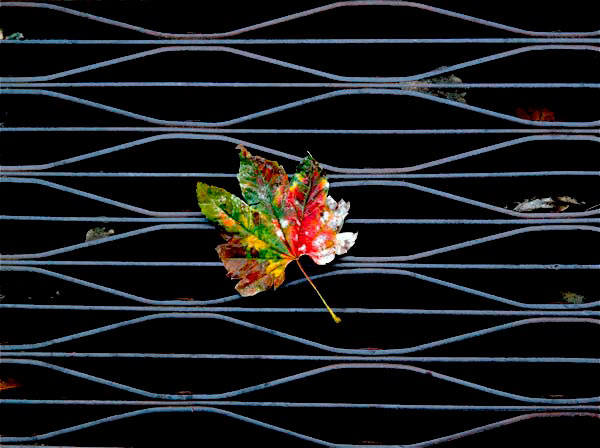
Leaf_On_Grille

Twenty years ago I wrote a story in which a man in San Francisco leaves his lover’s bed at 3 AM to go into his basement and talk to a woman in Denmark “on the Web.” My readers frowned and asked, “The Web? What is that? You’ll have to footnote that because no one will know what you’re talking about—we certainly don’t.” It may be difficult to believe, but there was such a quaint and innocent time and I was privileged to be, for ten minutes, ahead of the curve. I did not know, as I put the story away unfinished, that the footnote was in fact the story.

When that man “logged on” he entered the beginnings of a metaphor most of the modern world lives in now. He looked transfixed at the picture of a woman’s bare shoulder and the pink and black tattoo winding down her back. He wrote sentences, and sentences came back. He was “here” and he was simultaneously over there in a way he had never experienced before. He went back to bed just before sunrise.

Sunrise, coincidentally, is when the original prototype of the Web becomes most visible. The highwire paths run from hydrangea to pine, from the fern to the apple tree; the circular weavings hang briefly intact. A friend told me of waking on an August morning in a fugue state, trying to puzzle out a difficult problem. She walked into the garden and the sight of spider webs strung with dew and shimmering like shields stunned her with beauty. She walked a few paces to the left, and they vanished. She walked to the right and they reappeared. And so for a long while she walked back and forth observing as the webs came and went depending on the light. And then she turned around and walked right into one she could not see, and it broke.

This struck me as metaphorically accurate on many levels, and stayed with me so strongly that when, a few weeks later I walked into my own spider web, even though I am a confirmed arachnophobe and shrieked hysterically, I did not immediately wipe the web off my glasses. Instead I took my glasses off and marveled, for the web had transferred perfectly to the lens. If I wanted to I could let the pattern remain indefinitely, and walk around the world quite literally seeing “through” the web.

Since that moment I have been thinking about the way we live in metaphor, and how, depending on whether or not we actually see it, our world changes in response. Words shape our consciousness and visa versa. They are neither incidental nor random. When we go on the Web it offers us a choice of roles: we navigate, following threads; we get lost, falling through the spaces; or we are “caught in the Net,” prey just as the fly that hangs in a pale skein outside my backdoor. The words are not innocent. A “net” is only welcome to the hunter or the trapeze artist or the person dangling from a bridge. The butterfly and the fish have quite a different perspective. [Read more…]
Filed Under: Essays Tagged With: coping with digital life, freedom through metaphor, living in metaphor, surviving the worldwide web, the net, the space between, the web, writing on social media

Morning: Visual Meditation Practice

October 26, 2012 by Iskra Leave a Comment

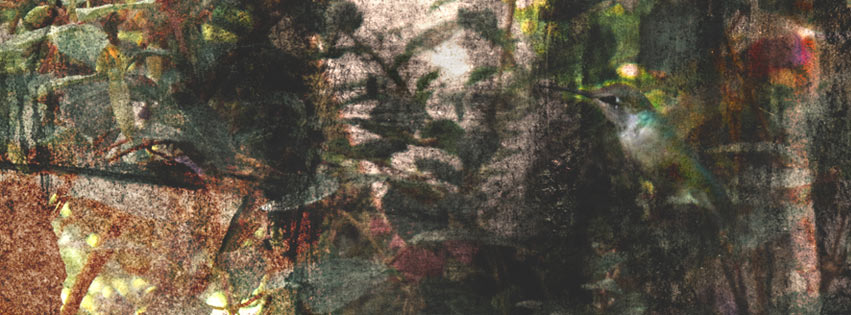
October-Hummingbird-Collage
Morning Meditation, Mixed Media digital collage. © Iskra Johnson

Filed Under: Digital Collage Tagged With: hummingbird collage, hummingbird in art, mixed media digital collage, visual meditation

Studio Visit With Zen Teacher Anita Feng: Expanding Our Idea of What Equanimity Looks Like

October 16, 2012 by Iskra 6 Comments

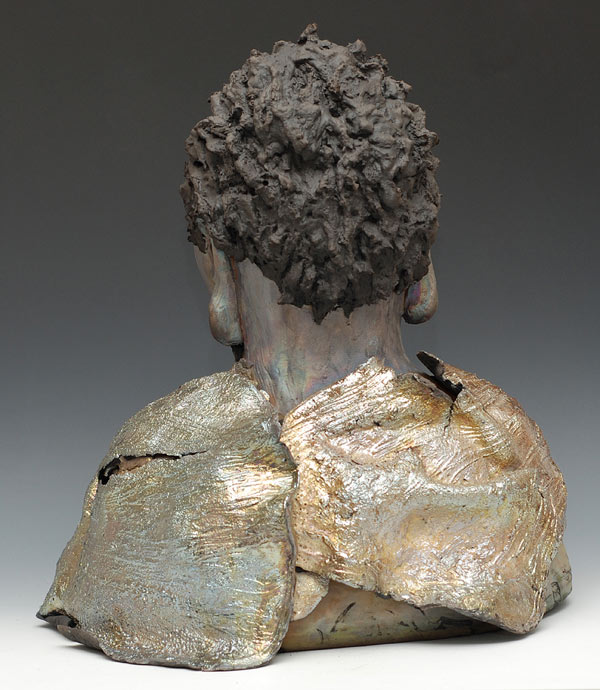
Anita_Feng_Balding-Buddha-copy
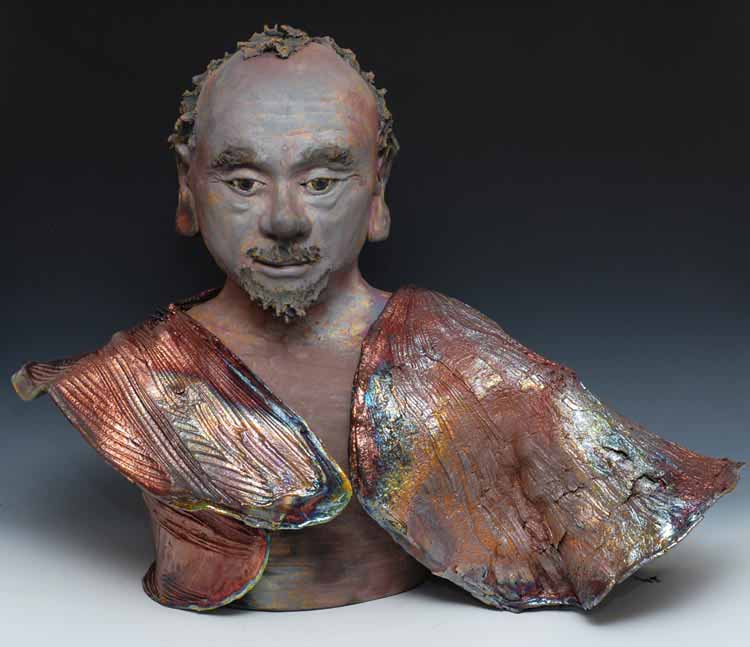
Balding Buddha, raku sculpture by Anita Feng

I visited the raku studio of artist and zen teacher Anita Feng in late August at the height of Indian summer. The trees had not yet caught fire, but the air held an expectant shimmer. Within a few weeks the leaves would deepen and turn, and that abalone glaze particular to this latitude would paint the city in subtle iridescence. If there is a season for raku, it is Autumn. This ceramic art form relies upon the drastic extremes of water and fire. It epitomizes the dynamic of change and working skillfully with change, and in this way it is the perfect parable for Zen practice.

I had met Anita earlier in the year, after seeing her Buddha sculptures in various galleries and visiting the Blue Heron Zen Center, where I very much enjoyed her clear-eyed Dharma talks. I was intrigued by her complex background as a poet, a potter and a 30- year practitioner of Zen in the Korean tradition. As a poet she has won many prestigious awards, including an NEA grant and the Pablo Neruda Prize and published two books of poetry. Much of her pottery background has been devoted to the making of ocarinas, the diminutive bird-shaped flutes of ancient times. I was very curious to know how she wove the threads of these different paths into her current focus as “The Buddha Maker.” As well, how she reconciles the traditions of devotional practice with a modern audience. I caught up with Anita as she took a break from preparations for Art in the Garden, an annual art and sculpture event held at Bellevue Botanical Gardens. We talked for many hours, and this interview is a combination of notes, memory, and email.

IJ) The power of Buddha images traditionally lies in their impersonality. The faces are based on years and years of archetypes, repeated and refined over centuries. In devotional statues the emotional element of mirroring, of liking what looks like us, is complicated by the idea of holiness or aspiration. In fact, we don’t really want the Buddha to be just like us. In contrast to the requirements for presidential candidates, we don’t judge the Buddha’s success by whether he would be a great guy to have a beer with. That not-having-a-beer-with characteristic is part of the deal. The statue is clearly not us. It is an idealized extreme. If we are from Northern European stock or African or Hispanic the Asian/Indian character of the features is not ours. This can be alienating. Alternatively we can experience it as restful–the burden of being personal is lifted, and we can surrender to something outside of ourselves.

One of the most difficult things to do in sculpture is to create a face that is universal, that does not create a subjective reactive “I don’t/do like you” response in the viewer. When a human being sees a face, whether on a real person or in a work of art, an immediate relationship arises. What guides you as you create the faces of your sculptures, and does your process or state of mind change as you work on the body?

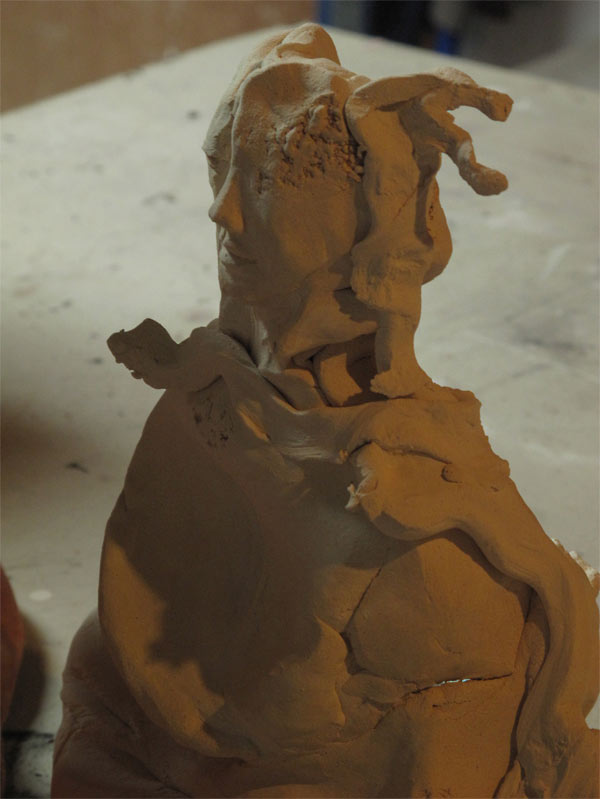
Face_In_Process

AF) There is a way in which iconography, indeed in which history, prettifies or re-invents the past to teach and/or inspire (or divert!) the following generations. As Zen students, as students of our own particular moment world, we have the responsibility to sort out inventions and embellishments from the root teacher/teaching.

For me, in sculpting a face, I am looking for a meeting place of the particular with the universal. There is, in all iconography, an ideal that is presented. (ie.- calm, equanimity, peace, centeredness). But from the teachings and enlightened experiential wisdom that has been passed down over the generations, the only way these qualities can arise and be authentic is in the present world/moment experience. So I create faces that reflect our/my world, but it should be said, this is a world that contains all the references of the past as well. We are, as creative creatures, a composite of past, present and future, all together.

In the physical act of working the clay I reflect these two essential components (moment world, infinite time and space) in this way: the fleeting, sometimes ragged and torn movement suggested in the body/robes…. paired with the enduring, infinite stillness within the calm face. These faces may be sad, happy, or in between — but all mean to suggest a still equanimity. There is something wonderful and necessary about having an idealized image that inspires us to think that equanimity is possible. What is dangerous is when we start to believe “equanimity looks like this.”

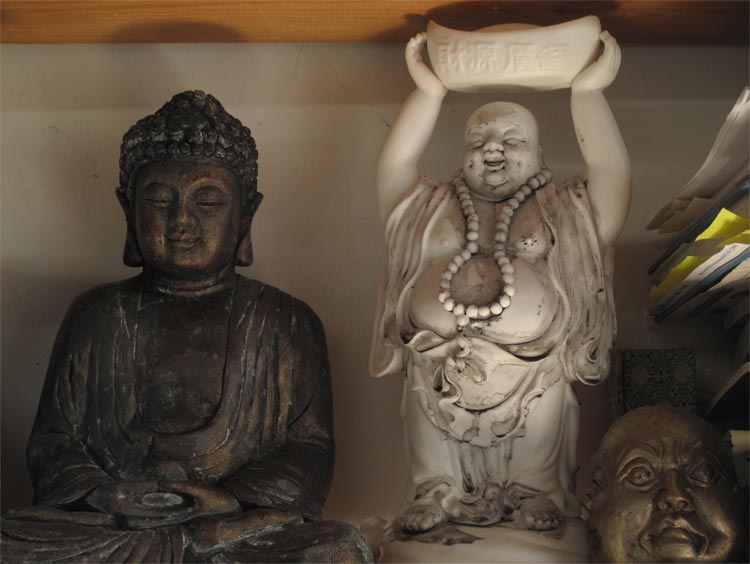
Buddhas_On_A_Shelf
Buddhas Watching the Buddha-Maker

IJ) Where and how do you draw your line between tradition and innovation? I have noticed that you have discarded many of the familiar aspects such as the stylized hair and dome-like stupa on the top. The robes can be completely wild.

AF) I don’t know if I draw any real lines between tradition and innovation. I do feel it’s important to reach back and honor aspects of the tradition where it seems to fit and serve. If the figure becomes too abstracted from the archetype people don’t have an anchor. I have chosen to keep the stylized ears, because it is an easily recognizable feature of a Buddha, but also because it points to a very real person, a privileged wealthy youth who became Buddha –with his ears elongated from the weight of heavy earrings.

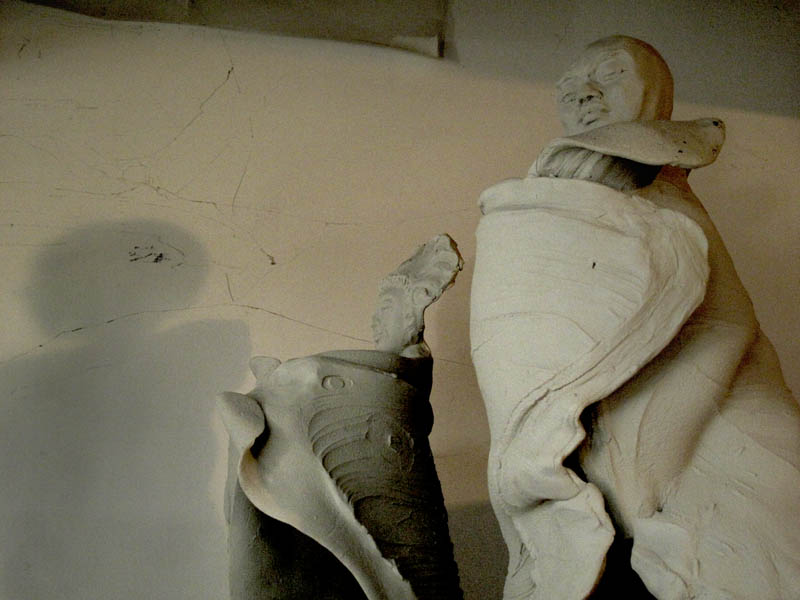
Buddha_Statues_In_Raw_Clay
Buddhas waiting for fire

Buddha_Listening_Feng The Ears [Read more…]

Filed Under: The Mystic Muse: Artists Working in the Contemplative Traditions Tagged With: Anita Feng, Buddhist poets, Buddhist sclupture, devotional figures, new contemplateive art, raku Buddha art, reinventing the Buddha

New Directions in Contemplative Art: Conversations with Artists

October 13, 2012 by Iskra 2 Comments

Iconography_Drawing
“Help Along the Way” Mixed Media Drawing, © Iskra Johnson

This week I am launching a new series of occasional interviews with artists working in the contemplative/devotional traditions. Many of these artists work within the rich iconography of Buddhism, and specifically with the image of the Buddha. Historically the Buddha is represented as a figure of serene composure, elegance and grace. The eyes look inward, closed or downward cast, the shoulders curve gently into hands held in perfect mudra.  A careful ritualized mathematics guides the distance between folds in the Buddha’s robes and the size and placement of snails on his head. The surface is stone-hard or wood, impenetrable.

This is a statue, not a man–and certainly not a woman, although Greek influence gives his robes a lyrical sweep and his body is not the emaciated one of early more ascetic representations. Not just the province of practicing “Buddhists,” the Buddha image lives ubiquitously in the contemporary marketplace of imagery and ideas. The popular shorthand for “Buddhism” is the relinquishment of desire and a state of serene acceptance, exemplified by the immobile statue. The statue is an ideal. What happens when society fills its spiritual landscape with an image of an ideal rather than a real?

It sets up a struggle, a dichotomy, hazardous and blessed in equal measure. The essence of devotional art is an image and an ideal larger than the human capacity to realize. It is aspirational. And in aspiration is a keen and particular form of suffering: you never get there, you are always leaning towards, but never reaching. Modern life, at least as practiced in America, is about getting there: and it is about getting. There is grasping and a kind of avarice in that. As well, a valuable practical truth and wisdom. The democratic revolutions tumbled the monarchies: we can all consider ourselves kings, queens, or at least the head of our local precinct caucus. Darwin, driving a nail into holy hierarchies, established that we might be on a less than mystical trajectory from birth to death and nowhere does he tell us if the soul is an acquired or inherited trait. Given the melting ice caps we don’t know if we or the sutras will be here in 2020. It is only logical to say: why not now? Why not me? Why can’t I understand in my own terms, and right now, — quickly?

The membrane between the modern urgency to leap efficiently from aspiration to getting and a deeper, timeless and more thoughtful understanding is being explored by the artists, writers and other creators reinventing religious iconography on their own terms. Some of them continue in the lineage of traditional forms, repositioning them in modern environments. Others take the sly point of view, working in illustration and advertising, and others work from the ground up re-inventing the very iconographic forms, with their own personal and aesthetic mathematics. Irony is rare, and to me this is a welcome blessing. These artists are not afraid to wear their aspiration on their sleeve. They may risk condescension and accusations of blasphemy from the spiritual establishments, and incomprehension from the secular consumer, and yet they continue on.

As someone who has followed the Buddhist path– with some detours– for most of my adult life, I want to talk to these people. The Buddha image in particular has huge resonance for me. I have done and continue to do visual art, or what I think of more properly as contemplative practice, that incorporates the image of the Buddha. This practice has led me towards viewing my own art making, regardless of the subject, as an extension of contemplation, primarily motivated by a desire for insight, beauty and emotional ballast, and secondarily as an object in the marketplace. I look forward to visiting the studios and work of artists with a similar perspective, and to seeing the varieties of ways in which their practice takes form.

Please check back from time to see the latest artists interviewed in the category of “The Mystic Muse“, or subscribe to receive this blog in your mailbox.

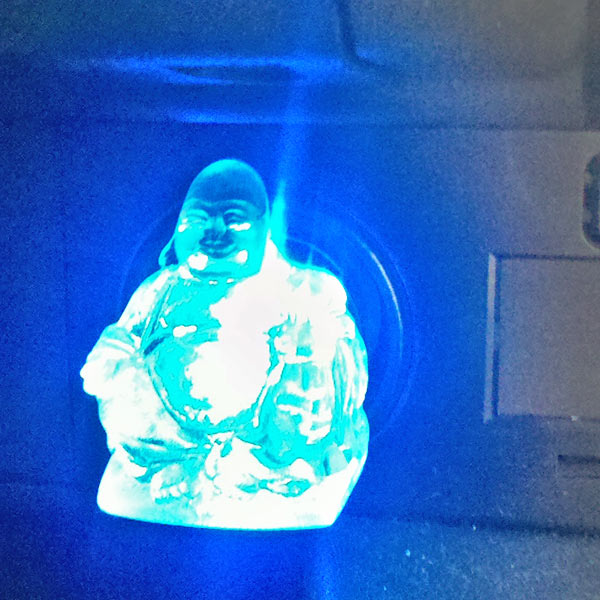
My companion in travels, the plug-in-‘88 Toyota-cigarette-lighter-laughing-while-driving-Buddha. Factory made in a high-stress environment by card-carrying atheists, no doubt.

Filed Under: The Mystic Muse: Artists Working in the Contemplative Traditions Tagged With: Buddha kitsch, Buddhist iconography, contemplative art, devotional art, essays on buddhist art, popular Buddhism, religious symbols in art

Viktoria Viktoria Site Study: Future Residential on Second Avenue

October 5, 2012 by Iskra 4 Comments

It is exhilarating beyond measure to be alive in Seattle during this endless Indian Summer. (By the way, before using this phrase, this being the city of all things politically correct, I spent an hour researching whether in fact it is politically okay to use this phrase. I am going to go with this: As the American Indians were reportedly the first to notice the loveliness of this time and to celebrate the harvest by looking at the light and perhaps smoking a pipe rather than engaging in more frantic scurrying, worrying and stacking of crops in the barn (as the pale settlers were wont), when the phrase is invoked by a non-Indian person caught up in the intoxicating Autumnal rhapsodies it is in fact an homage to the wisdom of the First Nations, and understood as such.) Whew.

So I walk around, temporarily off the hook, and I can’t help but notice but the city is damn fine beautiful. I am sure nature is also doing something, but the construction sites are in their prime, as in primary colors, none of this faded pink of cosmos and hydrangeas and plum feather grass. Give me the street, the baylight glinting on scaffolds and glass, the scattered jump rope song of grafitti and the fifteen people gathered to watch the man in the Mercedes try to park his car in the the lot on Second Avenue with one-sixteenth inch margin of error and a flawless polish on that fender. Pretty much anytime of day is good light, because we actually have light which makes, yes, shadow. If you live here, you know.

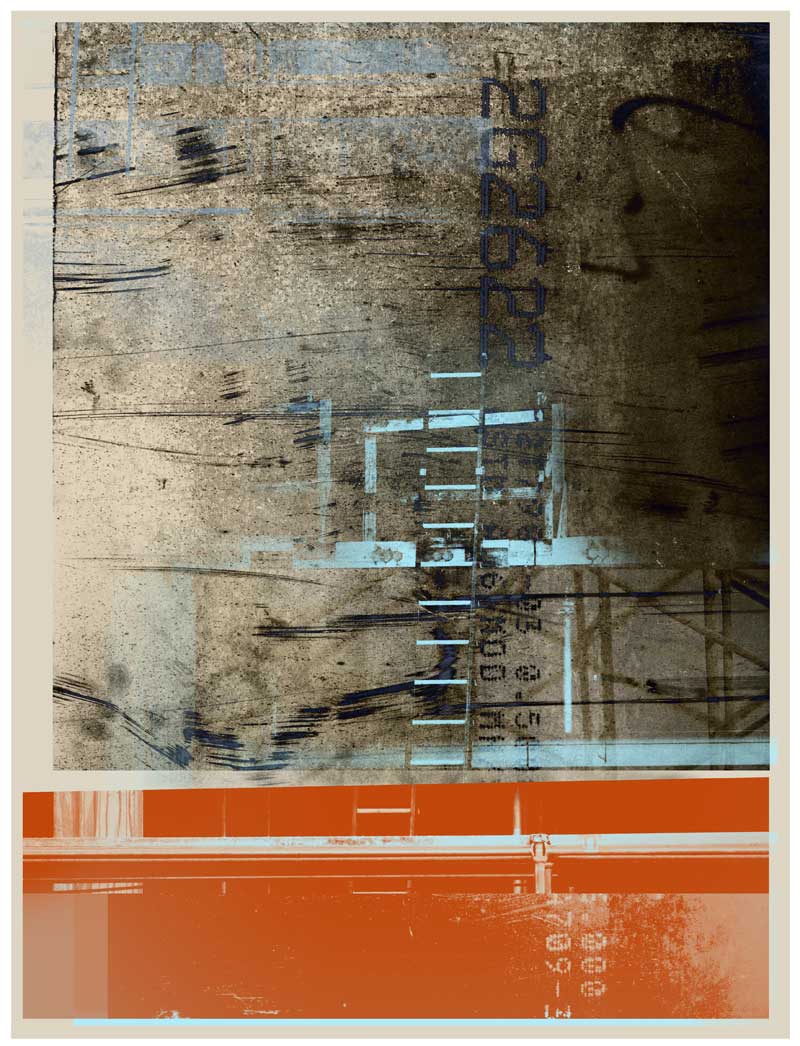
Here is a piece that will probably go through another fifty iterations, but which has landed here, comfortably, for the moment. The rule for this series, (thank you John Cage for pointing out how necessary rules are in your fine book Silence) are simple. All elements of photographic evidence must come from an actual construction site. Paint and other elements layered into the work may come from my drawing table.

ViktoriaViktoria_Construction_Project_Photocollage
ViktoriaViktoria, 24 x 19 inches, photocollage, © Iskra Johnson


Filed Under: Construction/Reconstruction, Digital Collage, Photocollage, Prints Tagged With: construciton site collage, construciton site photography, digital collage of construction site, photocollage of building

  • « Previous Page
  • 1
  • …
  • 37
  • 38
  • 39
  • 40
  • 41
  • …
  • 60
  • Next Page »

Join Iskra’s Mailing List

Don't miss a thing! Subscribe to receive show announcements, first peek at new work and my semi-monthly blog by email. I primarily use the blog for news and updates but by signing up you will also receive the occasional newsletter and special offers for items in my shop.

Iskra Fine Art Blog

the creative process | conversations with artists | the contemplative impulse in art

Instagram

The photography show opening Friday, October 9th a The photography show opening Friday, October 9th at Slip Gallery is curated by my friend and fellow photographer, Scott Wipperman. This seemed like a good time to share his work and the story of our friendship on the road. Half the photographs are his and half are mine. This is an excerpt, and you can read the rest of it on my blog, see link tree in bio:

One of the rarest gifts in the life of an artist is finding a creative muse: someone who truly sees your work, and better yet, has a similar vision that is just enough different that you can collaborate without competing. In the often solitary studio life these connections can be difficult to find, but during pandemic, Instagram brought a new creative companion into my life. I do not know who started following who first. But in May 2020 I found myself sharing instant messages with a photographer working under the name “Concrete spaces“— a handle that immediately piqued my interest. Concrete has been one of my obsessions for years. Miraculously, there was someone out there who understood why I was working on a book called Parking Lot Floors Of North America. . .

©️Scott Wippermann

©️Scott Wippermann

©️Scott Wippermann

©️Scott Wippermann

©️Iskra Johnson

©️Iskra Johnson

©️Iskra Johnson

©️Scott Wippermann

©️Iskra Johnson
I am excited to be part of a show opening Friday, I am excited to be part of a show opening Friday, October 9th featuring eight Seattle  photographers and curated by Scott Wipperman @concretespaces at Slip Gallery. The theme of this show is complex and interesting: Intimate Structures. How the human body and human emotions connect with the built environment. And how the structures in our environment shape our lives, our relationships, and our possibilities. I will be showing industrial landscape as well as six pieces from the series “Immersions” based on tableaus of human relationship captured at Seattle’s waterlines. A diving platform is a stage, and the summer season a riveting drama of ever-shifting players. Most of these pieces have not been shown before.

I’m fascinated by the work of the seven other photographers, each one approaching the theme of the show from a completely different perspective, using both traditional photography and contemporary experimental techniques. Alienation, sublimation, meditation, connection:
Annie Regerson
Dimitri Wessendorf
Gillian Peckham
Iskra Johnson
Janis Mathieson
Mack Greene
Nina Bolger
Scott Wipperman
I hope to see you there!

The runs until the end of October. 
Thursday – Friday: 1:00 PM – 6:00 PM
Saturday – Sunday: 1:00 PM – 4:00 PM

Slip Gallery
2301 First Avenue in Belltown

Two Divers ©️Iskra Johnson

Guardian ©️Iskra Johnson
Morning Pages: Doors The first thing I saw when I Morning Pages: Doors

The first thing I saw when I woke up this morning was shadows on a door. Last night, I dreamt of an old building, one I have visited in dreams for years. It is a co-op apartment in some imaginary Canadian city, on a long steep hill above which are what appear to be the Swiss Alps. It was built in the early 1900’s and has grand staircases and balconies, huge rooms, bronze doorknobs and leaded glass windows. In my dreams, I interview with the board, I make an offer and I even buy an apartment— and then suddenly the door of my new home opens into a parking lot or a garage or someone else’s basement and I wake up and check my bank account, mystified by the power of this particular place, and how opening a door universally signals a new chapter in the story. 

Doors and windows are the most metaphoric parts of architecture. 100 years ago builders understood the attention they deserved. Now I live in a city where we have torn down historic churches, dumped the stained glass into a landfill and replaced these devotional structures with stacked box apartment complexes covered with Hardie Plank. I’m watching million dollar houses go up in my neighborhood with the cheapest vinyl windows from Home Depot, no eaves and often no roof— simply a flat lid to seal the box — and no trim at all. It is architecture as expedience, and it degrades the experience of how we see and experience the commons, and our human values, because, as Churchill noted, “We shape our buildings and afterward our buildings shape us.” 

We don’t look twice at these new houses, whereas I can look at this particular building somewhere in England for hours. Whoever built this wall took great care. They used the art of subtraction to add rather than to diminish. The vast flat wall of stone, the curved lintels, make the windows and doors speak. The doors and windows are not grand, but curiously condensed. They are portals through which one must squeeze with effort, which makes a person pause, and wonder. Later, they may find themselves dreaming of what is behind the walls.
Westminster Mall deconstruction project. I had to Westminster Mall deconstruction project. I had to go to the Department of Licensing this morning and stand in line and it gave me an opportunity to watch the Sears building come down. Sears was the last place left in the Seattle area where you could buy a vacuum cleaner from a man wearing creased polyester slacks, a tucked in shirt and an engraved name badge making a commission on the number of vacuum cleaner bags you bought to go with the Electrolux. I fondly remember my conversations about uprights versus canisters. This building is where I bought a snowsuit for a child that just barely fit me the day we had the epic snow and I was caught unprepared. I walked a mile on ice to get to Sears and then left looking like a nine year-old robot trying to get my knees to bend and move swaddled in 4 inches of poly blend padding. But I was warm! I doubt that anything that goes up this year in the Westminster Mall will last as long as Sears did. And there will be no catalogue unless I create one.
Excited tonight for the opening of Art and Steel a Excited tonight for the opening of Art and Steel at Youngstown Cultural Center! This is primarily a painting show from the Plein Air Watercolorists Association of Seattle (although I don’t think any of us were actually painting inside the mill on our tour!) I have been included as a photographer and mixed media artist, see last image in carousel, “Glide.” 

An exhibition of paintings telling the story of steel fabrication at NUCOR mill, hosted by Delridge Neighborhood Dev Association.

Friday, September 18 | 6:30 PM - 9:00 PM
Join us for a special evening celebrating art, industry, and community.

This exhibition features original paintings that tell the story of steel fabrication at the NUCOR Mill, presented by the Delridge Neighborhood Development Association (DNDA).
The evening will include a panel discussion, light refreshments, and an opportunity to learn more about the intersection of art, labor, and local history.

All donations made during the event will be matched and directed to DNDA’s Art Education Programs, helping support creative opportunities in our community.
Friday was my birthday. 9.11 is a day of remembran Friday was my birthday. 9.11 is a day of remembrance and national tragedy, and it seems bizarre to claim some kind of importance for having been being born on that day in the context of the event. 

Several days after, I allow myself reflection on the passage of time. This is me 15 years ago, with my Canon Powershot, which offers an astonishing naive pre-Cabrian 6 Mb image. It was much more kind than today's 24 MP iPhone, which not only captures the older me but turns that version into a character from Shakespeare with hi-def Bertrand Russel thought lines above my eyebrows and unforgiving evidence of allergies and time. 

On reflection I realize that 2011 was a very good year. I am going to allow myself to be that person for the month, and remember what that was like. The love of my life from the 8th grade had come to stay with me that summer. He took terrible photos of me that I now realize were not so bad. 99% of of the corrosive social media influences had not been invented yet. Women over whatever age was deemed desirable were not subjected to an ad every minute telling us that a new part of our face or body had gone south, and offering us a (discounted! on sale! watch the entire 30 minute video!!) $165 remedy on a monthly subscription to fix it. 

Now every day I look at the thinking and brooding lines above my eyebrows (which are also the lines caused by considering how funny some things can be even when crying) and ask myself what Bertrand Russel would say. If you are too young to know that name, AI is your ever-friend and will tell you how you too can become a "towering British philosopher, logician, mathematician, and social critic" and also how to fix those lines that come from considering things with your face. 

I think my romance with the iPhone is coming to a partial close. I want to go back to the idea of “glass.” It costs serious wages. It is made by Germans— Lately, (subtract the umlaut) Sony, the wizards of sand and heat and bending light to high high focus. I need to return to optics, f-stop, aperture, focal length— words that require frowning. 61 megapixels seems like the bare minimum. There is no cosmetic cure to being a lens-based artist:))

Featured Posts

  • Book Launch! The Water Tower Project from Iskra Fine Art
  • How to Purchase Artwork from Iskra Fine Art
  • About This Blog
  • New Directions in Contemplative Art: Conversations with Artists
  • What is a Transfer Print? (Artist Statement)

Categories

  • Abstract Calligraphy
  • Architecture & Sense of Place
    • Construction/Reconstruction
    • The Alaska Way Viaduct
    • The Water Tower Project
  • Art Reviews
  • Artist Studio Visits
    • The Mystic Muse: Artists Working in the Contemplative Traditions
  • Botanical Art
    • Botanical Art Cards
  • Collage
    • Digital Collage
  • Commissioned Art
  • Drawing
  • Essays
    • Object Lessons: Essays and images inspired by "A History of the World in 100 Objects."
  • Iskra Shows, Upcoming and Past
  • Iskra Sketchbooks & Journals
  • Living With Art
  • Meditation & Buddhism
  • Mixed Media
  • Painting
  • Photocollage
  • Photography
    • American West Landscape Photography
  • Print Sale
  • Prints
    • Transfer Prints
  • Seattle Iconic Landscape Prints
  • Social Media for Artists
    • The 100 Day Projects
  • The Garden
    • The Gardener's Almanac of Irreproducible Phenomena
  • The Spiritual in Art
  • Travel
    • Road Trips
  • Uncategorized

Archives

Search

Connect on Facebook

Iskra Fine Art Facebook Page

Creative Inspiration

  • Alternative Photography
  • An Artist's Retreat
  • Anonymous Chinese Textile Genius: Moo Won
  • Chocolate Is A Verb
  • Contemplative Art Process: Danila Rumold
  • Eva Isaksen
  • Old Industrial Japan
  • The Altered Page
  • The Heart Sutra Loop
  • The Patra Passage

Galleries for Contemplative Art

  • ArtXchange Gallery
  • Seattle Asian Art Museum

Links

  • CollageArt.org
  • Iskra at SAM Gallery
  • Iskra Fine Art on Houzz
  • Seattle Art Museum Blog
  • Seattle Artist League
  • Seattle Print Arts
  • Seeing Fresh: Contemplative Photography
  • The Painter's Keys

What I'm Reading: Online Magazines and Books I Love

  • 16 mi.
  • Essays by David Whyte
  • Evening Will Come: Poetry
  • Hyperallergic
  • Painter's Table
  • Shu: Reinventing Books in Contemporary Chinese Art
  • Streetsy
  • The Original Van Gogh's Ear Anthology
  • Tricycle Magazine
  • Unincorporated Persons in the Late Honda Dynasty
  • Vanguard

Let’s Connect

  • Contact Iskra
  • How to purchase artwork
  • Iskra Fine Art Blog : The creative process, conversations with artists, the contemplative impulse in art
  • Facebook
  • Instagram
  • Pinterest
  • Twitter

All Images Copyright © 2026  Iskra Johnson · Site by LND · WordPress