Iskra Fine Art

  • Prints
    • The Tarmac Residency: Airport Landscapes
    • Immersions | At The Shore
    • ColorBath: Images of the Harbor
    • The Floating World
    • Industrial Strength | Urban Industrial Landscape
    • The Scaffold
    • Industrial Pastorale: The Rural/Urban Landscape
    • Botanical Prints | The Natural World
    • Construction | Reconstruction : Urban Landscape
    • Infrastructure
  • Drawings
    • Pencil Drawings: Pandemic Pause
    • Drawings in Dust 1
    • Signs & Symbols (Archive)
    • Botanical Drawings (Archive)
  • Photography
    • Nucor Steel Industrial Landscape Photography
    • New Work Inspired by England
    • Seattle Waterfront Park Photography
    • Architectural Photography | Construction Sites
    • American West Landscape Photography
  • Mixed Media
    • Modern Botanical | Mixed Media on Plaster
    • From the Sea | Water Paintings
    • Sleep Studies
  • Wabi Sabi Abstract
    • Minimalist Modern
    • Ink Painting Abstractions
  • Shop
    • The Water Tower Project
  • About
    • Contact
  • Blog

Gouache Bootcamp at Fort Worden

August 26, 2013 by Iskra 2 Comments

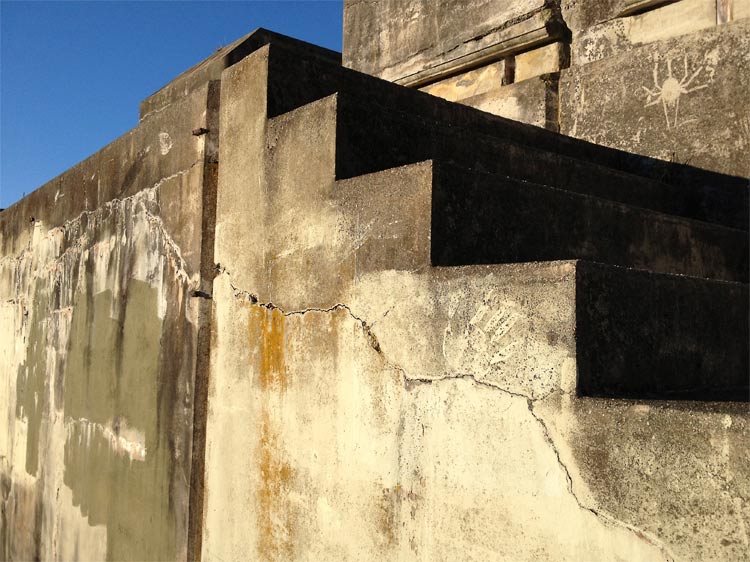
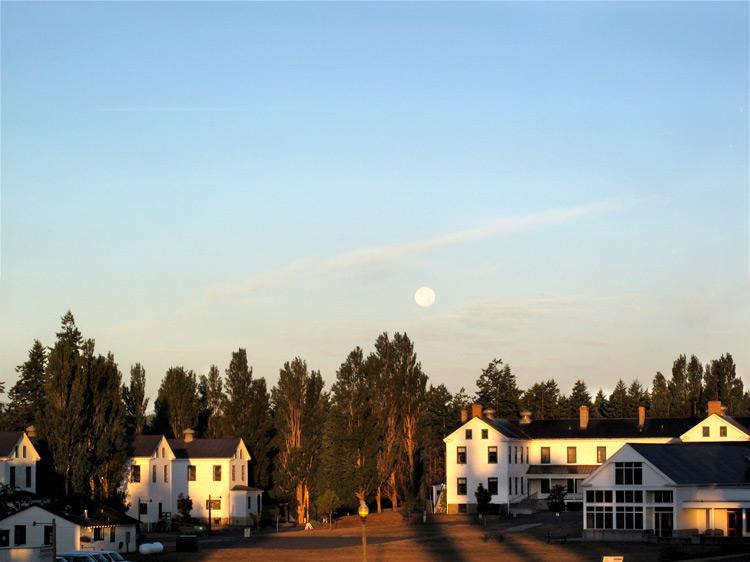
Fort Worden With Full Moon

I have been possessed by my camera for the past few years, and in spite of public avowals that I was going to “get back to painting” evidence of new paintings has been scarce. So when I saw an opportunity to take a weeklong intensive in gouache through Gage Academy with realist painter Karen Hackenberg I leapt. What better antidote to procrastinating impulses than a retreat at Fort Worden, where I could incarcerate myself in a creative compound with fellow artists?

The fort, a former military battery designed to protect the entrance to Puget Sound, sits high on bluffs above the Straits of Juan de Fuca. The landscape ranges from saltwater shore to open meadow and forest, and the vistas are breathtaking. Centrum, which partners with Fort Worden, provides multi-media programming and coordinates facilities. Its mission is focused on creativity, connection and renewal, and as you move about the grounds you meet fascinating people radiating exactly these qualities. In Centrum’s own words: “It’s a place where the land stops, the sea begins, and the mind keeps going.”
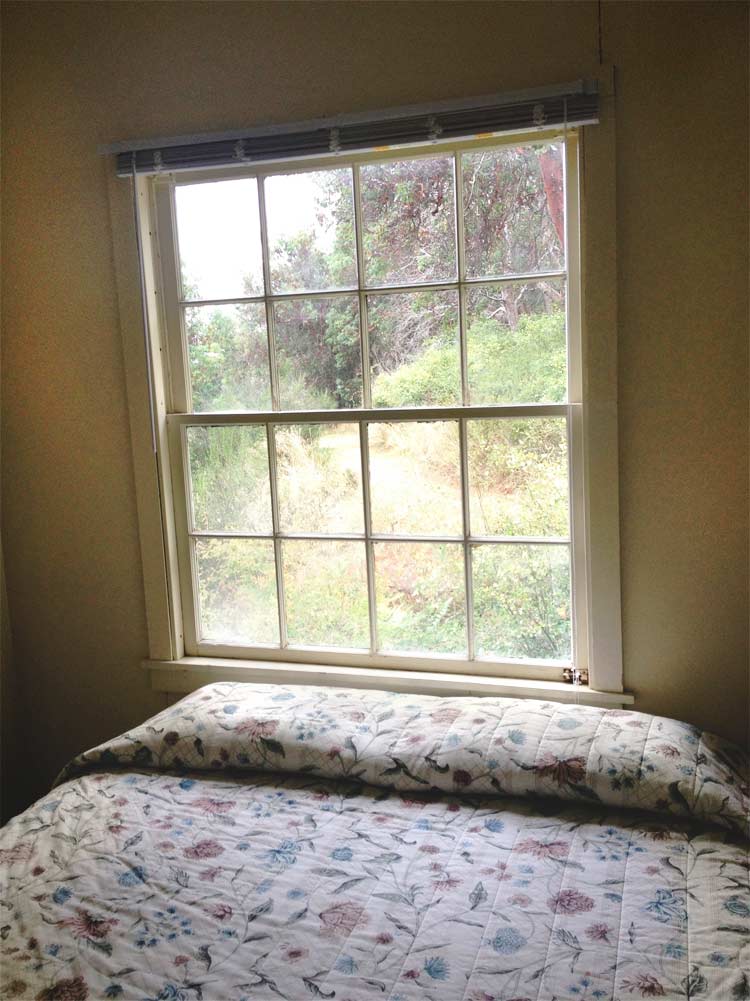
Barracks Bed
Barracks Bed, slightly off center, as perhaps it should be for artist quarters.

I started my stay with a walk on the beach in search of objects for a still life, and to get my mind into the abstract state required to see in paint.
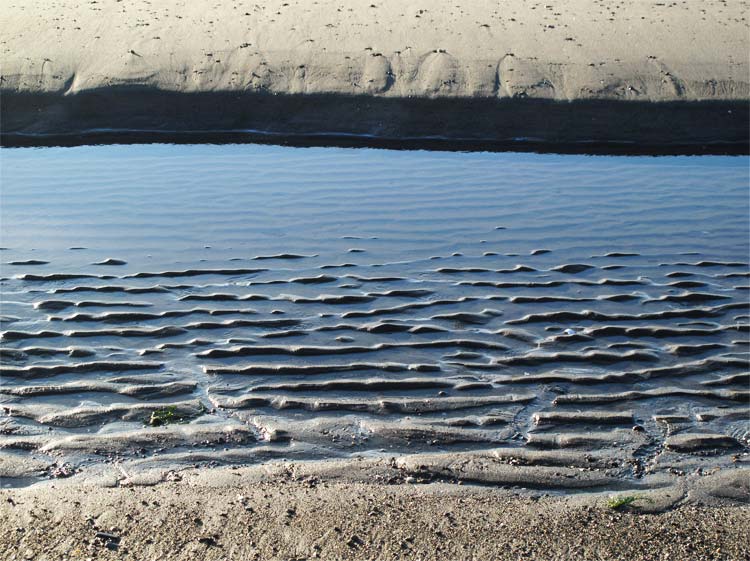
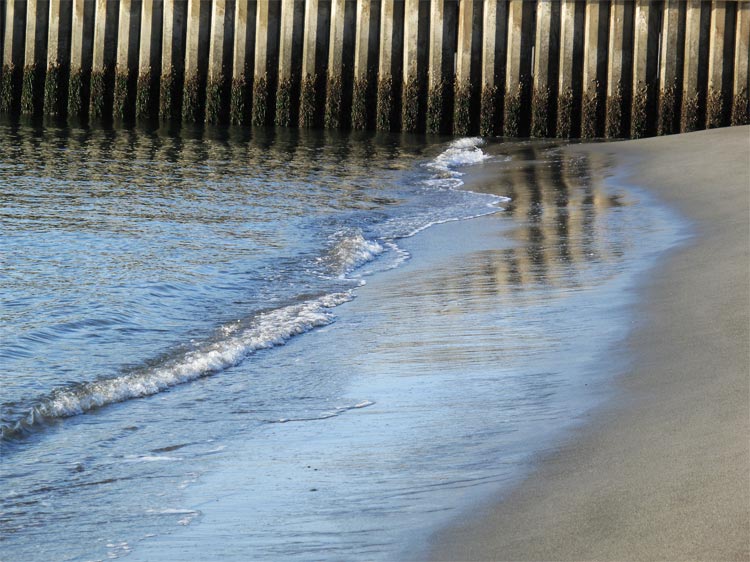
Shore Study 1

Shore Study 2

Visitors do not seem to need a book deal or an NEA grant to go about rearranging the beach. These are just a fraction of the useless battlements and airy fortifications I came across– far better than a museum for a lover of sticks.
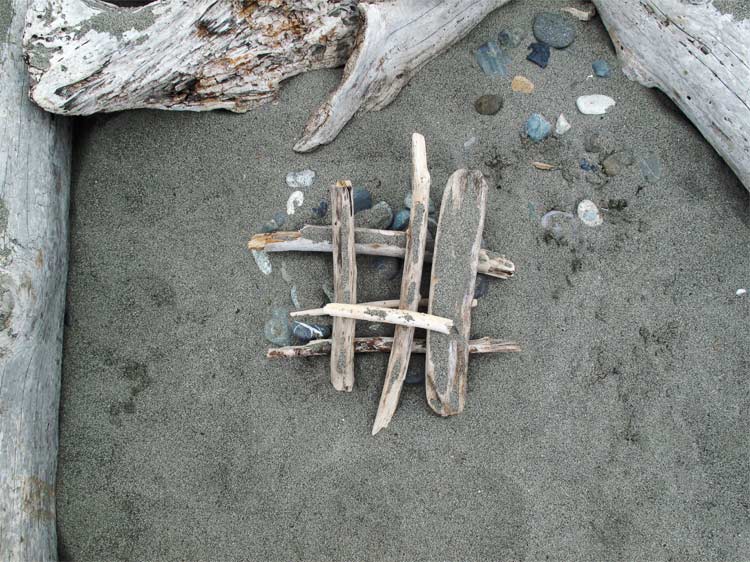
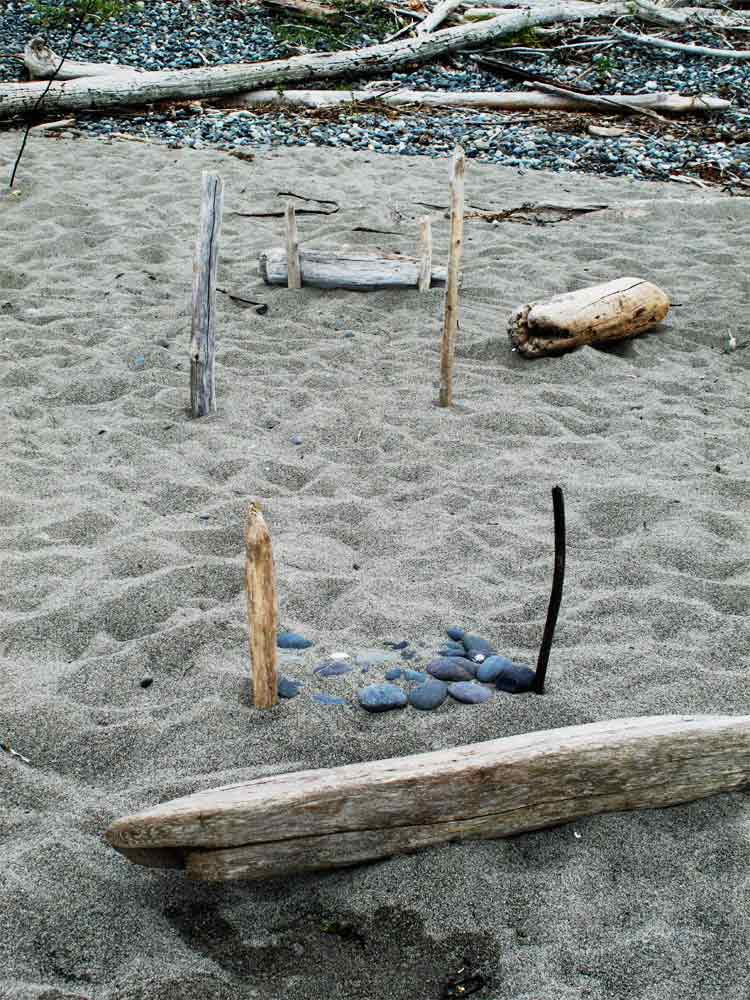
The Useless Battlement

Twigs in SandAs I wandered the beach I was reminded of one of my favorite passages from Leonard Koren’s book on Wabi-Sabi:

Definition of “aesthetic”…. refers to a set of informing values and principles — guidelines — for making artistic descriminations and decisions. The hallmarks of an “aesthetic” are 1) distinctiveness (distinct from the mass of ordinary, chaotic non-differentiated perceptions), 2) clarity (the aesthetic point has to be definite — clear — even if the aesthetic is about unclearness, and 3) repetition (continuity.)

The fort environment itself pulls you into the heart of paradox. You look up from reverie on golden yarrow, snowberry and roses to the harsh silhouettes of concrete battlements. Fort Worden was built in the early 1900’s, and the parade grounds rang with the boots of storied generals like August Quarles and Aronson Randol for whom the ruins are named. Among these purposeful ghosts now ramble barefoot banjo players and writers gazing into the distance and painters studying the shapes of clouds.
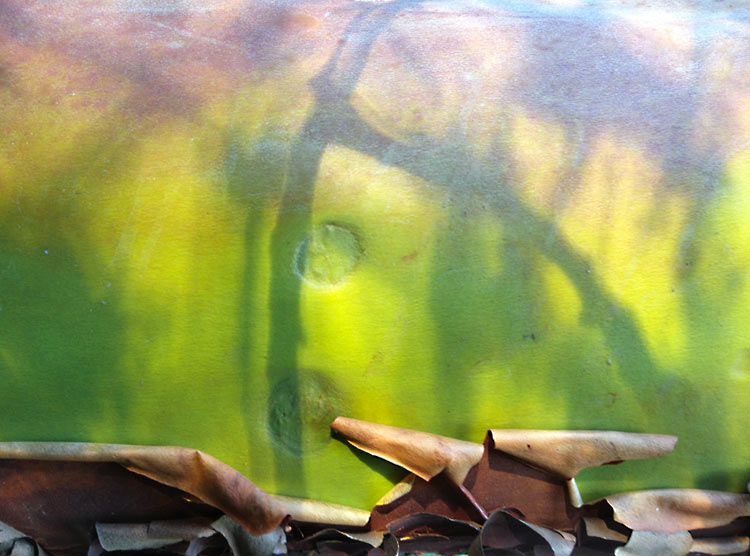
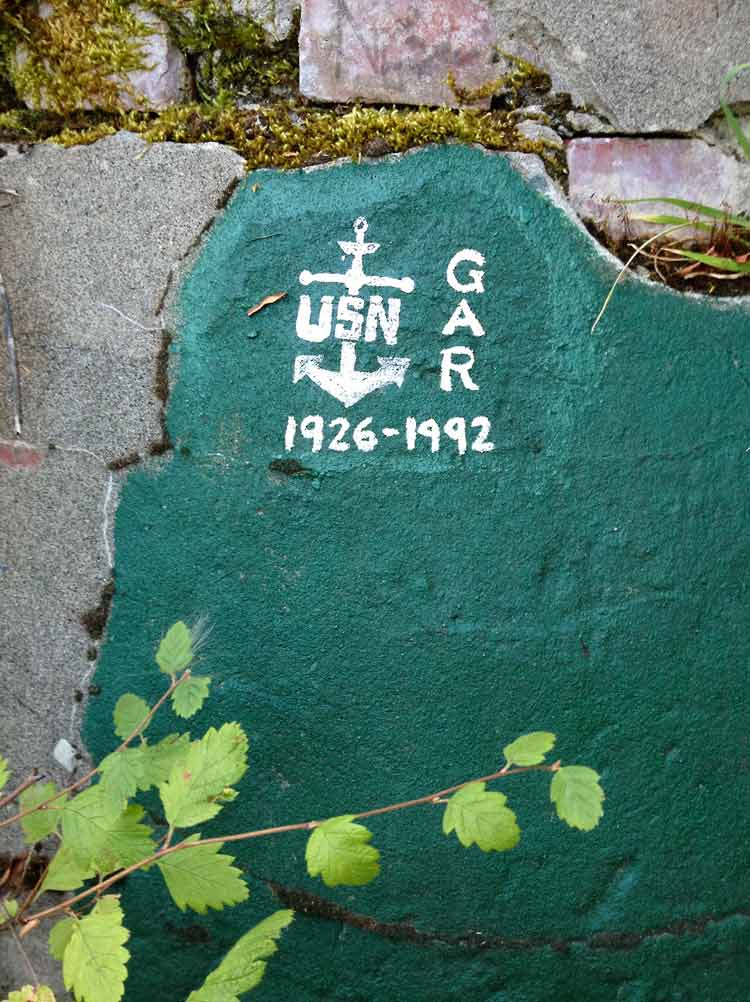
MadroneRock With AnchorFort Worden StairLadder To the Sky

At any hour, and with much appreciated leavening, you will encounter Bambi, who’s benign gaze seems to bless all forms of artistic experimentation and failure. Sometimes there are berries left for a human breakfast.
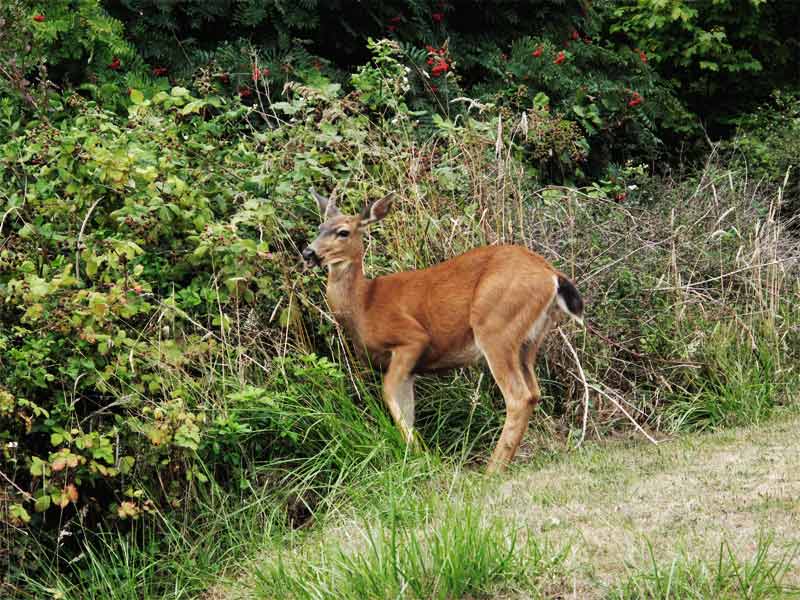
Bambi

Fortified by the muse I began my painting days, starting with still life painting and moving into more adventurous explorations of the medium. We each set up our own objects with a single light source. I worked on 300 pound hotpress Lanaquarelle, which I discovered does not like frisket. It does however adore the paint, and I have fallen madly in love with its velvet surface. On the first study I left the paper white as in traditional watercolor and in the second I masked out the objects and did an opaque wash, returning later to fill in the central subjects.
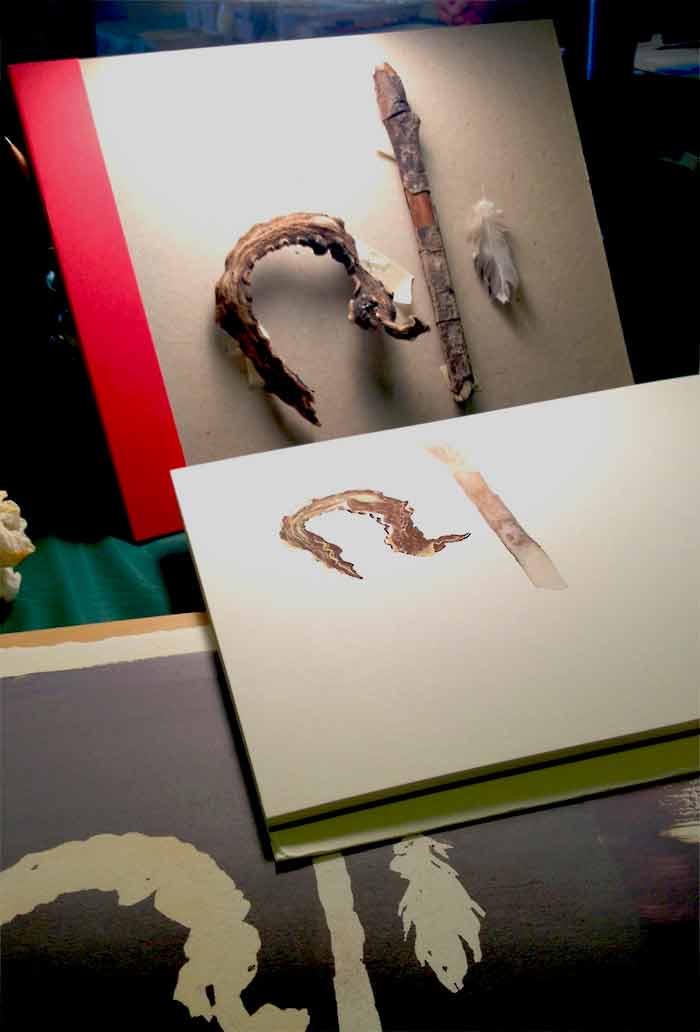
Still Life Setup
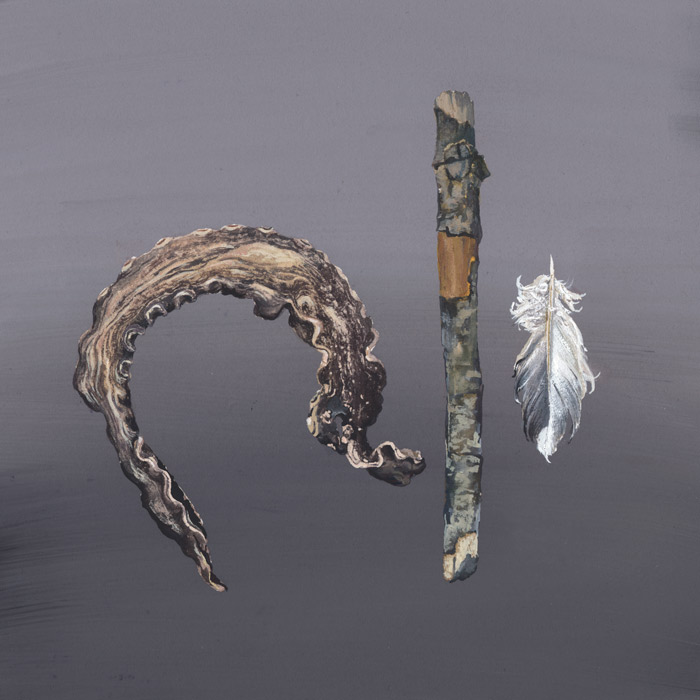
Still Life Setup, with petrified octopus, twig and feather from the beach. Somehow I thought these would be easy…..
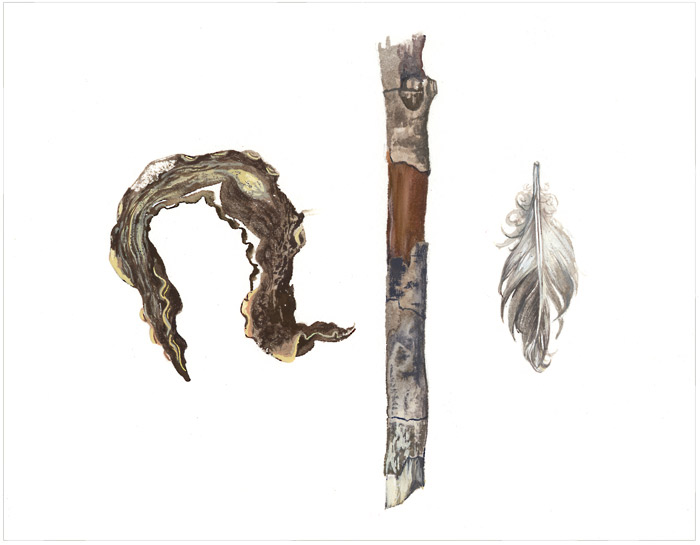
Specimen Still Life in Gouache
Specimen Still Life in gouache on hot press paper
Stick Feather Octopus Specimen Study
Stick, Feather and Petrified Octopus, round two. I had to get up and go talk to Bambi many times during this one.

When painting from life, still or otherwise, one can be assailed by competing impulses: awe and devotion, an almost painful form of supplication to “the real” — and another wilder desire to create in the same way as “life,” with its exuberant dance of omniscience and intuition. I found the quote that Karen keeps on her drawing board the perfect motto for this practice: “Beauty is the love that we devote to an object.”— Paul Serusier.

However, it is important to honor the lessons of restlessness as much as devotion. [Read more…]
Filed Under: Painting, Photography Tagged With: artist painting retreat, August Quarles, Centrum, Fort Worden Photography, Gage Academy summer class, gouache exercises, Gouache painting class, gouache still life painting, Karen Hackenberg, photography and painting journal, retreat at Fort Worden

August

August 16, 2013 by Iskra Leave a Comment

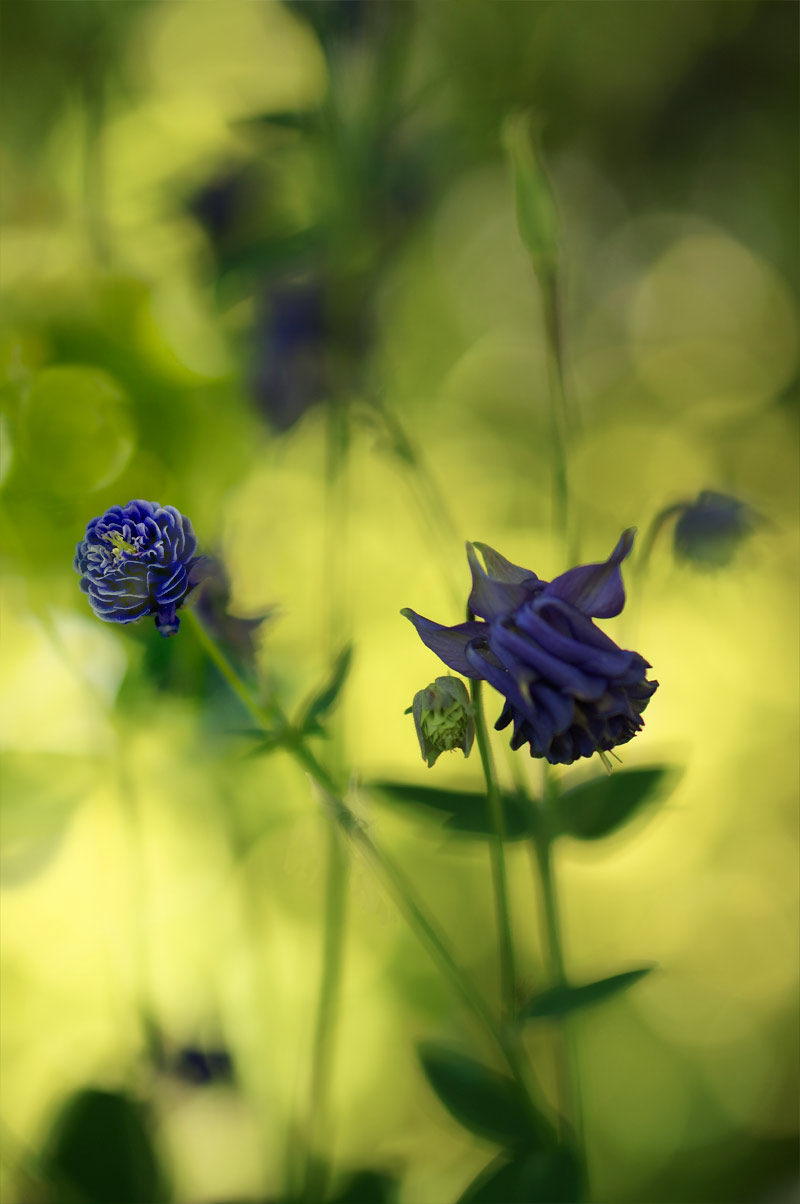
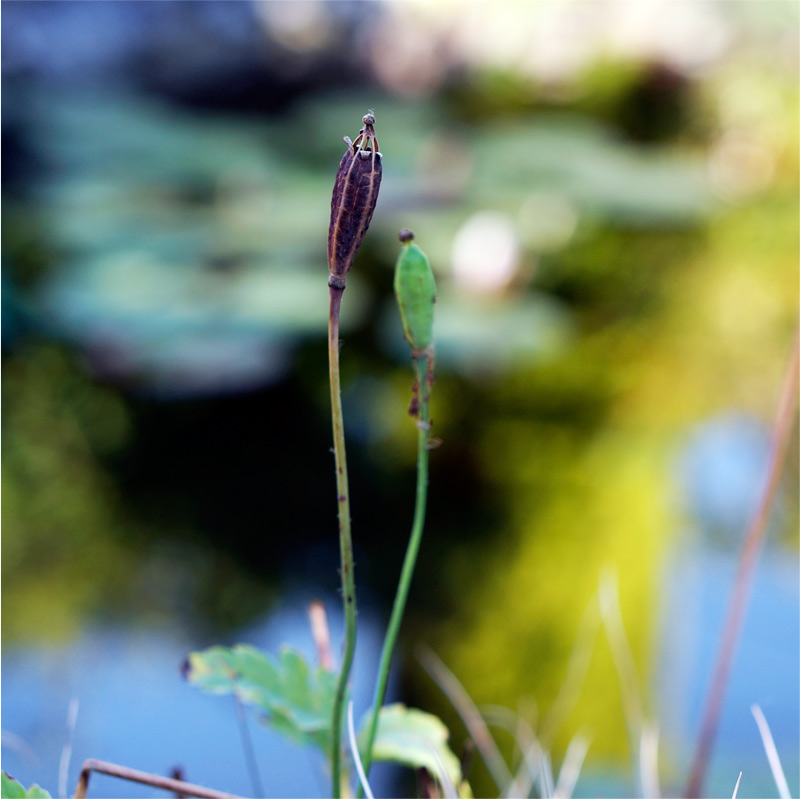
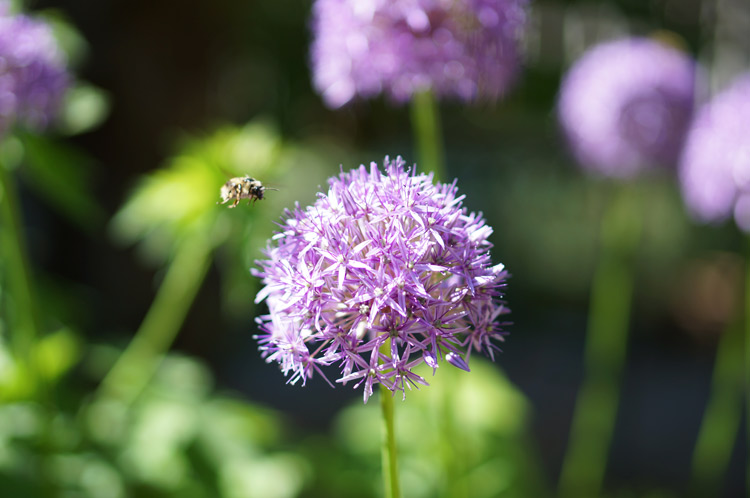
Allium and BeeColumbineYellow Poppy PodPond With Two Lillies

Yarrow

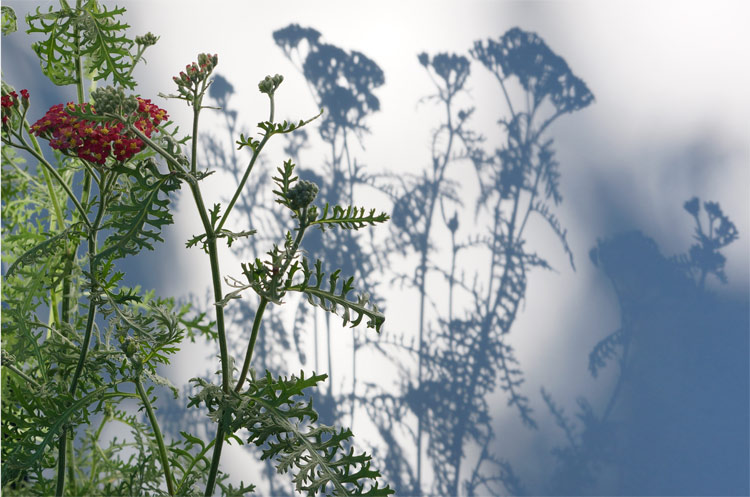
August Shadows

Sometime in the last week August remembered itself and began changing. This is not a month obvious with new beginnings. It doesn’t announce itself with bright resolutions or an accounting of all that has been figured out. It writes itself in twigs and sprinkler water. It explodes from its own fullness: the split pod, the swollen tomato, the echinacea’s violet paper bent back like wings from a gilded heart.

It’s all too much.

I stand barefoot in my nightgown, yellow grass harsh against my toes and watch the sky grow pink in early morning. The house, unused to sun-colored earth, seems to float. Are there things to do? Did I have ambition? It melts into one impulse: to walk through the garden with my arms full of poppies, to shake them until their dry rattle is all I can hear.

Photography and text © Iskra Johnson

Filed Under: Photography, The Garden Tagged With: August in the garden, end of summer elegy, Ode to August, the month of August

My House Is Not A Tree: Art, Shamanism & The Demon Flicker

August 1, 2013 by Iskra 4 Comments

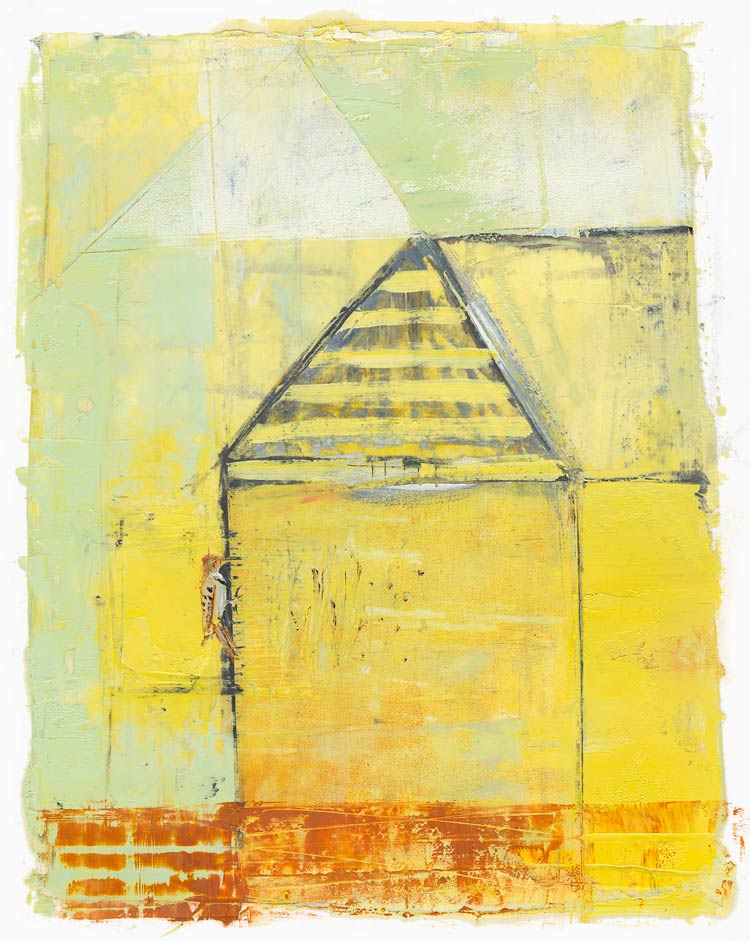
Awhile back I had a Flicker on the side of my house. By the wording of that sentence you may know that I mean attached as though with adhesive, firmly anchored, determined, and loud. A Flicker is a bird that thinks your house is either A) a piece of wood that he can bore into and coax ants into or B) a dead tree or soon to be dead tree that already has ants and other insects living in it rent free — insects which the Flicker plans to have for breakfast, between 4 and 5 AM.

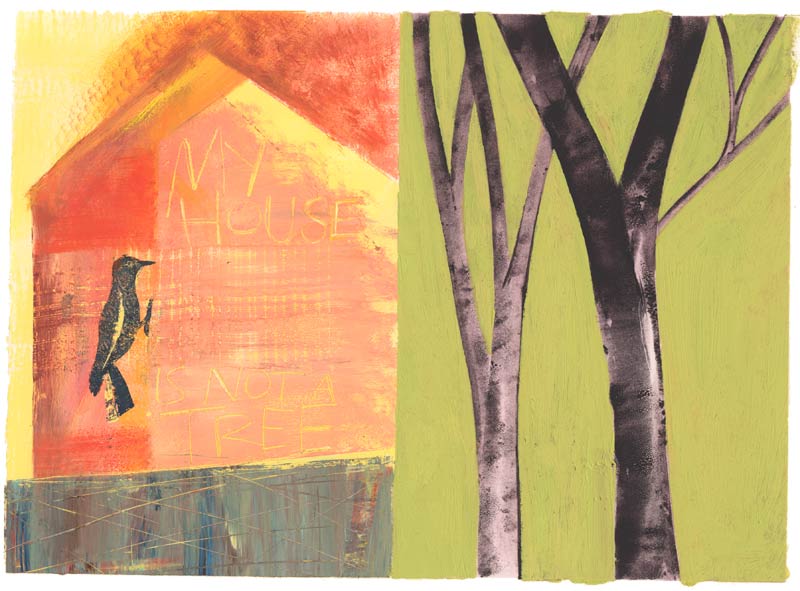
On a fine spring morning you may find yourself barefoot in your bathrobe with a garden hose, screaming and spraying into the eaves as the protected and very handsome bird looks over his shoulder at you and says, “Huh.” If you are me, you start painting pictures to explain the situation — to the bird.

 House Is No A Tree
My House is Not A Tree  © Iskra Johnson

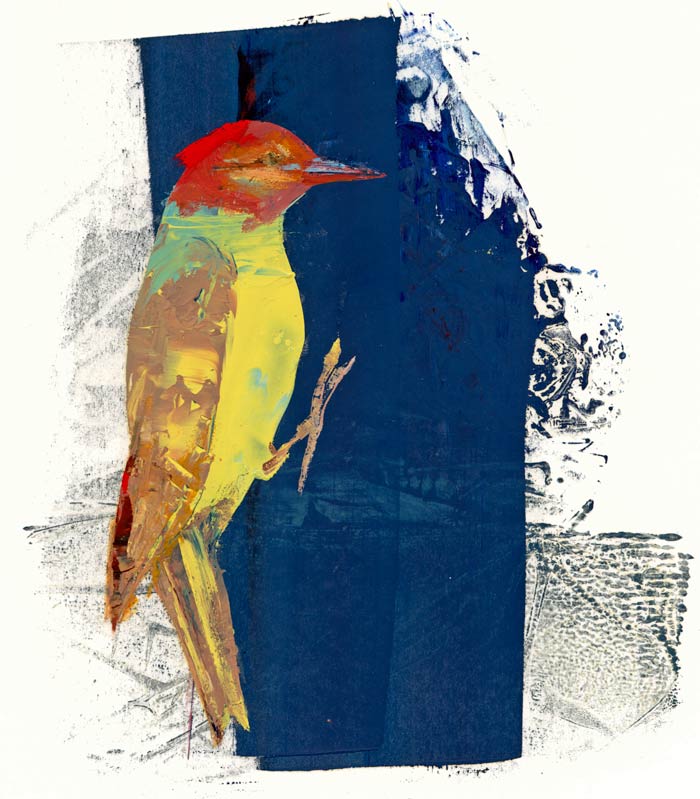
This went on for quite awhile. I tried a lot of different approaches to organizing the message. Some were direct, some were oblique.

Flicker 2
Flicker 2, © Iskra Johnson
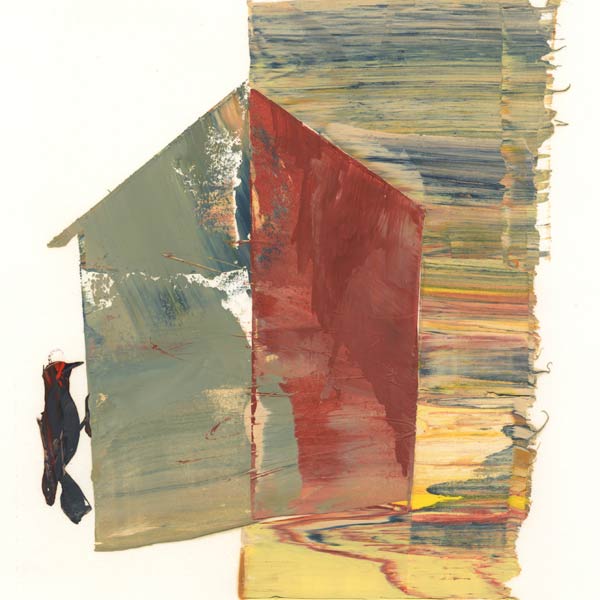
House Carpenter
House Carpenter © Iskra Johnson

I grew in a strange way quite fond of him. I assumed he was a him. When he attacked the gutters I nicknamed him Donald Rumsfeld, remember him?

Flicker: Getting To Know You
Flicker: Getting To Know You, © Iskra Johnson

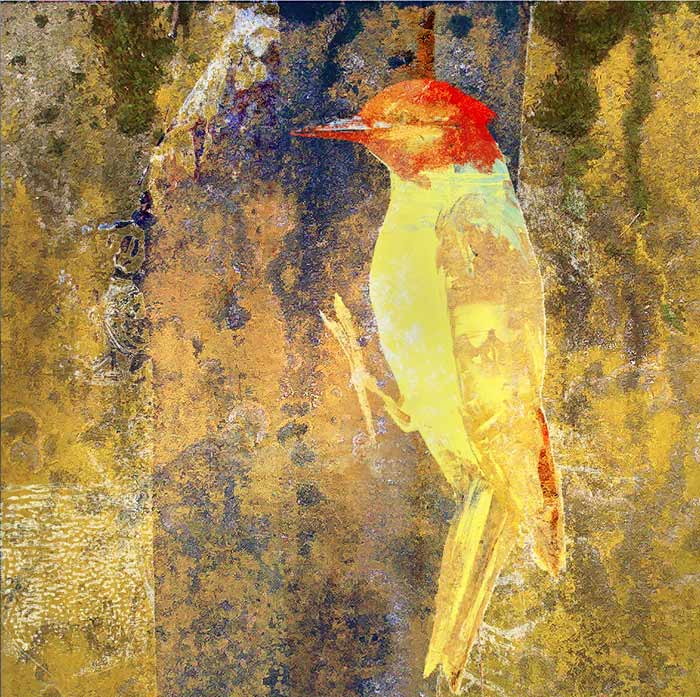
Flicker In Yellow Tree

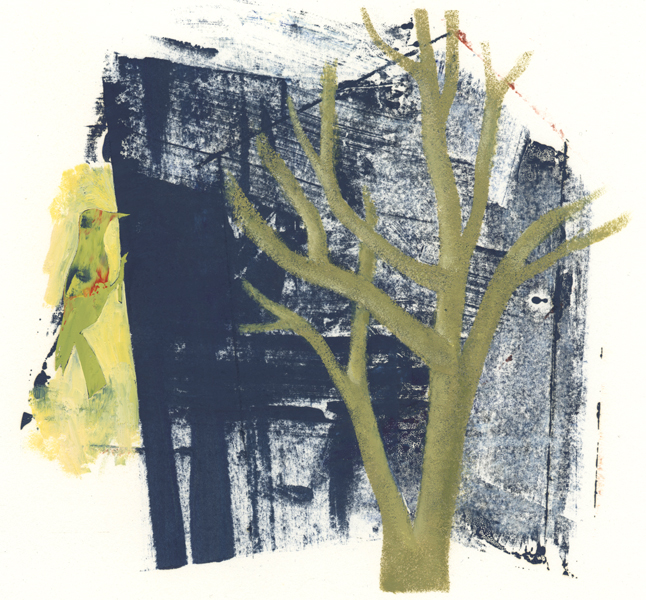
I tried reversing him, and I gave him a very fine tree with lots of bark. And finally I did this painting, the last in the series, which may have been the one that finally got the message across, because he went away and I have never been bothered since:

Flicker 3
Flicker 3 © Iskra Johnson

I recently was approached by someone who also had a bird attached to her house, and she took possession of this painting to see what powers it might have. I requested that my patron sign an indemnification agreement, as I cannot guarantee that this kind of magic will work twice. And it occurs to me tonight as I look around the studio and into the eaves that I may have broken a rule of art and magic, as now my bird is gone, and perhaps along with it the protective spell. Tomorrow morning, if you see a woman in her bathrobe spraying a garden hose into the sky and shouting in some strangled and incomprehensible language, that will be me.


Filed Under: Painting, Uncategorized Tagged With: art and shamanism, house and Bird Painting, house carpenter, Northern Flicker Painting

New Portfolio of Construction Site Photography

July 9, 2013 by Iskra Leave a Comment

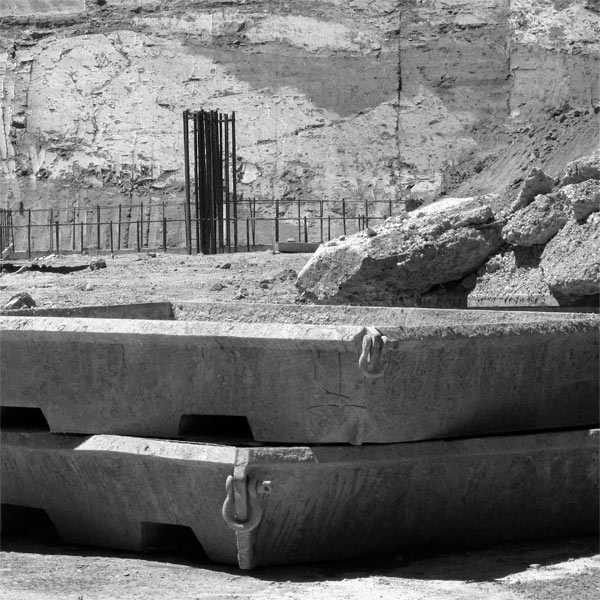
Landscape With Concrete Forms
Landscape With Concrete Forms, © Iskra Johnson

I photographed my first construction site over 30 years ago. At least three men with bullhorns shouted at me as I walked a long gangplank into the center of an open pit the size of a city block. I could not resist the bright red ladders, the spiking rebar and randomly thrown coils of wire, the orange triangles and cones and wooden spools, the augurs and blades – all massed against a landscape of mud brown and gray. The scene spoke of the chaos phase of creativity, when shape and sense are only dimly glimpsed, and anything is possible. Not to mention that it was BIG. A few months later the newspaper carried a piece about a woman in an evening dress with a cast on her arm who was found, drunk and asleep on a beam in the unfinished 6th story. It occurred to me then that not for nothing do they measure skyscrapers in “stories.”

Barrier View 1

My fascination with monumental structure, excavation, history, surface and the ambiguous terrain between ruin and renewal has continued as our world has moved into a phase of urban development in hyperdrive. You can visit any city in the world and see the unmistakeable filigree of orange cranes rising above the skyline. The new landscape incorporates an ever-changing theater of half-walls, scaffolds, massive draperies and open pits girded by barriers as interesting as what is behind them.

The photographs here reflect the influence of the theory of wabi-sabi: nothing lasts, nothing is finished and nothing is perfect. And within this recognition lies a very particular kind of beauty. Purely documentary photographs form the basis for much of my work in the series Construction/Reconstruction although I often obscure or alter them beyond recognition in the process of collage. The images in this new portfolio stand alone as photographs, a record of a singular time and place. Archival pigment prints are available in a range of sizes.

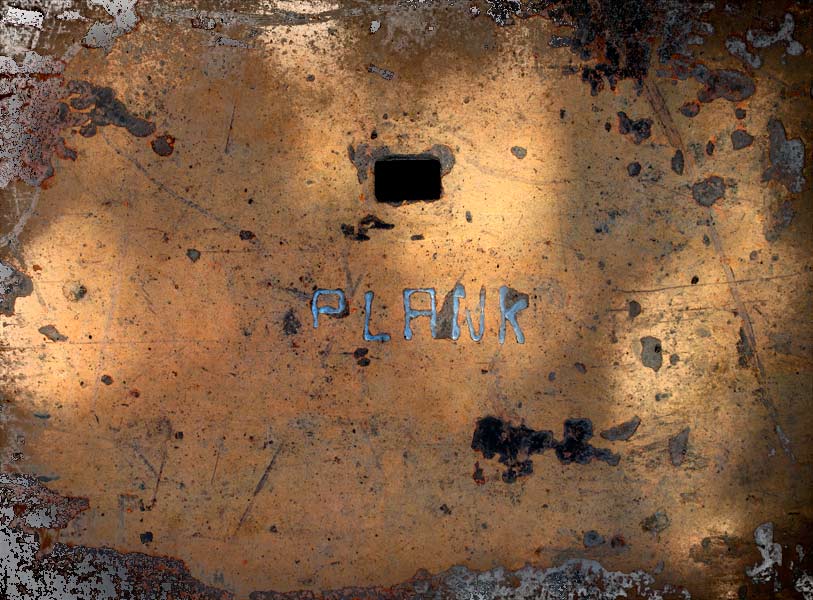
Plank
Plank, © Iskra Johnson

See more at: Construction Site Photography

Filed Under: Construction/Reconstruction, Photography Tagged With: architectural landscape, architectural photography, building photographs, construction site photography, construction sites, industrial photography, site documentation, wabi sabi in photography

“Drive-By”: The Alaska Way Viaduct at the Golden Hour

July 2, 2013 by Iskra 1 Comment

One of Seattle’s soon to be lost treasures is the Alaskan Way Viaduct. I had my office next door to it for eight years and learned to love and hate its noise and dirt and it’s hulking and fundamental “in-the-way-ness.” However, when one is not eye level from an office window cursing the dust and noise but rather on it or driving right next to it, perhaps at the golden hour, there are few more intoxicating sights than the Port and the great cranes and Elliott Bay glimpsed between its pillars.

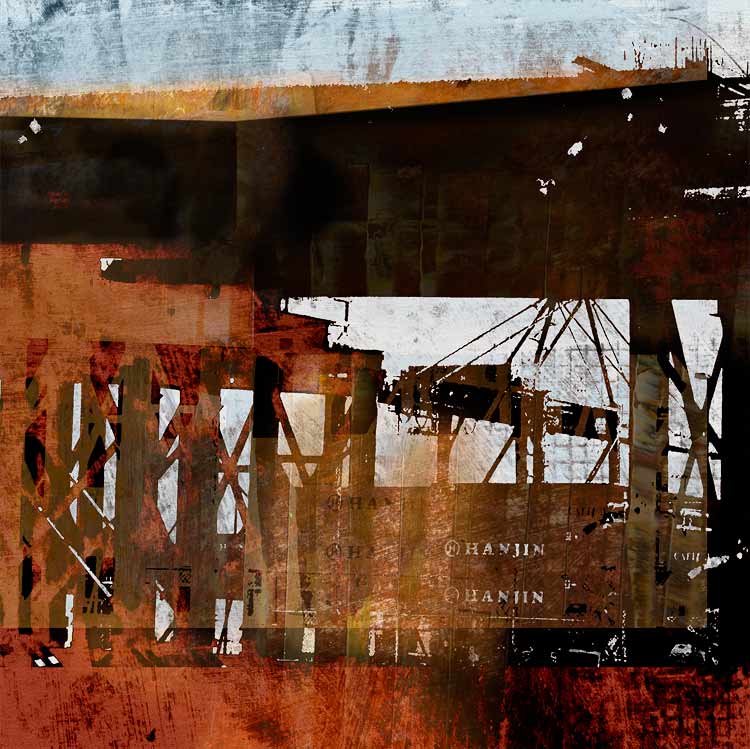
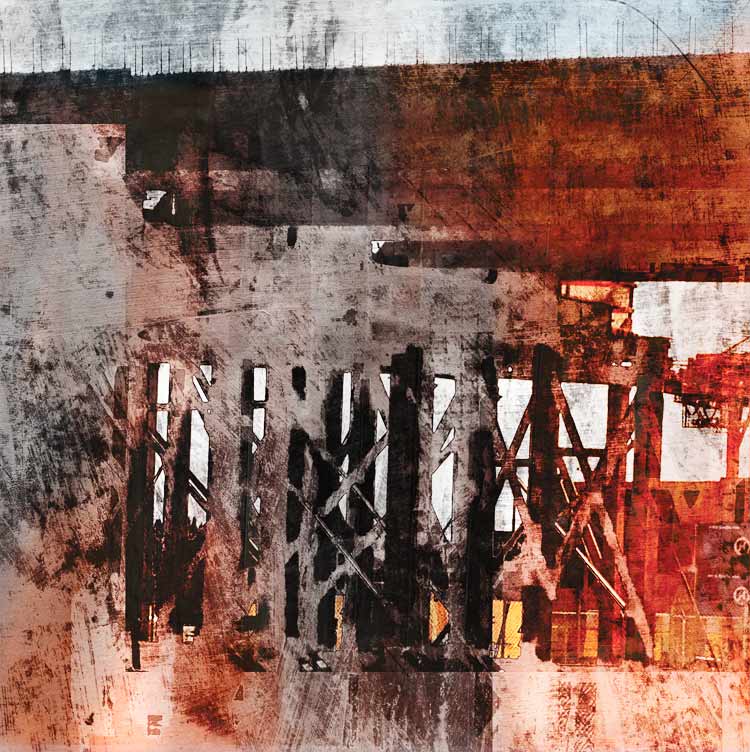
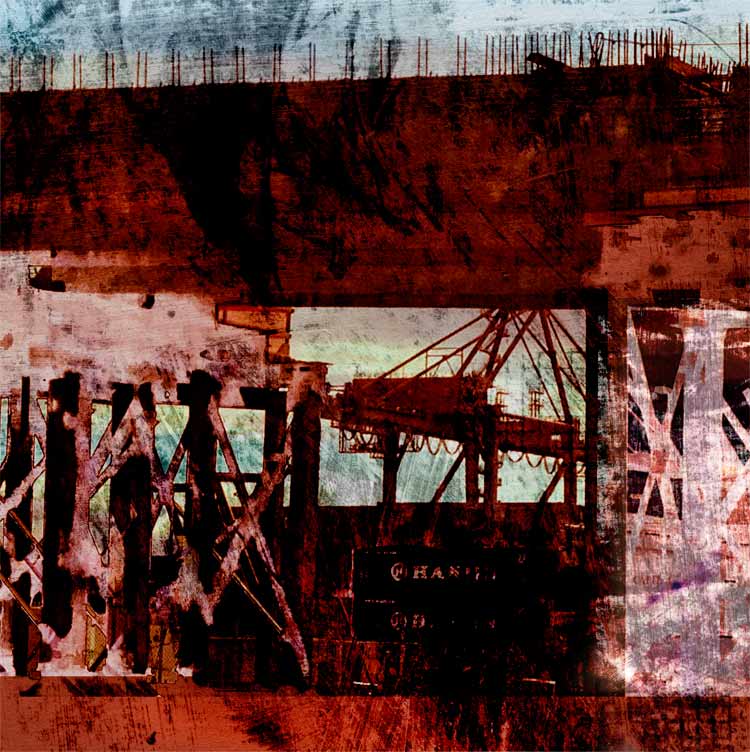
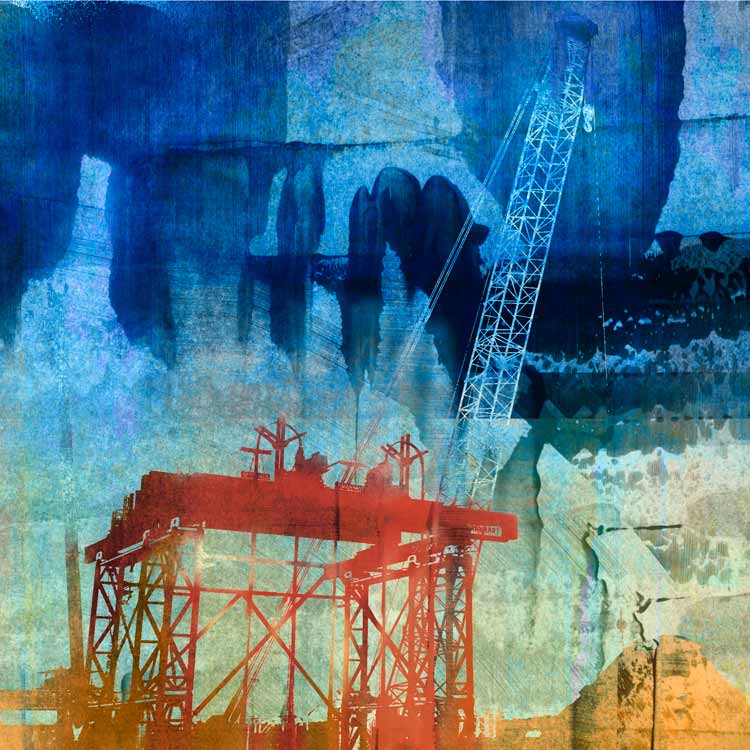
This view is now complicated with additional intrigue by the Big Dig. If you love structures and infrastructure and seeing the bones of things, this is the place to be. I have taken hundreds of cellphone pictures on the drives to West Seattle and back, and have begun a project using these images called, quite literally, “Drive-By.” I am using digital media combined with painting to create what feel to me very much like old fashioned monoprints. I made monoprints for years using oil based ink on zinc, and I love the technique. It is a wonderful challenge to use digital technology with the same sense of play and spontaneity, using masks and layer effects to “wipe” the plate, and to print plates (translated as Photoshop layers) over each other, with infinite ability to adjust density and color.

Photography and print making are ideal ways to capture the sense of time flashing, of the way reality exposes itself on the retina and how then memory overlays one image onto another, like tissue paper through which color and a sense of the sky bleed through. In this case of course it is not just memory but motion itself creating the layers.

Three glimpses:

Drive By At Dusk The Port arachival pigment print
“Drive-by at Dusk: Hanjin” archival pigment print © iskra Johnson
Drive By 2 The Port archival Print
“Drive-by 2,” archival pigment print, © Iskra Johnson
Drive-By-In-Pink:Hanjin
“Drive-by in Pink,” archival pigment print, © Iskra Johnson

Drive-By Day Two: Cellphone Transfer Prints

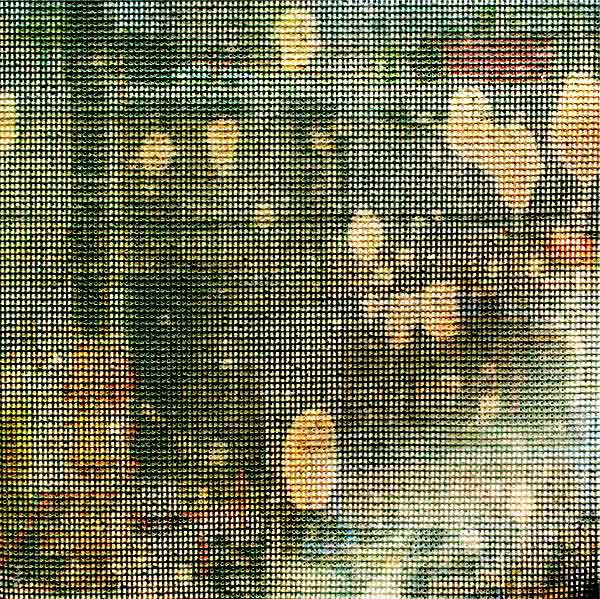
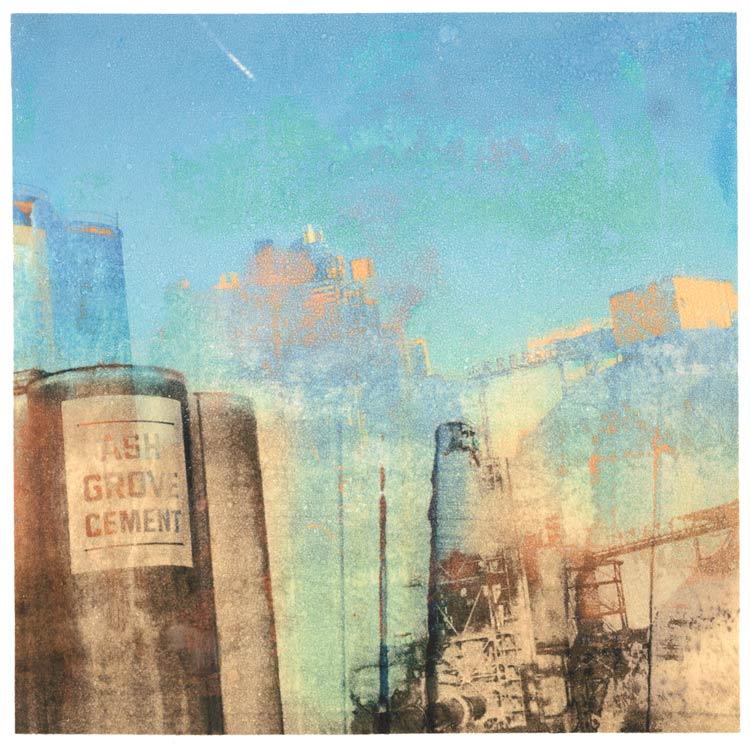
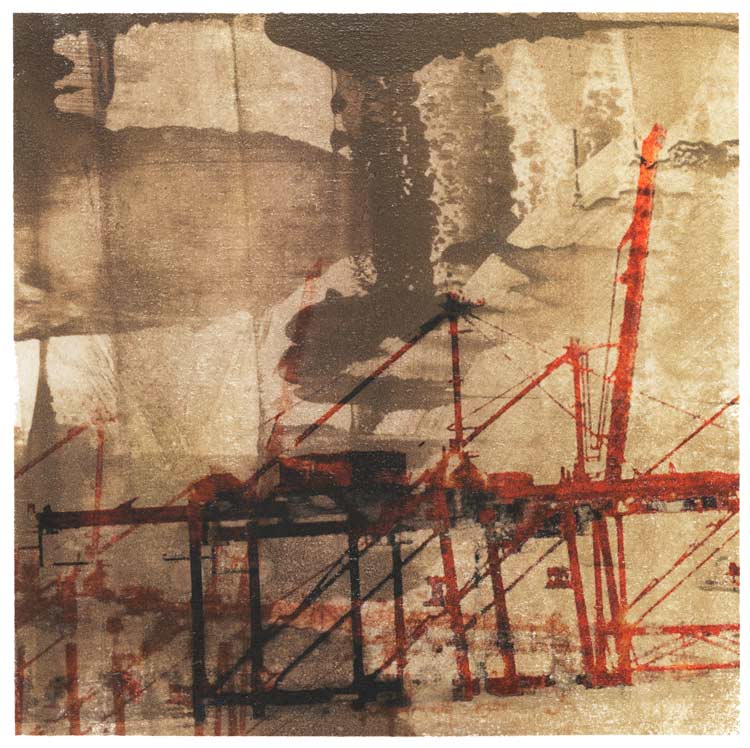
I have not made any transfer prints in awhile, and it occurred to me that it might be the next step for these images. Cell phone resolution can be frustratingly chunky when printed large, but the transfer process takes natural advantage of soft blurs and ambiguities, and these images lend themselves to a tactile surface and intimate scale. On these two I used Apollo transfer film on hot press watercolor with spray alcohol (92%). It’s counter-intuitive, but for some reason the temperature today in the studio, which nearly matched that of the alcohol, seemed to help the process along.

It feels wonderful to surrender to color. I fell in love with Maxfield Parrish’s clouds in a junk shop when I was in the sixth grade. Ash Grove Cement might as well be a neo-Greek column, and that shape in the middle could be a neo-nymph looking up in reverie at plumes of steam. Who says industry isn’t romantic? And who can resist a name like “Ash Grove?”

Ash Grove Cement (For Maxfield Parish) transfer print
“Ash Grove Cement, for Maxfield,” transfer print on watercolor paper 7″ x 7″ © Iskra Johnson


"To Avalon," transfer print on watercolor paper, 7" x 7", © Iskra Johnson
“To Avalon,” transfer print on watercolor paper, 7″ x 7″, © Iskra Johnson


Terminal 5
“Terminal 5 ,” © Iskra Johnson

(Not yet printed, but I thought I would include it here to show the surface difference between the native image and prints with similar imagery.)

See more artwork on industrial themes at the print portfolios for Construction/Reconstruction and Infrastructure.

Filed Under: Construction/Reconstruction, Photography, The Alaska Way Viaduct Tagged With: Alaska Way Viaduct art, Ash Grove Cement, cellphone art, drive-by photography, industrial art, Maxfield Parrish Clouds, memory in art, monprinting with a computer, printmaking and digital process, Terminal 5 print, the Big Dig, the golden hour

  • « Previous Page
  • 1
  • …
  • 31
  • 32
  • 33
  • 34
  • 35
  • …
  • 60
  • Next Page »

Join Iskra’s Mailing List

Don't miss a thing! Subscribe to receive show announcements, first peek at new work and my semi-monthly blog by email. I primarily use the blog for news and updates but by signing up you will also receive the occasional newsletter and special offers for items in my shop.

Iskra Fine Art Blog

the creative process | conversations with artists | the contemplative impulse in art

Instagram

The photography show opening Friday, October 9th a The photography show opening Friday, October 9th at Slip Gallery is curated by my friend and fellow photographer, Scott Wipperman. This seemed like a good time to share his work and the story of our friendship on the road. Half the photographs are his and half are mine. This is an excerpt, and you can read the rest of it on my blog, see link tree in bio:

One of the rarest gifts in the life of an artist is finding a creative muse: someone who truly sees your work, and better yet, has a similar vision that is just enough different that you can collaborate without competing. In the often solitary studio life these connections can be difficult to find, but during pandemic, Instagram brought a new creative companion into my life. I do not know who started following who first. But in May 2020 I found myself sharing instant messages with a photographer working under the name “Concrete spaces“— a handle that immediately piqued my interest. Concrete has been one of my obsessions for years. Miraculously, there was someone out there who understood why I was working on a book called Parking Lot Floors Of North America. . .

©️Scott Wippermann

©️Scott Wippermann

©️Scott Wippermann

©️Scott Wippermann

©️Iskra Johnson

©️Iskra Johnson

©️Iskra Johnson

©️Scott Wippermann

©️Iskra Johnson
I am excited to be part of a show opening Friday, I am excited to be part of a show opening Friday, October 9th featuring eight Seattle  photographers and curated by Scott Wipperman @concretespaces at Slip Gallery. The theme of this show is complex and interesting: Intimate Structures. How the human body and human emotions connect with the built environment. And how the structures in our environment shape our lives, our relationships, and our possibilities. I will be showing industrial landscape as well as six pieces from the series “Immersions” based on tableaus of human relationship captured at Seattle’s waterlines. A diving platform is a stage, and the summer season a riveting drama of ever-shifting players. Most of these pieces have not been shown before.

I’m fascinated by the work of the seven other photographers, each one approaching the theme of the show from a completely different perspective, using both traditional photography and contemporary experimental techniques. Alienation, sublimation, meditation, connection:
Annie Regerson
Dimitri Wessendorf
Gillian Peckham
Iskra Johnson
Janis Mathieson
Mack Greene
Nina Bolger
Scott Wipperman
I hope to see you there!

The runs until the end of October. 
Thursday – Friday: 1:00 PM – 6:00 PM
Saturday – Sunday: 1:00 PM – 4:00 PM

Slip Gallery
2301 First Avenue in Belltown

Two Divers ©️Iskra Johnson

Guardian ©️Iskra Johnson
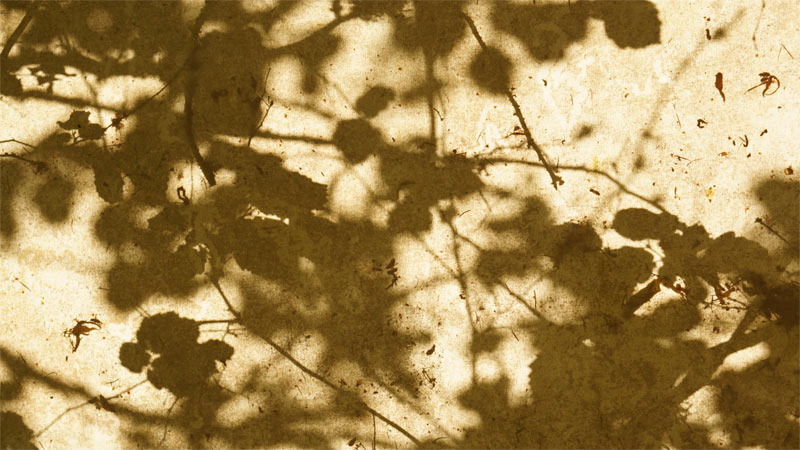
Morning Pages: Doors The first thing I saw when I Morning Pages: Doors

The first thing I saw when I woke up this morning was shadows on a door. Last night, I dreamt of an old building, one I have visited in dreams for years. It is a co-op apartment in some imaginary Canadian city, on a long steep hill above which are what appear to be the Swiss Alps. It was built in the early 1900’s and has grand staircases and balconies, huge rooms, bronze doorknobs and leaded glass windows. In my dreams, I interview with the board, I make an offer and I even buy an apartment— and then suddenly the door of my new home opens into a parking lot or a garage or someone else’s basement and I wake up and check my bank account, mystified by the power of this particular place, and how opening a door universally signals a new chapter in the story. 

Doors and windows are the most metaphoric parts of architecture. 100 years ago builders understood the attention they deserved. Now I live in a city where we have torn down historic churches, dumped the stained glass into a landfill and replaced these devotional structures with stacked box apartment complexes covered with Hardie Plank. I’m watching million dollar houses go up in my neighborhood with the cheapest vinyl windows from Home Depot, no eaves and often no roof— simply a flat lid to seal the box — and no trim at all. It is architecture as expedience, and it degrades the experience of how we see and experience the commons, and our human values, because, as Churchill noted, “We shape our buildings and afterward our buildings shape us.” 

We don’t look twice at these new houses, whereas I can look at this particular building somewhere in England for hours. Whoever built this wall took great care. They used the art of subtraction to add rather than to diminish. The vast flat wall of stone, the curved lintels, make the windows and doors speak. The doors and windows are not grand, but curiously condensed. They are portals through which one must squeeze with effort, which makes a person pause, and wonder. Later, they may find themselves dreaming of what is behind the walls.
Westminster Mall deconstruction project. I had to Westminster Mall deconstruction project. I had to go to the Department of Licensing this morning and stand in line and it gave me an opportunity to watch the Sears building come down. Sears was the last place left in the Seattle area where you could buy a vacuum cleaner from a man wearing creased polyester slacks, a tucked in shirt and an engraved name badge making a commission on the number of vacuum cleaner bags you bought to go with the Electrolux. I fondly remember my conversations about uprights versus canisters. This building is where I bought a snowsuit for a child that just barely fit me the day we had the epic snow and I was caught unprepared. I walked a mile on ice to get to Sears and then left looking like a nine year-old robot trying to get my knees to bend and move swaddled in 4 inches of poly blend padding. But I was warm! I doubt that anything that goes up this year in the Westminster Mall will last as long as Sears did. And there will be no catalogue unless I create one.
Excited tonight for the opening of Art and Steel a Excited tonight for the opening of Art and Steel at Youngstown Cultural Center! This is primarily a painting show from the Plein Air Watercolorists Association of Seattle (although I don’t think any of us were actually painting inside the mill on our tour!) I have been included as a photographer and mixed media artist, see last image in carousel, “Glide.” 

An exhibition of paintings telling the story of steel fabrication at NUCOR mill, hosted by Delridge Neighborhood Dev Association.

Friday, September 18 | 6:30 PM - 9:00 PM
Join us for a special evening celebrating art, industry, and community.

This exhibition features original paintings that tell the story of steel fabrication at the NUCOR Mill, presented by the Delridge Neighborhood Development Association (DNDA).
The evening will include a panel discussion, light refreshments, and an opportunity to learn more about the intersection of art, labor, and local history.

All donations made during the event will be matched and directed to DNDA’s Art Education Programs, helping support creative opportunities in our community.
Friday was my birthday. 9.11 is a day of remembran Friday was my birthday. 9.11 is a day of remembrance and national tragedy, and it seems bizarre to claim some kind of importance for having been being born on that day in the context of the event. 

Several days after, I allow myself reflection on the passage of time. This is me 15 years ago, with my Canon Powershot, which offers an astonishing naive pre-Cabrian 6 Mb image. It was much more kind than today's 24 MP iPhone, which not only captures the older me but turns that version into a character from Shakespeare with hi-def Bertrand Russel thought lines above my eyebrows and unforgiving evidence of allergies and time. 

On reflection I realize that 2011 was a very good year. I am going to allow myself to be that person for the month, and remember what that was like. The love of my life from the 8th grade had come to stay with me that summer. He took terrible photos of me that I now realize were not so bad. 99% of of the corrosive social media influences had not been invented yet. Women over whatever age was deemed desirable were not subjected to an ad every minute telling us that a new part of our face or body had gone south, and offering us a (discounted! on sale! watch the entire 30 minute video!!) $165 remedy on a monthly subscription to fix it. 

Now every day I look at the thinking and brooding lines above my eyebrows (which are also the lines caused by considering how funny some things can be even when crying) and ask myself what Bertrand Russel would say. If you are too young to know that name, AI is your ever-friend and will tell you how you too can become a "towering British philosopher, logician, mathematician, and social critic" and also how to fix those lines that come from considering things with your face. 

I think my romance with the iPhone is coming to a partial close. I want to go back to the idea of “glass.” It costs serious wages. It is made by Germans— Lately, (subtract the umlaut) Sony, the wizards of sand and heat and bending light to high high focus. I need to return to optics, f-stop, aperture, focal length— words that require frowning. 61 megapixels seems like the bare minimum. There is no cosmetic cure to being a lens-based artist:))

Featured Posts

  • Book Launch! The Water Tower Project from Iskra Fine Art
  • How to Purchase Artwork from Iskra Fine Art
  • About This Blog
  • New Directions in Contemplative Art: Conversations with Artists
  • What is a Transfer Print? (Artist Statement)

Categories

  • Abstract Calligraphy
  • Architecture & Sense of Place
    • Construction/Reconstruction
    • The Alaska Way Viaduct
    • The Water Tower Project
  • Art Reviews
  • Artist Studio Visits
    • The Mystic Muse: Artists Working in the Contemplative Traditions
  • Botanical Art
    • Botanical Art Cards
  • Collage
    • Digital Collage
  • Commissioned Art
  • Drawing
  • Essays
    • Object Lessons: Essays and images inspired by "A History of the World in 100 Objects."
  • Iskra Shows, Upcoming and Past
  • Iskra Sketchbooks & Journals
  • Living With Art
  • Meditation & Buddhism
  • Mixed Media
  • Painting
  • Photocollage
  • Photography
    • American West Landscape Photography
  • Print Sale
  • Prints
    • Transfer Prints
  • Seattle Iconic Landscape Prints
  • Social Media for Artists
    • The 100 Day Projects
  • The Garden
    • The Gardener's Almanac of Irreproducible Phenomena
  • The Spiritual in Art
  • Travel
    • Road Trips
  • Uncategorized

Archives

Search

Connect on Facebook

Iskra Fine Art Facebook Page

Creative Inspiration

  • Alternative Photography
  • An Artist's Retreat
  • Anonymous Chinese Textile Genius: Moo Won
  • Chocolate Is A Verb
  • Contemplative Art Process: Danila Rumold
  • Eva Isaksen
  • Old Industrial Japan
  • The Altered Page
  • The Heart Sutra Loop
  • The Patra Passage

Galleries for Contemplative Art

  • ArtXchange Gallery
  • Seattle Asian Art Museum

Links

  • CollageArt.org
  • Iskra at SAM Gallery
  • Iskra Fine Art on Houzz
  • Seattle Art Museum Blog
  • Seattle Artist League
  • Seattle Print Arts
  • Seeing Fresh: Contemplative Photography
  • The Painter's Keys

What I'm Reading: Online Magazines and Books I Love

  • 16 mi.
  • Essays by David Whyte
  • Evening Will Come: Poetry
  • Hyperallergic
  • Painter's Table
  • Shu: Reinventing Books in Contemporary Chinese Art
  • Streetsy
  • The Original Van Gogh's Ear Anthology
  • Tricycle Magazine
  • Unincorporated Persons in the Late Honda Dynasty
  • Vanguard

Let’s Connect

  • Contact Iskra
  • How to purchase artwork
  • Iskra Fine Art Blog : The creative process, conversations with artists, the contemplative impulse in art
  • Facebook
  • Instagram
  • Pinterest
  • Twitter

All Images Copyright © 2026  Iskra Johnson · Site by LND · WordPress