Iskra Fine Art

  • Prints
    • The Tarmac Residency: Airport Landscapes
    • Immersions | At The Shore
    • ColorBath: Images of the Harbor
    • The Floating World
    • Industrial Strength | Urban Industrial Landscape
    • The Scaffold
    • Industrial Pastorale: The Rural/Urban Landscape
    • Botanical Prints | The Natural World
    • Construction | Reconstruction : Urban Landscape
    • Infrastructure
  • Drawings
    • Pencil Drawings: Pandemic Pause
    • Drawings in Dust 1
    • Signs & Symbols (Archive)
    • Botanical Drawings (Archive)
  • Photography
    • Nucor Steel Industrial Landscape Photography
    • New Work Inspired by England
    • Seattle Waterfront Park Photography
    • Architectural Photography | Construction Sites
    • American West Landscape Photography
  • Mixed Media
    • Modern Botanical | Mixed Media on Plaster
    • From the Sea | Water Paintings
    • Sleep Studies
  • Wabi Sabi Abstract
    • Minimalist Modern
    • Ink Painting Abstractions
  • Shop
    • The Water Tower Project
  • About
    • Contact
  • Blog
You are here: Home / Archives for Collage

Driving While Dreaming, Two Studies of the Alaska Way Viaduct

February 21, 2014 by Iskra Leave a Comment

I am hard at work on my series of prints about the Alaska Way Viaduct. Big Bertha, our sensitive and emotionally overwrought digging machine is helping me out by quitting on the job. We may have several extra years to contemplate incipient ruin, the subtleties of patina and the beauty of going nowhere.
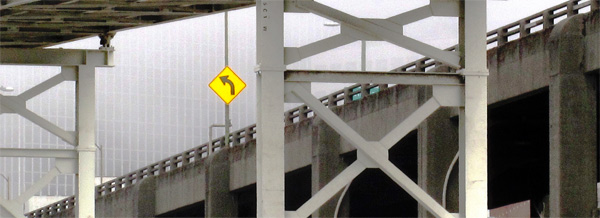
Enroute
Enroute. One of my favorite arrows.

This morning I started on a new collage with Pandora in the background set to my favorite station, which I am guilty, guilty, guilty of listening to instead of finding each song individually or listening to mixtapes made by friends 30+ years ago. The station, wouldn’t you know, is named for the father of music for airports Brian Eno. I do like this phrase from the Rolling Stone review of 1979, “...there’s a good deal of high craftsmanship here, but to find it, you’ve got to thwart the music’s intent by concentrating.” The trick of collage is often to concentrate while not concentrating, a sleight of hand through which something interesting may appear. Mr. Eno and his friends are the perfect soundtrack to encourage this state of mind.

As I was working, shifting layers back and forth and on and off and testing all the ways two simple images can converse and transform each other, I thought about driving and the visual emotional space of the car, which is so entirely married to music. I got my first and only car, a gray Toyota Corolla, in 1989. I will never take it for granted. The first time I sat on a lookout at sunset and turned on the radio I had a kind of American Satori experience: so this is what they were talking about! I get to sit here in my room on the street and just turn the dial and look out at the view?

The view of course is what the lovers of the viaduct will miss the most when it comes down. It is the last populist vista, where you don’t have to pay big dollars to see The Mountains and the Sound which make us want to live here. When it is gone we will have to buy a multi-million dollar penthouse condo or use binoculars to peer across the six to eight lanes of traffic they propose to go on top of the tunnel, which by then will cost 10 dollars per trip and which no one will use because who wants to drive in the dark?? Hmmm.

The music of this situation is both requiem and anthem, weaving its modal intervals in and out in lane changes and near-misses and ultimately onto the great offramp of what-it-is. Requiem for what is to be lost, anthem for what we can still see if we ditch our worries about gas and earthquakes and just go for a drive. I checked Pandora to see what lovely song was transporting me: “Ballad of Distances” from The Tired Sounds of Stars of the Lid, and “Requiem for a Dream” by the Kronos Quartet. Gotta love this many-splendored synchronistic modern life.
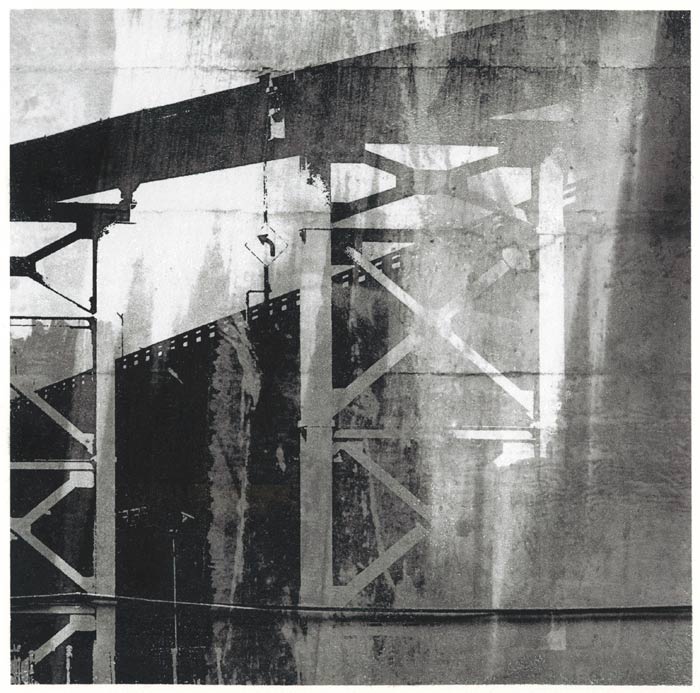
Ballad Of Distances 1
Ballad Of Distances 1, Transfer Print, 10″ x 10″, © Iskra Johnson
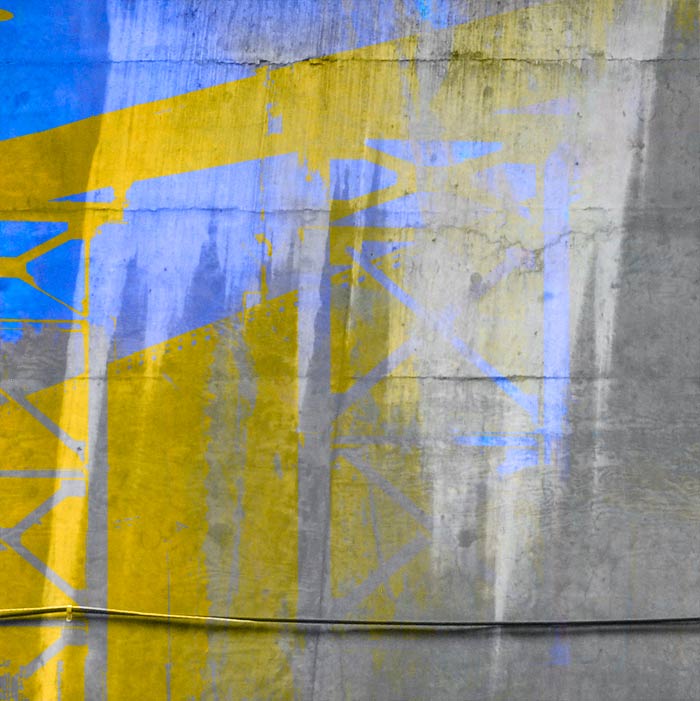
Ballad Of Distances Part 2
Ballad Of Distances Part 2, © Iskra Johnson

Stay tuned for details on my upcoming show, “Excavations,” at Zeitgeist, opening the first week of April.
Filed Under: Digital Collage, Photocollage, Prints, The Alaska Way Viaduct Tagged With: Alaska Way Viaduct, art about construction sites, art about urban renewal, ballad of distances, Big Bertha, Big Dig, brian eno, collage to music, photo collage

Homage to Nabokov’s “Speak Memory”: Ex Libris 100 Books Exhibit, Seattle

February 18, 2014 by Iskra Leave a Comment

        “The cradle rocks above an abyss, and common sense tells us that our existence is but a brief crack of light between the eternities of darkness.”         

“Come with us by all means, but do not chase butterflies, child, it spoils the rhythm of the walk.” — Speak Memory, by Vladimir Nabokov

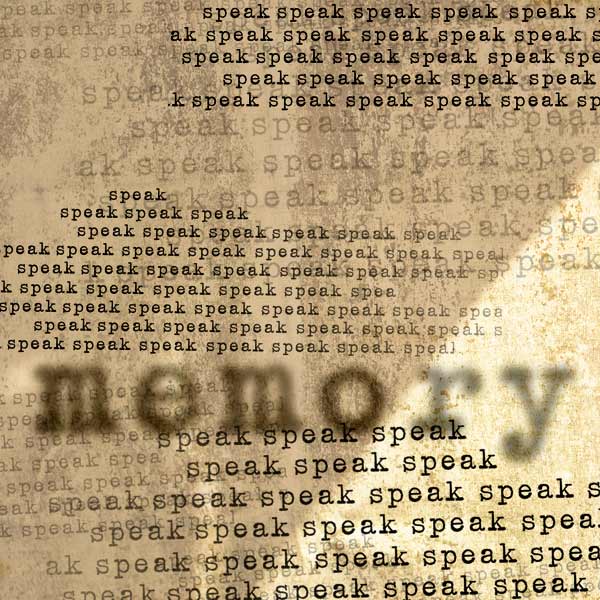
Speak Memory Nabokov Typographic Study
Typographic Study for “Speak Memory” © Iskra Johnson

When I was invited to participate in the exhibit “Ex Libris: 100 Artists, 100 Books” I had no question about which book I would choose to interpret. Vladimir Nabokov’s Speak Memory: An Autobiography Revisited has murmured in the back of my mind for twenty years as an unsolved koan. In my work as a book title designer I have designed a dozen hypothetical covers as portfolio exercises, and always I felt I could do another hundred without exhausting the timeless incantation of the words. I knew that this time I wanted to focus on shadow and light, the beauty of sensory experience and tactile surface. [Read more…]

Filed Under: Digital Collage, Iskra Shows, Upcoming and Past, Photocollage, Photography Tagged With: art process, AWP Seattle, book title as muse, etymology of collage, Ex Libris Seattle, how to apply GAC 800, how to mount photo on panel, Iskra in Ex Libris, photocollage, Speak Memory, Vladimir Nabokov homage

Year End Reflections, “Keeping Safe the Love Affair”

December 31, 2013 by Iskra 2 Comments

Drive-By Viaduct In The Evening
Glimpse 3, The Viaduct in Evening © Iskra Johnson

I started this New Years’ Eve morning with an early visit to the Painters Keys, where Sara had posted an exceptionally lovely letter for the new year. If you don’t know about this site, do visit; it is an endless source of inspiration for painters and and artists in all media. Sara’s reminder via Corot to “never lose the first impression” stayed with me all morning as I returned to a series about the Alaska Way Viaduct after a long time away. The creative process (or at least my process) is one of continually losing the glimpse, and then looking for the way back. Sometimes getting lost is a necessary, if bracing, part of the journey.

_________________________________

It has been a wonderful year in art. I have been fortunate to be included in some terrific exhibits at Prographica, Bainbridge Arts & Crafts, Seattle Architecture Foundation and SAM Gallery (ongoing.) Studio visits with collectors and a recent purchase of one of the Duwamish prints by King county for their Portable Works Collection have rounded out the year. Ahead are two shows this spring, which I will be posting about soon. I feel very grateful for my artist groups that provide encouragement and critique, including my salon, Painters Under Pressure which is ending its first decade (!), and the unnamed but equally wonderful group of self-employed designers and artists I have met with each month for over a dozen years. We are a rare tribe, and I couldn’t persevere without them.

I’ll close with part of the letter from The Painters’ Keys, as I am completely smitten with it and I can’t put it any better:

When Claude Monet noticed the village of Giverny from a train window, he  made a decision to live out his days there. He later said that everything he ever earned went into his Giverny garden. “I love you because you are you,” he wrote to his work. Artists and their subjects are the star-crossed lovers of the world. They recognize each other on impact. Making the discovery on human steam, fueled by the spirit to get up and down the ladders, makes the most eventful love affair. “What your heart thinks great is great. The soul’s response is always right,” said Ralph Waldo Emerson.

As our year closes, we consider resolutions, or mark our moments of recognition……. As a community, we might just keep safe each other’s love affair.”

Filed Under: Digital Collage, Iskra Shows, Upcoming and Past Tagged With: art 4 culture, artist salon, new years reflections, Painters Keys, Painters Under Pressure, portable works, Quotes about art, The glimpse, viaduct art, viaduct in evening

Listening with an Innocent Ear: Bill Frisell’s “Big Sur” at Earshot Jazz

November 12, 2013 by Iskra 3 Comments

The Shimmer, music collage
The Shimmer (Never use pink) © Iskra Johnson

I am neither a musician nor a music reviewer. For which I am quite grateful as I sit down to recall and review Bill Frisell’s Earshot Jazz debut of “Big Sur.” Free of musical expertise I can write this as a wine review, and try my best to convey the evening’s intoxication.

With my innocent ear I would say:

notes of Americana (the fiddler in his soft hat under the eaves in an Appalachian rain, the hop-skip polka and waltz, hints of hay);

minerality (chalk cliffs and blue swallows in morning light, brine of licked seashells first tasted and then put in your pocket);

bouquet (goldenrod and sunflowers nodding to an off-stage wind and saved from sentiment by a high cloud in a minor key that rescues yellow from banal happiness moving to joy and a state just shy of unapologetic rapture);

complexity (yes, the calico of polka and waltz but also sufis in white tennure whirling on the edge of a cliff, the generous embrace of dissonant drone and snake charmer smoke or is it a surfer’s campfire on the beach, Oh, Surfer Girl!);

And as I listen I think: this is a rare irreplaceable experience. So often when I go to live music I stand at the end, I clap and I leave, and as I walk out of the theater I cannot recall one note, just a vague blur of feeling. As I listened to Bill Frisell and his Big Sur Sextet something else happened. Even as my mind ran into the high meadows, the soaring skies and the surf of this very particular place I could hear with a second ear the jazzness of it, which has its own narrative that lives in no place at all except this exact moment. I could see each note as a shape and a color colliding and riding with the others. Tone shapes and weavings and world-weary minor bending to reliable blue. The sudden shock of melody, but unsure of what that would look like, so very viola it was. My vision tripped and refused to picture: perhaps melody, the one singable memory, is incense after all, or smoke. But snare and drum and brush and repeated incantation, I could see this.

The Break, Music collage
The Break © Iskra Johnson

Jazz of course can only be so sweet. Then they have to tear it all apart in the middle and that is when I want to get up and take a walk or go have a glass of lillet in a quiet room. The “break?”, the “bridge?” is this what they call it? Such anxiety it provokes. I always dread that they will never figure out how to put the pieces back together, and I move quickly from that to doubt in whatever “music” they were playing after all. Which as I opened my eyes to watch the violist tap her red shoe I realized is exactly the way collage works. It is music. And I decided to come back home and remember everything and try to see what I saw. I played “Big Sur” all day and constructed and reconstructed this image from an original black and white charcoal drawing, five variant files and over a hundred layers moving in (sound) space.

Listening to Bill Frisell, collage
Listening to Bill Frisell (Big Sur 1) © Iskra Johnson


Jazz In Black And White
Jazz in Black and White (Homage to Ben Nicholson) © Iskra Johnson

The original drawing on which these color collages are based.

Filed Under: Collage Tagged With: art about listening to music, Big Sur music, Bill Frisell, collage music, music deconstructed

Ready To Wear, ReComposing the Word on the Street

February 19, 2013 by Iskra 1 Comment

Tar Study 2, With Pigeons
“Tar Study 2, With Pigeons,” archival print, © Iskra Johnson

Over the President’s weekend I have been working on a series of street collages. Background reading that hovers, a guiding helicopter as I shuffle shards of color and type, is a book I just picked up at Elliott Bay called “Rapt.” Who could resist a book written by “Winifred Gallagher”? The name alone gives her instant credibility, but if that isn’t enough for you, she does have a thesis, and hard-won: “The quality of our lives is determined by what we pay attention to.” If you are a cancer survivor and you decide to write an entire book about this, I will most definitely tune in, with undivided attention. Although a quarter of the book is already dogeared with turned corners and notes in the margins, this passage in particular struck me:

“Just as bad feelings constrict your attention so you can focus on dealing with danger or loss, good feelings widen it, so you can expand into new territory — not just regarding your visual field, but also your mind-set. This broader, more generous cognitive context helps you think more flexibly and creatively and to take in a situation’s larger implications. …….when you feel upbeat, you’re much likelier to recognize a near-stranger of a another race — something that most people usually fail to do. “Good feelings widen the lens through which you see the world,” …… “You think more in terms of relationship and connect more dots. That sense of oneness helps you feel in harmony, whether with nature, your family, or your neighborhood.”

This idea affects me on many levels. February marks the recent passage of a marvelous Northwest artist and teacher, Alden Mason. I was privileged to take his last class at the University of Washington, when he was just beginning his artistic prime at 63. I remember working on a dreary watercolor of a nectarine, a plank of wood, a teapot and god knows what else on oatmeal paper in black gouache when I wailed to him to come and help. I don’t recall his exact words, but I will never forget his generosity and his wide yet intimate view. Each inanimate and dispiriting object in my still-life was a character, in relationship — the plank with the fruit, the teapot with the slanting light from the window, the floor with the paper and its hundreds of tiny fragments of non-archival woodpulp (oatmeal paper! bring it back! humble us as we work on 100% acid-saturated  disintegrating fragments of trees, and teach us to be free!). Alden was not a painter who was trying to “make good compositions” or even good paintings, for that matter. He paid attention to each blob of color, each squiggle of paint, as though it was a friend to carry on with, to converse and conspire and perhaps float down the Amazon with, looking for birds. He passed this jubilant anthropomorphism on to his students. In that moment as he stood by me looking at my watercolor what had been a “problem” to “solve” became a cocktail party full of fascinating characters who’s story I wanted to hear. With that frame of reference the painting took off, and in a quiet way my life changed.

Composition is, in essence, the practice of paying attention, and becoming conscious of what you pay attention to. When I walk down the city street an overwhelming flood of sensory imagery pours towards me. How do I order it? Do I look for signs of the modern saber-tooth? the predator of worry or an actual assailant? for signs of rain or for police who will tell me to buckle up whatever untoward sensibilities have gotten loose? Or do I follow my native tendency to read the random like a book, and to connect the dots of the particular into the bigger unfathomable poem, as it changes, as I walk?

Ready To Wear digital collage
“Ready to Wear,” archival print, © Iskra Johnson

After these urban walks, when sitting at my computer with (conservatively speaking) — three to five thousand collected images of a lifetime of walking — I am confronted with the question of how I choose and arrange and then navigate the variations available in Photoshop’s magic trunk.  How wide is the net, and how deliberate is the choice? Do I focus on color, or shape, or opposites, or harmonies or atmosphere or conversation or pathos or humor? And in choosing, what balance do I also choose, how do I weight one over the other? Lastly, or more properly firstly, how can I access a spirit of open good will that rewards possibility and does not punish the hours of blind alleys and disasters? “Rapt” is the state I have always sought in making art, and yet the process of decision making can easily shatter it.

Sunday I took a break from the studio and went to a demonstration against coal trains at Golden Gardens. At the end of the demonstration, when the polar bear with claws made of recycled tires had slunk away and the men with daisy heads on stilts had gone back to normal height I paused with a friend and watched the trains rush past above the playground. I instinctively started photographing the moving graffiti, which is as much a part of the landscape of the park as volleyball or the grebes. My friend’s daughter shouted after each train, “Is that coal?” “No, just oil,” we said. And although I was standing there and being sociable I was also transported to trainyards in another time under the dark of the moon: I’ve ridden the rails, climbed on with a backpack at four AM long before the invention of fancy spray cans. Politics and aesthetics gives me a lot to think on. In scavenging the street there is this paradox: the graffiti artist defaces the wall of the property owner, the artist captures the defacement and…..offers it back. Yes, it is for sale. You could call this the art of revenge. Or poetic opportunism, if you are feeling generous.

Approaching Spring

“Approaching Spring,”  archival print, © Iskra Johnson


Recent walks have been under deeply pessimistic skies. Seattle is known for its one hundred words for bleakness, and Paynes and Davey’s Grey would be among them. Yet a person’s mind turns to possibility. And hope. These collages are composed of pieces of the world bordered by Seattle’s Fifteenth Avenue East and First Avenue, and north to south, Eighth and Aurora and Jackson Street, with a lot of time spent in the parking lot at 2nd and Pike.


Filed Under: Digital Collage, Photocollage, Uncategorized Tagged With: Alden mason teacher, art of digital composition, collage process, homage to Alden Mason, Rapt by winifred Gallagher, street art, street collage

  • « Previous Page
  • 1
  • …
  • 4
  • 5
  • 6
  • 7
  • Next Page »

Join Iskra’s Mailing List

Don't miss a thing! Subscribe to receive show announcements, first peek at new work and my semi-monthly blog by email. I primarily use the blog for news and updates but by signing up you will also receive the occasional newsletter and special offers for items in my shop.

Iskra Fine Art Blog

the creative process | conversations with artists | the contemplative impulse in art

Instagram

The photography show opening Friday, October 9th a The photography show opening Friday, October 9th at Slip Gallery is curated by my friend and fellow photographer, Scott Wipperman. This seemed like a good time to share his work and the story of our friendship on the road. Half the photographs are his and half are mine. This is an excerpt, and you can read the rest of it on my blog, see link tree in bio:

One of the rarest gifts in the life of an artist is finding a creative muse: someone who truly sees your work, and better yet, has a similar vision that is just enough different that you can collaborate without competing. In the often solitary studio life these connections can be difficult to find, but during pandemic, Instagram brought a new creative companion into my life. I do not know who started following who first. But in May 2020 I found myself sharing instant messages with a photographer working under the name “Concrete spaces“— a handle that immediately piqued my interest. Concrete has been one of my obsessions for years. Miraculously, there was someone out there who understood why I was working on a book called Parking Lot Floors Of North America. . .

©️Scott Wippermann

©️Scott Wippermann

©️Scott Wippermann

©️Scott Wippermann

©️Iskra Johnson

©️Iskra Johnson

©️Iskra Johnson

©️Scott Wippermann

©️Iskra Johnson
I am excited to be part of a show opening Friday, I am excited to be part of a show opening Friday, October 9th featuring eight Seattle  photographers and curated by Scott Wipperman @concretespaces at Slip Gallery. The theme of this show is complex and interesting: Intimate Structures. How the human body and human emotions connect with the built environment. And how the structures in our environment shape our lives, our relationships, and our possibilities. I will be showing industrial landscape as well as six pieces from the series “Immersions” based on tableaus of human relationship captured at Seattle’s waterlines. A diving platform is a stage, and the summer season a riveting drama of ever-shifting players. Most of these pieces have not been shown before.

I’m fascinated by the work of the seven other photographers, each one approaching the theme of the show from a completely different perspective, using both traditional photography and contemporary experimental techniques. Alienation, sublimation, meditation, connection:
Annie Regerson
Dimitri Wessendorf
Gillian Peckham
Iskra Johnson
Janis Mathieson
Mack Greene
Nina Bolger
Scott Wipperman
I hope to see you there!

The runs until the end of October. 
Thursday – Friday: 1:00 PM – 6:00 PM
Saturday – Sunday: 1:00 PM – 4:00 PM

Slip Gallery
2301 First Avenue in Belltown

Two Divers ©️Iskra Johnson

Guardian ©️Iskra Johnson
Morning Pages: Doors The first thing I saw when I Morning Pages: Doors

The first thing I saw when I woke up this morning was shadows on a door. Last night, I dreamt of an old building, one I have visited in dreams for years. It is a co-op apartment in some imaginary Canadian city, on a long steep hill above which are what appear to be the Swiss Alps. It was built in the early 1900’s and has grand staircases and balconies, huge rooms, bronze doorknobs and leaded glass windows. In my dreams, I interview with the board, I make an offer and I even buy an apartment— and then suddenly the door of my new home opens into a parking lot or a garage or someone else’s basement and I wake up and check my bank account, mystified by the power of this particular place, and how opening a door universally signals a new chapter in the story. 

Doors and windows are the most metaphoric parts of architecture. 100 years ago builders understood the attention they deserved. Now I live in a city where we have torn down historic churches, dumped the stained glass into a landfill and replaced these devotional structures with stacked box apartment complexes covered with Hardie Plank. I’m watching million dollar houses go up in my neighborhood with the cheapest vinyl windows from Home Depot, no eaves and often no roof— simply a flat lid to seal the box — and no trim at all. It is architecture as expedience, and it degrades the experience of how we see and experience the commons, and our human values, because, as Churchill noted, “We shape our buildings and afterward our buildings shape us.” 

We don’t look twice at these new houses, whereas I can look at this particular building somewhere in England for hours. Whoever built this wall took great care. They used the art of subtraction to add rather than to diminish. The vast flat wall of stone, the curved lintels, make the windows and doors speak. The doors and windows are not grand, but curiously condensed. They are portals through which one must squeeze with effort, which makes a person pause, and wonder. Later, they may find themselves dreaming of what is behind the walls.
Westminster Mall deconstruction project. I had to Westminster Mall deconstruction project. I had to go to the Department of Licensing this morning and stand in line and it gave me an opportunity to watch the Sears building come down. Sears was the last place left in the Seattle area where you could buy a vacuum cleaner from a man wearing creased polyester slacks, a tucked in shirt and an engraved name badge making a commission on the number of vacuum cleaner bags you bought to go with the Electrolux. I fondly remember my conversations about uprights versus canisters. This building is where I bought a snowsuit for a child that just barely fit me the day we had the epic snow and I was caught unprepared. I walked a mile on ice to get to Sears and then left looking like a nine year-old robot trying to get my knees to bend and move swaddled in 4 inches of poly blend padding. But I was warm! I doubt that anything that goes up this year in the Westminster Mall will last as long as Sears did. And there will be no catalogue unless I create one.
Excited tonight for the opening of Art and Steel a Excited tonight for the opening of Art and Steel at Youngstown Cultural Center! This is primarily a painting show from the Plein Air Watercolorists Association of Seattle (although I don’t think any of us were actually painting inside the mill on our tour!) I have been included as a photographer and mixed media artist, see last image in carousel, “Glide.” 

An exhibition of paintings telling the story of steel fabrication at NUCOR mill, hosted by Delridge Neighborhood Dev Association.

Friday, September 18 | 6:30 PM - 9:00 PM
Join us for a special evening celebrating art, industry, and community.

This exhibition features original paintings that tell the story of steel fabrication at the NUCOR Mill, presented by the Delridge Neighborhood Development Association (DNDA).
The evening will include a panel discussion, light refreshments, and an opportunity to learn more about the intersection of art, labor, and local history.

All donations made during the event will be matched and directed to DNDA’s Art Education Programs, helping support creative opportunities in our community.
Friday was my birthday. 9.11 is a day of remembran Friday was my birthday. 9.11 is a day of remembrance and national tragedy, and it seems bizarre to claim some kind of importance for having been being born on that day in the context of the event. 

Several days after, I allow myself reflection on the passage of time. This is me 15 years ago, with my Canon Powershot, which offers an astonishing naive pre-Cabrian 6 Mb image. It was much more kind than today's 24 MP iPhone, which not only captures the older me but turns that version into a character from Shakespeare with hi-def Bertrand Russel thought lines above my eyebrows and unforgiving evidence of allergies and time. 

On reflection I realize that 2011 was a very good year. I am going to allow myself to be that person for the month, and remember what that was like. The love of my life from the 8th grade had come to stay with me that summer. He took terrible photos of me that I now realize were not so bad. 99% of of the corrosive social media influences had not been invented yet. Women over whatever age was deemed desirable were not subjected to an ad every minute telling us that a new part of our face or body had gone south, and offering us a (discounted! on sale! watch the entire 30 minute video!!) $165 remedy on a monthly subscription to fix it. 

Now every day I look at the thinking and brooding lines above my eyebrows (which are also the lines caused by considering how funny some things can be even when crying) and ask myself what Bertrand Russel would say. If you are too young to know that name, AI is your ever-friend and will tell you how you too can become a "towering British philosopher, logician, mathematician, and social critic" and also how to fix those lines that come from considering things with your face. 

I think my romance with the iPhone is coming to a partial close. I want to go back to the idea of “glass.” It costs serious wages. It is made by Germans— Lately, (subtract the umlaut) Sony, the wizards of sand and heat and bending light to high high focus. I need to return to optics, f-stop, aperture, focal length— words that require frowning. 61 megapixels seems like the bare minimum. There is no cosmetic cure to being a lens-based artist:))

Featured Posts

  • Book Launch! The Water Tower Project from Iskra Fine Art
  • How to Purchase Artwork from Iskra Fine Art
  • About This Blog
  • New Directions in Contemplative Art: Conversations with Artists
  • What is a Transfer Print? (Artist Statement)

Categories

  • Abstract Calligraphy
  • Architecture & Sense of Place
    • Construction/Reconstruction
    • The Alaska Way Viaduct
    • The Water Tower Project
  • Art Reviews
  • Artist Studio Visits
    • The Mystic Muse: Artists Working in the Contemplative Traditions
  • Botanical Art
    • Botanical Art Cards
  • Collage
    • Digital Collage
  • Commissioned Art
  • Drawing
  • Essays
    • Object Lessons: Essays and images inspired by "A History of the World in 100 Objects."
  • Iskra Shows, Upcoming and Past
  • Iskra Sketchbooks & Journals
  • Living With Art
  • Meditation & Buddhism
  • Mixed Media
  • Painting
  • Photocollage
  • Photography
    • American West Landscape Photography
  • Print Sale
  • Prints
    • Transfer Prints
  • Seattle Iconic Landscape Prints
  • Social Media for Artists
    • The 100 Day Projects
  • The Garden
    • The Gardener's Almanac of Irreproducible Phenomena
  • The Spiritual in Art
  • Travel
    • Road Trips
  • Uncategorized

Archives

Search

Connect on Facebook

Iskra Fine Art Facebook Page

Creative Inspiration

  • Alternative Photography
  • An Artist's Retreat
  • Anonymous Chinese Textile Genius: Moo Won
  • Chocolate Is A Verb
  • Contemplative Art Process: Danila Rumold
  • Eva Isaksen
  • Old Industrial Japan
  • The Altered Page
  • The Heart Sutra Loop
  • The Patra Passage

Galleries for Contemplative Art

  • ArtXchange Gallery
  • Seattle Asian Art Museum

Links

  • CollageArt.org
  • Iskra at SAM Gallery
  • Iskra Fine Art on Houzz
  • Seattle Art Museum Blog
  • Seattle Artist League
  • Seattle Print Arts
  • Seeing Fresh: Contemplative Photography
  • The Painter's Keys

What I'm Reading: Online Magazines and Books I Love

  • 16 mi.
  • Essays by David Whyte
  • Evening Will Come: Poetry
  • Hyperallergic
  • Painter's Table
  • Shu: Reinventing Books in Contemporary Chinese Art
  • Streetsy
  • The Original Van Gogh's Ear Anthology
  • Tricycle Magazine
  • Unincorporated Persons in the Late Honda Dynasty
  • Vanguard

Let’s Connect

  • Contact Iskra
  • How to purchase artwork
  • Iskra Fine Art Blog : The creative process, conversations with artists, the contemplative impulse in art
  • Facebook
  • Instagram
  • Pinterest
  • Twitter

All Images Copyright © 2026  Iskra Johnson · Site by LND · WordPress